Monday, 3 August 2026

'Halfway' by Cecil Roberts

A few weeks ago, I was in Bromley House Library’s Thoroton Room doing some research and making notes from a pile of books. I took a break to browse the shelves behind me, the Local History Collection. My attention was caught by five volumes of autobiography by Cecil Roberts – a name I had encountered in articles about Nottingham’s literary heritage. Roberts was a famous, bestselling novelist in his day, but his star faded in later life and he is now largely forgotten today. I pulled the first volume, The Growing Boy (1967), off the shelf and looked at the introduction, which opens with Roberts explaining he had previously written an autobiography at age 35 – halfway through his biblically-allotted threescore and ten – and is now returning to the genre in his 70s.

I have had a very intense and reflective few years, and am approaching 35. Events from the past few years – including bereavement, burnout, hospitalisation, surgery, and more – meant I have been reflecting on my own life, making sense of it, reevaluating it, chronicling it via journaling, and thinking of writing it up as a memoir, to make sense of it for myself if nothing else. As I read Roberts recall his first autobiography, I felt as though his ghost had rested his hand on my shoulder, understood what I was feeling, and was offering support, advising me to read his Halfway (1931). But it wasn’t here. It was not alongside the later five volumes.

I went downstairs to the library reception to check the catalogue. There was a copy! In a different part of the library! Bromley House has a very old fashioned cataloguing system which pre-dates Dewey, so this sort of thing is normal. I jotted down the shelfmark and went to find it: up in the library’s attic. I followed the shelfmarks to where it should be; but, no, it’s not there; instead, a different book with that shelfmark. Where is it? I feel Roberts’ presence again, and there is more than an offer of mentorship now: he wants me to right a wrong.

I return to the library reception, and inform the staff that a book is missing or misplaced. After a bit of investigation, they discovered there had been a typo in the Halfway shelfmark when the catalogue was digitised. It has been corrected now, and with the correct shelfmark I am able to locate Halfway in another part of the attic. The book is falling apart: the front and back boards are both attached by carpet tape, the spine is crumbling and splitting down the middle: as I read over the following weeks, the spine would fall apart a little more each time. A crack at the bottom of spine grew, extending almost all the way to top, like a progress bar tracking my reading.


Inside, the due date slip warns the prospective borrower that THIS BOOK IS IN DEMAND. Roberts was from Nottingham, and may have had some interaction with the library, or at least was known by many of its members. Halfway had fifty borrowers between 1931-36, one each in 1945 and ‘51, two in ‘67, one in ‘97, and now me, in 2026. Almost thirty years after the last borrower, who was thirty years after the one before. Will this book be waiting another thirty years after me before it is borrowed again?

Roberts opens Halfway by describing Venice, where he celebrated his 35th birthday. From there, he jumps back to his early 20s, when he left the civil service to embark on a literary career, jumps further back to gloss over his childhood with a speed suggesting it was uncomfortable to write about. He mentions attending the Mundella School, which is not far from where I live: it is now closed and converted into apartments. The narrative jumps around in time, mixing personal history and amusing anecdote in a way that feels like it doesn’t know where it’s going, as though Roberts was writing what came to mind and hadn’t managed to organise his thoughts on his life. I could relate.

(Later, I returned to The Growing Boy and, in chapter titled ‘Tragedy’, learnt about his father’s death when he was a young teenager. Evidently this was still a very raw experience for him at the time of writing Halfway.)

And then we come to the Great War, during which he was a war correspondent. The chapters on his wartime experiences are strange, only occasionally touching on his own life and often diverting to generalities about the war. There is a sense he doesn’t know how to write about it, how to make sense of it. Some passages stand out, where you get a glimpse of the emotional toll. After the war, he attempted university but soon left: he describes a vast chasm in experience between himself and the younger students who had not been to war. It sounds like a trauma response, the young students reminding him of what has been lost.

Travelogue and anecdote make up the bulk of the autobiography. He describes various holidays and lecture tours; some chapters are simply descriptions of famous and/or interesting people he has been friends with. There is very little reflection on his own growth as a writer or as a person. His inner world comes across as extremely shallow… but there is the occasional diamond in the rough, passages which stand out and linger in the mind. I would share these with friends, referring to Halfway as ‘the book from the ghost in the library’.

Some passages hint at homosexual love affairs and hook-ups: according to Wikipedia (which cites the autobiography of Frances Henry King, another novelist largely forgotten today), in private Roberts would boast about his many, and famous, male lovers. The real Cecil Roberts is hidden behind a mask of conventionality, only occasionally slipping out through hint and innuendo.

‘Nowhere in this autobiography have I betrayed a confidence, or imposed upon hospitality received. I have nothing but contempt for the writer of the chronique scandaleuse or the purveyor of indiscretions.’

‘The real, the intense life of each of us can never be written. The whole of this autobiography is as nothing in comparison with the heart’s journey. Strange peaks stand forth from the mist of years, a voice here, a look there, the line of a neck, the shape of a hand. In one furtive act the starved years may rebel, the imprisoned spirit beat through the bars of convention.’

When describing his work life, he emphasises his productivity and effort rather than his growth in the craft. Given the amount of space devoted to describing his holidays, you could easily get the impression those holidays occupied most of his time, rather than being memorable breaks from the grind. The most interesting chapter is probably the one about his time as editor of local paper The Nottingham Journal, which provides a fascinating behind-the-scenes look at the newspaper industry in the 1920s. The workload eventually led him to burnout and convalescence, and he resolved to leave journalism behind. When I look back on my own life leading up to burnout, my work-life is a constant blur of activity, the details smeared and lost: no time to think properly or let things settle into your memory: just doing, doing, doing.

While on holiday in France, Roberts nearly died of a car crash: his friend was overconfidently speeding, and crashed them into a gate.

‘Had a bar of iron been six inches lower I should not have seen this, my thirty-fifth year.’

The book closes by bringing us back to the beginning: setting off to Venice, everything he encounters brings back memories, making him melancholic and reflective. Everything a trauma trigger. An overwhelming kaleidoscope of feeling and memory. Friends and acquaintances are brought to mind. The name Barrett is on an advert: he knew a Barrett at school: ‘Alive or dead? Dead probably; the war cut a swathe through our youth.’ The leather of a handbag reminds him of a wallet he bought for a friend: he died in the war, a bullet piercing both wallet and John’s heart. A Harrods advert recalls his school uniform. The shape of a window ‘makes me twelve again’. As he voyages to Venice, the book ends and comes full circle: we understand he needed to write Halfway to make sense of his life in the wake of burnout, car crash, and confronting mortality.

As an autobiography, Halfway is deeply flawed and often dull, but I can see how it meant so much to Roberts to try to make sense of his life, to sort through the overwhelming barrage of memories that swirled in his head. I could relate intensely, and felt a deep connection with him across time: Cecil became like both a friend and an encouraging mentor to me. This little-known, little-remembered book became one of the most meaningful and personal reading experiences I have ever had. Such can be the magic of a library, where you can make friends across time and a ghost can become a mentor.

Wednesday, 27 November 2024

'The Big Time' by Fritz Lieber


'The Big Time' is a locked-room mystery set in a recuperation station outside the universe, where soldiers from across time rest between missions. The soldiers - including a tentacular alien, a Roman Centurion, a British Tommy, a Nazi officer, and others - have all been recruited to fight a universe-spanning, time-spanning war between two mysterious factions who repeatedly rewrite history to try to ensure their own far-future cosmic dominance. Sounds awesome!

My understanding was that it was an influential classic of the Change War trope. Now I've read it, I wouldn't use the word 'classic': the novel has aged extremely poorly, and while there are certainly things to like, these are the mainly on the ideas front rather than the execution. As a piece of post-WW2 pacifist fiction, it contains some interesting reflections on the nature and futility of war, but the overall package feels very wooden and awkward. Unfortunately, unless you are interested in the history and development of the Change War trope, I would advise against reading this old novel.

I received a battered 1961 Ace paperback edition of 'The Big Time' with a funky cover from a friend. As I read, my old paperback was coming apart in my hands. First the front cover fell off, and I took to using it as a bookmark. Then, the back cover fell off. I started imagining the old book just wanted to be read one more time in its old life, and I felt sorry for it. I wonder how many people had read this copy before the covers finally gave way in my hands, perhaps thought it was mind-blowingly inventive in its first decades of life. I'm going to repair the cover with Sellotape as best I can and then donate the book to a local charity shop, hopefully it will find a reader who enjoys it more than I did.

Following this short, interesting, but unsatisfying foray into the Change War trope, I think it is probably about time for me to read 'This Is How You Lose The Time War', published 61 years after 'The Big Time'.

Monday, 1 April 2024

'The Righteous Mind' by Jonathan Haidt

The Righteous Mind serves as an introduction to moral psychology, in particular to the theories favoured by, and personally developed by, the author. The book's narrative thrust is the author's personal hero's journey through academia. He relates how his understanding of the topic grew over the years, from his time as a student through to carrying out the research that led to the Moral Foundations theory. This is a very effective mechanism for introducing all the various concepts to the reader, naturally building on what came before, and the autobiographical elements give you a personal connection with the author-protagonist. The narrative sweeps you along, you share his joy at learning more at each step of the journey, and cheer on as the quest continues. Haidt's intuitionist theories are also very compelling, and do provide a good framework for understanding people of various political and religious persuasions. It's an excellent example of how to communicate ideas from academia to a lay audience.

 That being said, there's plenty to criticise in Haidt's theory and conclusions. The central metaphor of the Elephant and the Rider irritated me. The elephant represents your emotional intuition, whereas the rider is your reasoning. The elephant does most of the work and movement, with the rider having little influence over where it goes: your emotions make most of your decisions, and your reasoning goes along with it, making up post-hoc justifications to rationalise the decision after the fact. This is a useful metaphor, but throughout I couldn't help thinking of real-world elephant riding, where the elephant has been brutalised into submission to make it passive enough to ride. 

The 'Emotions First' approach also provides an easy built-in method for dismissing Haidt's critics: their elephants have recoiled, and their riders are rushing to come up with justifications to rationalise this response. Haidt does not discuss criticisms of his theory from other academics; instead, the theory forms the conclusion of his hero's journey: now he can return to the real world to share his wisdom and save American politics.

According to Haidt, a big part of the motivation behind his research and this book was frustration over the Democrats not connecting with voters, and a desire to understand conservative moralities that were extremely alien to him as a student at a very liberal university. Having gone on his hero's journey, Haidt is now an Enlightened Centrist who sees the merits and flaws of both sides: he sees morality for what it is, not for what it should be. In the book, he is presenting a descriptive theory of morality, which ostensibly avoids any judgment on what is actually good and moral. However, he does make these kind of judgments throughout, while also claiming not to.

He tries his best to be a both-sidesing critic of both liberals and conservatives, but the way he writes about the two camps is very different. An early chapter describes a visit to India, during which he began to see beauty in a society built on a deeply religious and socially conservative morality; many passages display a deeply orientalist romanticism, and elements of this romanticism are carried forward into descriptions of American conservatism. He writes with anthropological fascination of conservatives, but with a weary tiredness about liberals. As an ex-liberal, he is not excited or interested in liberal morality: he is familiar with and bored with it; he associates it with his own immaturity, and thus his criticisms of liberalism are couched with the cringe adults feel looking back on their younger selves.

This is not to say that his criticisms of liberalism are not valid, especially those about how a lot of liberals refuse to understand conservatives. This is a very real issue which prevents liberal criticisms of conservative positions getting through. A few years ago I read Margaret Thatcher's books, which I found a very useful and enlightening experience, enabling me to understand and critique her actual motivations and goals, rather than those of the demonic caricature presented in left-wing media. I remember discussing this with a friend who said, "But I don't want to give those views legitimacy by trying to understand their motivations."

Compared to other factors, Haidt places more blame on liberals refusing to understand conservatives for the extreme polarisation of American politics. The book was first published in 2012, and this is one of many of Haidt's opinions which has aged poorly over the subsequent decade. Evidently, despite the success and popularity of 'The Righteous Mind', it has failed to undo the polarisation he was decrying a decade ago, and the various culture wars over 'wokeness' have taken that polarisation to obscene new highs. In 2024, Haidt's soft criticisms of conservatives now read as extremely cowardly.

The book is also in part a response to the New Atheists, and this is another aspect which has aged less well. The New Atheists were in vogue when it was first published, but popular culture has now moved on considerably. He defends religion as a means of social and moral cohesion, and decries what he calls 'the Rationalist Delusion'. I enjoyed his argument in favour of evolutionary group selection via religions, and this aspect of the book nicely synergizes with Tara Isabella Burton's Strange Rites: New Religions for a Godless World, which looks at modern neo-religious movements through a similar lens to Haidt, and fills a large gap in his analysis.

Despite these flaws, and others not described here, I do actually very much recommend the book. The Moral Foundations Theory is a useful if imperfect descriptive model to help you understand different moralities, like the similarly useful but imperfect Political Compass. The narrative sweeps you along like a rousing adventure; it's a great example of a non-fiction book that takes you on a ride and makes you feel like you've learnt a lot. After the initial exhilaration fades, the flaws become more obvious the more you think about it, but not so much that I wouldn't recommend it to others.

Sunday, 24 December 2023

'The Quick Roasting Tin' by Rukmini Iyer

I received this book along with 'The Green Roasting Tin' and 'The Roasting Tin Around the World' for my birthday in 2022. Initially, the World book was my favourite - the geographical organisation gives you a sense of exploring the world through food - but now I'm not so sure.

The Quick book is organised into themed chapters such as 'Worknight Dinners' and 'Date Night', which I didn't feel as excited by. However, I think this book may contain recipes I love more than those in World.

Over the past two years I've made 51/75 recipes in this book, some of them multiple times.

Worknight Dinners - 11/11 recipes made

These were some of the first recipes I made from this book - because most of the meals I cook are 'Worknight Dinners' - but as a result most have faded from memory and my notes are not especially detailed. The Tomato, Leek & Artichoke Bake (pg40) is my favourite from this section and one I have made multiple times - it is a vegetarian alternative to Toad-In-The-Hole that periodically becomes a household regular when jarred artichokes are on offer in Lidl. The Cauliflower Curry (pg42) is great, but is similar to other cauliflower curries in Iyer's other books. I remember really enjoying the Beetroot Orzotto (pg34), but made the mistake of making it too many times in a short period and going off it - I haven't made it since, unfortunately.

Family Favourites - 7/11 recipes made

The Baked Gnocchi with Ham Hock and Peas (pg50) is great comfort food, and probably my favourite of Iyer's baked gnocchi recipes, although I write 'lol' next to where it says 'Serves: 4 generously' because we comfortably ate it all between two of us. The Sweet Potato Curry (pg60) is a solid easy curry, while the Broccoli and Bacon Pasta Bake (pg62), an improved version of the Kale and Bacon Macaroni Cheese in the World book, has become a household regular - I made it two nights ago and had the leftovers for lunch today. The Whole Tomato Dhal (pg70) was my favourite dhal recipe until a more recently discovered slow cooker dhal recipe.

Make Ahead Lunchboxes - 9/10 recipes made

Each of the recipes I tried from this section I have ended up making multiple times, and my work colleagues were often jealous of my packed lunch. Bulgar wheat is magical, as are naan croutons. The only recipe here I haven't made is the Fig, Chicory, and Hazelnut Salad (pg86).

Date Night - 7/10 recipes made

After 'Worknight Dinners', this was the section I next focused on, because each dish is aesthetically impressive despite being very easy to make. The Roasted Ricotta with Tomatoes and Aubergine (pg104) I have made multiple times as part of a Mediterranean spread while hosting guests. The Baked Gnocchi with Dolcelatte, Figs, and Hazelnut (pg106) was delicious but extremely rich and indulgent - definitely a special occasion dish. The Scallop Gratin (pg108) was great, but scallops are expensive so I haven't made it again. The Sage and Mushroom Tart (pg110) was one of my husband's favourites, but I found the texture of the pine nut mixture unpleasant. The Vietnamese style fish (pg114) was gorgeous.

And then there's the Pomegranate Duck. With this dish I felt like I'd discovered a new level of culinary enjoyment. It was a bit of a faff to make, but the mixture of flavours and textures were absolutely divine. I was thinking about it for days afterwards. Just thinking about it now has made me want to make it again as soon as possible.

Feed a Crowd - 4/12 recipes made

I was initially put off from this section, because I had incorrectly assumed that a 'Crowd' was rather bigger than 4 people. I enjoyed the four recipes I tried from this section, but don't really get why they've been grouped together as Crowdfeeders. The Charred Tenderstem (pg152) is a variant of a stir fry recipe in India Express, and I prefer the the even quicker stir fry version.

Weekend Cooking  - 5/10 recipes made

The breakfast dishes - pancake (pg170), baked eggs (pg172), traybake (pg174) - were great ways to start the day. I made the traybake for brunch yesterday, and it was certainly easier than making a fry up. The baked eggs with asparagus soldiers I enjoyed with a friend who was visiting in summer; we ate them sat outside in the garden. The Chilli Peanut Chicken (pg180) is another great comfort food recipe, one that's become a bit of a household regular. As I type, I am reflecting that is has been a while since I last made it, and I ought to correct that. The Fish Stew (pg186) was excellent, but the cost of the ingredients has prevented me from making it again, though I should treat us to it again sometime.

Sweets - 8/11 recipes made

I am not as fond of baking as I am of cooking, but the sweet made here were received well and some of them I have made more than once. The Sage and Dark Chocolate Cookie Cake (pg194) has wonderful herby savoury notes from the sage, which make it very distinct and memorable (I have made it twice to take into work). We've Blackberry and Pistachio Cake (pg196) a few times for dessert when we've had friends over for dinner. The Pomegranate Yoghurt Cake (pg198), Salted Chocolate Peanut Brownies (pg200) and Pecan and Dark Chocolate Banana Bread (pg206) were all well received at work. The Gingerbread Pears (pg208) was the first of the sweet recipes I made, and I've made it a few times since then, including most recently to take to a friends' Christmas meal; to the same meal last year I took the Apple Crumble Cake (pg212).

Reflecting on all these recipes to write this review, I am extremely glad to have made and eaten such a wide selection of dishes over the past two years, and now want to make many of them again soon. I highly recommend others eat them too!

Tuesday, 10 October 2023

'Strange Rites' by Tara Isabella Burton

Of the books I read during my Religion Phase, 'The Case for God' by Karen Armstrong was one of my favourites. It was marketed as a rebuttal to the various New Atheist books in vogue at the time; the cover is similar to that for 'The God Delusion' by Richard Dawkins, but blue where Dawkins is red. I imagined the books battling each other to the sound of Star Wars' 'Duel of the Fates' whenever I left the room.

However, the book largely sidesteps, or indeed implicitly agrees with, many of the New Atheist arguments. Instead, via a potted history of religion and theology, mainly focused on the Judeo-Christian traditions, the book argues that religiosity is an incredibly important part of human nature, going far beyond the crude literalism attacked by the New Atheists, whose understanding of theology she derides as 'poor' but also 'not radical enough'. For Armstrong, supernatural entities are not the basis of religion: the search for transcendence is.

As much as I liked the book, I also found it frustrating because it was, ironically, not radical enough. A former nun, Armstrong's immersion in the traditional religions had left her oblivious to the various ways the religious behaviours she celebrates are expressed by the nominally irreligious. I wanted her to go further in exploring religiosity as human nature, but at the time I could find no book that delivered on what I wanted. I remember finding a conference on the subject, but being unable to attend due to my limited budget. George Steiner's 'Nostalgia for the Absolute' scratched the itch a bit, but it wasn't enough.

Eight years later, I've found the book I wanted: 'Strange Rites' by Tara Isabella Burton. I first heard about the book and its core argument via the BBC Sounds podcast 'The New Gurus', on which the author was a guest (the podcasts cover art also uses a similar stained-glass art-style to the book cover). 

Burton compares the World Wide Web to the printing press which was the essential catalyst behind the Protestant Reformation in Europe: those who disagreed with the established church could print and propagate their ideas, leading to Christianity fragmenting into many smaller sects. The World Wide Web is like a Super Printing Press, enabling everyone with access the ability to spread their own ideas, or find whatever beliefs suit them. Together with cultural shifts towards individualism, emphasizing the importance of the self and growing distrust of institutions, this has led to us living through a Super Reformation (or, to use Burton's more America-focused term, a new Great Awakening), in which an increasing number of people are 'religiously remixed', combining ancient and modern beliefs and practices in heavily individualised ways.

An early chapter establishes Burton's understanding of what religion is, based on the works of sociologists Emile Durkheim, Peter Berger, and Clifford Geertz. For Burton, religions fulfil four needs: meaning, purpose, community, and ritual.  

The grand narratives of religion provide an explanation as to why things are the way they are, imbuing reality with meaning and putting adherents lives into a wider context. Adherents are also given a role, a purpose, in the grand narrative, and asked to change their behaviour in various ways: personal decision-making, for even the small and mundane, is linked to and influenced by the universe-spanning narrative. Groups of adherents together form a community (physical or online), with all the psychological benefits that belonging to a community brings. Rituals help re-affirm the grand narrative, bind the community together, and mark the passage of time. 

A single religion in a person's life can cover all four needs, as historically was the norm, but modern individualism encourages a more 'pick and mix' approach to cover all the bases. For example, someone could pray to the Christian God on Sundays, practice meditation on Mondays, go to a Yoga class on Wednesdays, profess a belief in Karma, and make changes to their diet based on the perceived 'Vibrational Energy' of the food.  Religions have always influenced each other, sharing ideas and practices, or splintering into new sects, but the process is happening faster than ever before, in our Internet-connected globalised world. (I once knew someone who believed that Jesus went to India and learnt Yoga during the 'Missing Years' not covered by the Bible.)

The bulk of the book then explores various modern religions identified by the author: fandoms, with particular emphasis on the extremes of the Harry Potter fandom ('Snapewives'); Wellness culture, which utilises spiritual and religious practices to sell products and create a loyal customer base; modern Witchcraft; sexual subcultures; social justice activism; techno-utopianism; and the many regressive, atavistic online cultures from across the online 'Manosphere'. The chapters are engaging but somewhat superficial, giving an overview with varying amounts of depth, but paint a convincing picture of these subcultures as neo-religions.

There's an interesting comment in the chapter on social justice activism about how its opponents deride it as a religion, without realising how accurate they may be, and I would have preferred this to lead into a greater examination of the religious nature of political ideologies more generally. In popular parlance that nature is usually only identified by opponents: socialists and communists deride capitalism and neoliberalism as religions which put their faith in the Invisible Hand.

It's a relatively short book, so an easy criticism is that there is plenty more which could have been included, but I prefer a book to leave me broadly satisfied if eager for more, to one that overstays its welcome. I'm extremely happy to have got hold of this, and highly recommend it, especially if combined with the other titles mentioned at the start of this review.

Sunday, 3 September 2023

'Ultra-Processed People' by Chris van Tulleken

Over the past two years I've got into cooking using a bunch of cookbooks, which has massive changed my relationship to food and had a huge impact on my wellbeing. I now get so much joy from cooking and eating as multisensory experiences: the intermingling of sounds, smells, and textures. 

For Phase Two of my food journey, I've decided to learn more about food and the food industry, and this book, which has had a lot of buzz and marketing around it, seemed like a good place to start. The book builds on various other work van Tulleken has done exploring Ultra-Processed Food (UPF), including a podcast (which I listened to beforehand) and various TV documentaries.

The term UPF comes from a food classification system proposed in 2010, which divides food into four groups:

1) Unprocessed or minimally processed food (such as raw kitchen ingredients)

2) Processed culinary ingredients (such as butter, honey, oils, vinegar, etc)

3) Processed food (such as tinned vegetables or fruit, cured meats, etc)

4) Ultra-Processed Food

The full definition of UPF is quite long, but the key points are that UBF is designed to be convenient and highly profitable, and is made using chemical ingredients that would not be encountered in a domestic kitchen. There is acknowledgement in the book that the definition can get a bit woolly around the edges, and there is disagreement over its usefulness. I'm personally quite happy with this breakdown, particularly with the emphasis on profitability over nutrition as the food's raison d'etre: the food is designed to encourage overconsumption. 

I had previously found complaints about "processed foods" quite tedious, and was pleased that van Tulleken took time to explain that most foods require some form of processing to be edible. There is a good discussion about how cooking is part of being human: over the course of our evolution, humans have used fire to externalised part of our digestive system. We cook food to make it is easier for us to digest; or, we cook food to partially digest it before it reaches our mouths.

(I was reminded of the various vegetarian/vegan memes which argue that since we find raw meat disgusting, this is evidence that humans shouldn't eat meat. It's certainly evidence that we shouldn't eat raw meat.)

We have complex sensory apparatus to help us detect both when something is safe to eat, and the nutrients it may contain. The chapters which explore the various ways UPF tricks our bodies into wanting more of it ('Once you pop you can't stop!') are the most eye-opening. Tastes and textures prime our digestive and metabolic systems into expecting certain nutrients: if something tastes umami or meaty, our bodies prepare to digest food rich in protein; creamy textures prime us to digest fat; sweetness signals an incoming sugar boost.

UPF tricks our bodies by dissociating these sensory inputs from the promised nutrients, leaving our digestive system unsatisfied, our metabolic system confused, and us craving more food. So we reach for another crisp, and still feel hungry after a UPF meal with 1000 calories. Fibre, very important in signalling fullness, is also largely stripped from UPF during its manufacture. When your diet is largely UPF, it is very difficult to regulate your eating behaviour. The book opens with a warning that UPF now makes up 60% of the average diet in the UK.

In addition to making me think more about ingredients and UPF deceptions, I was particularly affected by descriptions of the microbiome: the microorganisms that live in our guts symbiotically with us. We provide them with nutrients; they help our digestion. Our body is the vehicle that transports them through space. I have often felt disconnected from my body due to my less than stellar coordination; I feel like my consciousness is a pilot awkwardly controlling a vehicle, rather than being one with it. Now I feel like I have a duty to keep my microbiome passengers safe (and in turn they won't make me ill). UPF additives harm the microbiome in various ways.

The book is written in a very chatty and light style that is easy to understand and read. There were times when I personally got frustrated that the book didn't go as in depth as I'd wanted, but I was pleased it did expand on the science presented in the podcast, and there are copious references for further reading.

The writing is occasionally stylistically conflicted. The author has clearly done a lot of reading about the topic, and often writes with authority; but at other times, he presents himself as an everyman going on a journey of discovery about the topic, interviewing various experts, in the style of the documentary TV and podcasts that preceded the book. This means that parts of the book feel like an urgent and in-depth investigation into a mounting crisis, whereas other parts feel more like light-hearted gonzo journalism (à la Jon Ronson). The transitions between these parts are often jarring.

As much as it is easy to read, there are also parts where it felt like van Tulleken struggled to balance the need to simplify for a lay audience with the desire to go more in depth with the science. This peaks with a particularly overly convoluted section explaining how our bodies utilise chemical energy from food via ATP; it is simultaneously extremely simplistic yet crammed with detail and similes which make it irritating when you know more about the topic (even if you're rusty like me), and largely incomprehensible if you don't. What's most irritating is that I don't think this sequence adds anything particularly useful to the book: it just shouldn't be there.

There are plenty of other things that could have been removed to make the book better. Mainly, footnotes. There are a lot of footnotes throughout, the contents of which should either have been incorporated into the body of the text or removed because they add little of value. Most of the footnotes felt like notes on a draft; combined with the stylistic shifts mentioned above, this made the book feel unfinished, in need of some more polishing and tidying.

Early chapters also have a tendency to imply that those working in the food industry are cackling cartoon villains. I know, because I've done it, how easy it is to imagine those you disagree with as simplistic villains (and, to be honest, there are a lot of people in the world who do talk like cartoon villains), but this tendency is often unhelpful since it does not help us to understand the incentives that drive their behaviour. I was pleased, however, that as the book approaches its end it does touch on a more nuanced and systemic critique of the food industry. 

To stop eating UPF, van Tulleken does not advise just quitting and going cold turkey. Instead, he recommends eating along but consciously thinking about the UPF as you eat it. How it is tricking your body, how it messes with your body, and as you do this you will develop a disgust response and learn to not want it. Shaming people to change their diet does not work - a subject covered extensively in the 'Addicted to Food' podcast and repeated in this book. Turning UPF into a taboo will give it the allure of the forbidden; you have to learn to not want it, and for many people on lower incomes, food that isn't UPF simply isn't affordable enough to eat regularly. Alleviating poverty is the path to improving people's diets and health. 

Despite my occasional irritations with the writing in this book, I did thoroughly enjoy it and found it revelatory. The information in this book is extremely important and I highly recommend it. It was a good choice to start with for Phase Two of my food journey. 

Next up, I have a couple of books about meat eating and the meat industry.

Saturday, 29 July 2023

'Fighting for Life' by Isabel Hardman

This year is the 75th anniversary of the NHS, so naturally a few books have been published to commemorate the occasion. Hardman's 'Fighting for Life' is a pop history of the institution, framed around 12 battles which shaped the NHS into what we have today. I would recommend it, with caveats, to those who work in or with the NHS, or use its services regularly. 

I found it an enlightening reading experience which helped me contextualise my working life into the story of the NHS. Hardman is a political journalist - her previous book, 'Why We Get The Wrong Politicians', is excellent and one I include in my canon of 'Books That Exacerbated My Disillusionment With British Politics' - but this means her NHS book is largely focused on the political personalities and arguments within government and parliament about NHS reforms. While I personally was engrossed (in another life I could imagine myself as a policy wonk), I imagine many people would find this political focus quite boring, especially if they don't go into the book with some pre-existing knowledge about UK politics.

The NHS is a political football; Hardman deftly shows the various ways all political parties have, often hypocritically, attacked each other over the NHS. She explores the realities and misunderstandings behind the fear, present since the inception of the service, that there is a secret plot to dismantle or privatise the NHS, and replace it with an American-style system. Like any good conspiracy theory, there are grains of truth to it: a small faction of the Conservative party does admire the American system, but are aware that going down that route in Britain would be political and electoral suicide on a truly colossal scale. 

Politicians are often frustrated that popular political discussions about healthcare in Britain are framed around, and therefore extremely limited by, the false dichotomy between the state-run NHS model and the American-style private hellscape, ignoring the myriad other ways that countries fund and manage their healthcare. Both Labour and Conservative governments have increased private sector involvement in the NHS and added charges, though Labour tends to get away with it because they are more trusted on the NHS.

Across the 12 battles, which range from early arguments over whether there should be an NHS and how it should be structured and funded, through many reforms and modernisations, to the COVID pandemic and the many crises that face the post-pandemic service, we learn about the origins of prescription charges and CQC inspections,; the uses and abuses of performance targets; why maternity units are particularly scandal-prone; the growth of the culture of cover-ups, bullying and blame; the many arguments between Health Secretaries and Chancellors over funding; and much, much, much more. 

The picture that emerges is of a vast, complex, bureaucratic system that is slow to change but has changed so much. A service which very few people even begin to understand, even as they claim to adore it. An institution that is extremely impressive and successful, but creaking, straining, and intensely suffering from deep seated problems exacerbated by recent systemic shocks. 

The final chapter ends with an attack on the shallowness of current NHS discourse, and a call for action for someone, or several someones, to actually do something about it:

'There has been enough lovebombing from politicians too fearful or lazy to confront the truth about the state of the service and what it needs. Now, it needs someone who knows what they are really fighting for. Depending on how well they fight, it could either be the latest or the last battle of the NHS's long struggle to exist'.

Thursday, 23 March 2023

'The Roasting Tin Around the World' by Rukmini Iyer

I first encountered Rukmini Iyer's recipes via some cuttings from The Times that my mum gave me, and on the strength of one of those recipes (Indonesian style roasted aubergines), I asked my family for some of her Roasting Tin cookbooks for my birthday. I duly received this one and two others, 'The Quick Roasting Tin' and 'The Green Roasting Tin', and have been working through the recipes in them since.

The books are well designed. Most of the recipes are accompanied by a full-page photo of the dish shot from above, against a solid colour background that makes the dish pop from the page. It gives the books the feel of an artsy catalogue, encouraging browsing - they could easily double up as coffee table photobooks.

Each recipe gets it own neatly structured page. The wording is clear, to avoid confusion, and concise, to emphasize simplicity. There's plenty of empty space around the text, so the pages don't feel crowded or overwhelming, further reassuring the reader that the recipes are simple and easy to use. It also means there's plenty of room to leave your own notes next to the recipes.

Unfortunately, there is the occasional typo or omission. For example, in the chilli recipe (p36), ground cumin is listed twice in the ingredients, but only used once in the method; the 'shrimp and gritz' recipe (page 56) is described as 'garlicky', but there is no garlic in the ingredients list (though it is easy enough to intuitively add it). These are not grave mistakes but they do bring the quality of the book down a bit.

A minor annoyance is that the page numbers are distinctly absent from the contents pages at the start of each section, which is less than ideal for navigation. It is a curious and unpractical omission, but I expect it made sense from a design perspective, making the contents pages cleaner. The recipes are listed in the order they appear, so it it easy enough to find the recipe you want by flicking through the section. There is also a comprehensive index.

The recipes are all fantastically and deceptively simple, given the quality of the finished dish. All involve whacking a mixture of things into a tin, putting it in the oven, and doing a bit of garnishing at the end. Sometimes you need to make a paste from certain ingredients beforehand, sometimes you need to add things to the tin at different times throughout cooking. You don't learn fancy and challenging cooking techniques from Iyer, but you do learn an awful lot about the wide range of flavours and textures your meals can so easily have.

I am not sure whether this is the fault of the recipes or my oven, but some of the more liquid recipes - for example the Indian Rice Pudding (pg112) - did not cook properly in the time given, or even with extra time, and so I started heating these dishes up to simmering on the hob before transferring them to the oven.

After getting accustomed to Iyer's style, I looked through various famous/popular cookbooks at Waterstones and friends' houses, and in many of them I was struck by the badly worded and overcomplicated recipes, the cluttered and unpleasant pages, and the inconsistent quality of the photography. It made me better appreciate how thoroughly well designed the Roasting Tin books are; they are user-friendly, practical, and aesthetically very pleasing. All those involved in putting these books together should be immensely proud of the results (Pene Parker is credited with the art direction in the acknowledgements - I hope they have an incredible career).

Of the three, the Around the World book has been my favourite, and is the cookbook I would give to anyone wanting to broaden their diet with minimal effort (so long as they were omnivorous and didn't have strict dietary requirements). The recipes are arranged by geographical region, which made it easier for me to flick through to find a recipe that suited what I was feeling, and the sense it gives of exploring the world through food made working through the recipes rewarding and exciting, especially as I encountered dishes and flavour combinations that were new to me.

By contrast, in the Green book, the recipes are organised by Vegan/Vegetarian and then Quick/Medium/Slow, while in the Quick book they are organised into vague categories, such as 'Worknight Dinners' and 'Date Night'. I appreciate that others might benefit from this organisation, but for me the geographical grouping was more inspiring.

Over the past year or so I've made 53/75 recipes in this book, some of them multiple times. The range of flavours and textures in the dishes has completely transformed my appreciation of food and cooking. It is worth mentioning that many of the recipes, having been adapted for oven cooking, are doubtless inauthentic and untraditional, but they thoroughly showcase the range of food flavours available around the world.

Even though my move to making better and more exciting food was a gradual process (which coincided with things like moving to a house with a better kitchen, working more regular hours, learning which foods I have an intolerance for and therefore to avoid, etc), the impact of the three Iyer cookbooks I received for my birthday, and this one especially, has been colossal. The earlier years of my life now seem in retrospect to be a vast culinary desert, and I can barely remember most of what I used to eat.

Some personal highlights from the Around the World tour:

In 'Central and South America' (8/12 recipes made), I had various dishes served in warm tortillas, including a Mexican slow cooked pork pibil (pg26), and smoky roasted sprouts (pg46). I've always thought of sprouts as the grim over-boiled vegetable served at Christmastime due to perverse and masochistic tradition, but Iyer's various roasted sprout recipes have given me a new appreciation of a vegetable I thought I hated.

However, my absolute favourite recipe from this section was the Brazillian black beans & rice with avocado & radish salsa (p30). The fragrancy of the lime and coriander made this very refreshing and lively, while the mix of greens, beans, rice, radish, avocado, and peanut was a textural delight. I made this for an evening meal and then very happily had the leftovers for both lunch and dinner the next day. I felt like I could eat it forever.

In 'USA and the Caribbean' (6/11 recipes made), I was blown away by the Baked polenta with prawns / Shrimp & Gritz (pg56). This dish is so quick and so satisfying: the baked polenta is like a cheesy mash potato cake, and makes a very satisfying combo with spicy seasoned prawns and the explosions of flavour from roasted cherry tomatoes. Baked avocado with walnuts and blue cheese (pg62) made for an extravagant-feeling and intensely flavoured lunch. The sweet and salty dark chocolate S'mores Rocky Road (pg76) was incredible, and quickly devoured when I took it to a work fuddle.

I made all but two of the recipes in 'Asia' (12/14). The jackfruit avial (pg88), mushroom and saffron pilau rice (pg92), spiced paneer and potato curry (pg98), and whole butter chicken (pg104) were standouts. Many of the Indian dishes from this section I served as part of an Indian Feast meal alongside dishes from the previously-reviewed 'Indian Food Made Easy' by Anjum Anand.

From 'Africa and the Middle East' (8/12), highlights included the lamb tagine (pg120) flavoured with orange zest and juice, Ugandan black-eyed beans (pg130), and the saffron pearl barley (pg140). The Persian love cake (pg146) was absolutely demolished and received a lot of compliments when I took it to a work fuddle.

The most recent dish I made from this section was the roasted squash with pomegranate and dukkah (pg138), which was such a delightful mixture of flavours and textures that I am very excited to make it again and for friends. Over the past few weeks I've made several of Iyer's Persian-style dishes, made with pomegranate seeds and molasses, and copious amounts of herbs. The intensity of the flavours - the sweetness, savouriness, and herbiness - has been revelatory.

I made everything except the steal & ale pie (pg160) from 'South East Asia & Australasia' (12/13). This section contains the recipe I first encountered via the Times cutting: Indonesian-style aubergines (pg168), which I've made multiple times and for various friends, many of whom wanted the recipe afterwards.

Other highlights include Malaysian coconut and lemongrass roast chicken (pg158), Peranakan-style mushroom and squash curry (pg164), and roasted aubergine with chilli and peanut (pg154), which is so easy it has become something I make when I 'can't be bothered to cook'. The salted chocolate and raspberry Lamington cake (pg180) was another work fuddle hit.

Highlights from 'Europe and North Asia' (8/13) include the chicken and chorizo paella (pg186), which I made on Boxing Day and would happily eat constantly; croque monsieur gratin (pg194), a savoury French bread and butter pudding made with croissants and an extreme amount of crème fraiche (Iyer says, 'It will look like you have far too much crème fraiche'); rosemary and hazelnut salmon with roast potatoes, asparagus, and lemon yoghurt (pg198); 'porcupine' meatballs (pg200) with rice in the meat mix, served in a tomato and sour cream sauce, which is now my favourite meatball recipe; and the stilton, pear, and walnut tart (pg208), which was another extravagant-feeling and flavoursome lunch.

In the introduction, Iyer says,

'What I wanted to recreate in this Roasting Tin book was that feeling of amazement that I had in trying dishes from abroad for the first time, but presented in a way that was accessible for easy weeknight cooking.'

For this reader at least, Iyer's objective was very thoroughly accomplished.

Thursday, 22 December 2022

'Indian Food Made Easy' by Anjum Anand

Over the past year or so I've made 39 of the 70 recipes in this book, some of them multiple times, so I feel like I'm in a reasonably good place to review it.

The experience of making recipes from this book was revelatory: having never made a curry from scratch before I found the intensity of the flavours incredible compared to shop bought, takeaway, and even many restaurant curries. Making dishes from this book led me to seeking out other cookbooks, making better and more interesting meals, and therefore improving my quality of life. For that, I will always be thankful to this book, regardless of the fact that it is probably not the best Indian cookbook available: the photography is of inconsistent quality, some of the instructions could be better written, and personally I was not interested in the fusion dishes.

The book serves its purpose well as a gentle introduction to Indian cooking. I imagine those with prior experience will find little of interest here, and will likely consider the recipes very basic, but if you are new to Indian cooking then regardless of your skill level this is a good place to start.

__________


Some of the author's comments in the book's introduction have dated and now seem a bit bizarre. Apparently, it used to be accepted wisdom that Indian food was unhealthy, an allegation the author hopes to refute. There is also a much wider array of Indian food available now in shops and restaurants compared to the situation Anand describes. Perhaps, we could therefore see the book (first published 2007) as part of an extremely successful cultural shift around Indian food over the past few decades.

Recipes are divided into nine sections: Light Meals & Snacks, Chicken, Meat, Fish & Seafood, Vegetables, Lentils & Beans, Bread & Rice, Raitas & Chutneys, Drinks & Desserts.

The vast majority of the recipes I cooked just for our household of two, but we also had friends over to sample our favourites as part of a larger meal consisting of a chicken or meat curry, a prawn or vegetable dish, a lentil curry, and rice or naan or both, and sometimes a raita. It was easy to adapt the recipes for vegan or vegetarian friends with only simple substitutions of fake chicken and vegan yoghurt.

Light Meals and Snacks (4/10 recipes made)

This section contains recipes which are the gentlest introduction to Indian cooking, and may be more fusion than traditional. Chicken Tikka Wraps, Tandoori Lamb Wraps, Paneer & Mushroom Wraps, Chilli Cheese Toast, Masala Scrambled Eggs. Tortillas are used rather than Indian flatbread in the wraps, and the chicken wrap even contains cheddar cheese - Anand says that the cheese was first introduced to please tourists but has now become standard. 

I didn't think these recipes sounded particularly exciting and only made the Cheese on Toast and Scrambled Eggs, which were both fine, but if you are already aware that seasonings can be added to these dishes then they are nothing special. However, I can imagine them being a pleasant introduction to the spices for someone more accustomed to blander food.

Of the more traditional sounding recipes in this section, I made the Semolina Pilaff and the Savoury Semolina Cake (Handvo). 

The pilaff was an excellent quick snack which I would happily make and eat again. I made the cake to take to a work fuddle as a bit of gamble, and both myself and my colleagues were initially sceptical of the idea of a savoury mixed vegetable cake, but were quickly converted after the first mouthful. It tasted incredible and was texturally divine: the crispiness, the sponginess, and all the vegetable textures. I absolutely want this to become a regular in my household.

Chicken (8/9 recipes made)

Recommended Chicken Recipes: Goan Coconut Chicken Curry, Oven-Fried Chilli Chicken, My Chicken Korma, Classic Northern Chicken Curry, Mangalorean Chicken. The Northern and Mangalorean dishes I have made on multiple occasions, and all the rest listed here I intend to make again at some point.

The remaining chicken dishes - Chicken in Creamy Yoghurt, Green Coriander Chicken, and Chicken with Peppercorns and Shredded Ginger - were not unpleasant but did not stand out compared to the better dishes.

I had no interest in making the Chicken Burgers fusion dish.

Meat (4/9 recipes made)

This section should really have been called Lamb, because no other meat is used - apart from chicken which gets its own section?

I found the Himalayan Lamb and Yoghurt Curry extremely disappointing, though at some point I do intend to try making it again with better quality lamb. The supermarket lamb I used was probably not good enough to give this simple dish enough flavour. I used lamb from a butchers for the Easy All-In-One Lab Curry, and it was great, so I do think that is what went wrong with my attempt at the Himalayan recipe.

Both the Honey-Roasted Spicy Leg of Lamb and Herby Lamb Chops sounded incredible, and they were certainly pleasant, but I didn't think either was good enough to justify the effort of making it or the cost of the meat.

I would still like to make other recipes in this section - in particular, North Indian Lamb Curry and Dry Coconut Lamb - if I can justify to myself the cost of lamb from a butchers. 

This section also contains an overtly fusion dish (Lamb Burgers with Herbed Yoghurt) and something which looks like a fusion pasta dish but is described as traditional (Curried Lamb Meatballs - served with noodles not pasta), neither of which I was interested in making.

Fish & Seafood (6/12 recipes made)

The two prawn curries I made - Mangalorean Prawn Curry and Prawn Balchao - are my two favourite recipes in this book. Gorgeous mixtures of flavours and spices that work incredibly with the both the texture and and taste of good quality prawns.

The Coconut Mackerel Curry was also excellent, while the North Indian Fish Curry and Green Fish Curry were both pleasant but underwhelming. The Coconut and Chilli Pan-Fried Halibut was a definitely superior to plain battered/bread-crumbed fish, but is not something I am likely to cook regularly.

Vegetables (6/14 recipes made)

The Southern Indian Mixed Vegetable Dish (Avial), Fried Spiced Okra (which we nicknamed 'Okra Chips'), and Paneer with Spinach are excellent as part of a feast, providing great textural contrast to other dishes, though I would not recommend them as meals in themselves.

The Spinach with Tomatoes, Stir-Fried Spring Onions, Aubergine Cooked in Yoghurt were underwhelming.

The other recipes I've not tried include two peanut salads, two sweetcorn dishes, two potato dishes, stir-friend cabbage, and stuffed jalapenos. I'm tempted to make the Five-seed Potatoes as well as the Stir-Fried Nigella Cabbage in future. 

Lentil and Beans (5/6 recipes made)

I was very happy with the curries in this section, and the toasted spiced chickpeas make a decent side dish. However, the Broad Bean Thoran was extremely bland and is probably the dish I liked least out of the entire book. 

On my second time making the Spinach and Lentil Curry, I used tomato puree as a substitute for the 'small tomatoes' and used ready chopped frozen spinach leaves, which made the recipe even simpler and, in my opinion, tastier and more aesthetically pleasing.

The first time I made the Garlic and Chilli Slit Pigeon Pea Curry, I accidentally burnt the garlic which made the dish very bitter. On the second try, the garlic was unburnt and it was great.

I've still to make the Buttery Black Lentils (Makhni Dahl), but I intend to make it in the next month or so.

Bread & Rice (3/9 recipes made)

I've made the Basmati Rice, Spinach Pilaff, and Mushroom Pilaff. The Spinach Pilaff is our favourite so far as the bright greenness of blended fresh spinach makes it stand out on the table. Looking through the rice recipes again while writing this review has made me realise that I should make the other rice recipes: Lemon Rice, Coconut Rice, Creamy Rice & Lentils, Simple Pilaff.

I cannot be bothered to make my own bread.

Raitas & Chutneys (1/5 recipes made)

The Cucumber and Mint Raita is refreshingly cooling, and I might get round to the other recipes in this section in future.

Drinks and Desserts (2/14 recipes made)

The Masala Tea wasn't for me, and the Coconut Sweets were delicious but I didn't cook them for long enough so they didn't set properly. Hopefully I'll get round to making some of the other recipes in this section; friends I've spoken to have said that they've never used the desserts sections of the Indian cookery books they own, and I would like to break that trend.


Sunday, 11 December 2022

'Greater' by Penny Mordaunt & Chris Lewis

I got a copy of Penny Mordaunt's book when she was one of the frontrunners to win the Conservative leadership contest back in summer.

I was originally intending to write a proper review of it, but the experience of reading it has been so exhausting and frustrating that I do not want to spend that much energy on it. While there was the occasional interesting observation or argument which I could either get behind or constructively disagree with, it is not those that spring to mind when I think about the book.

What comes to mind is the inane waffle that pads out the word count; words for the sake of words, the literary equivalent of filibustering. The parts that are potentially interesting or worth reading are utterly drowned by a relentless deluge of shallow cultural commentary, tedious rehashes of already stale arguments, groan-inducing attempts at humour, and excessively long lists.

So. Many. Lists.

Every few pages there is an atrociously long list. Used sparingly, such lists could be good for humour or emphasis, but there are SO MANY of them, and some of them are SO LONG. A few times I verbally exclaimed in frustration when I reached the next one.

The book is appallingly written; all the padding gives it the feel of a rushed AS level essay written the night before the deadline. I am quite confident that at least 50% could be cut out, leaving behind an at least slightly better book.

However, a shorter book wouldn't look so impressive. The physical copy is a nice edition. The cover design is elegant, and its thickness gives it a satisfying weight and the illusion of depth and seriousness. It perfectly encapsulates the way politicians adopt the aesthetics of intelligence and competence to hide the shallowness of their thinking - see Jacob Rees-Mogg for a particularly extreme example of this tactic.

The book comes recommended by various political or business figures - Bill Gates wrote the foreword, and blurbs are provided by the likes of Tony Blair, Richard Branson, Elton John, and more. Assuming those quotes are genuine recommendations and not just a friendly favour, this is a damning indictment of our political class.

If you ever wanted a physical manifestation of the sheer intellectual and imaginative bankruptcy of the political class, then this book is for you!

Some excerpts:


Monday, 7 November 2022

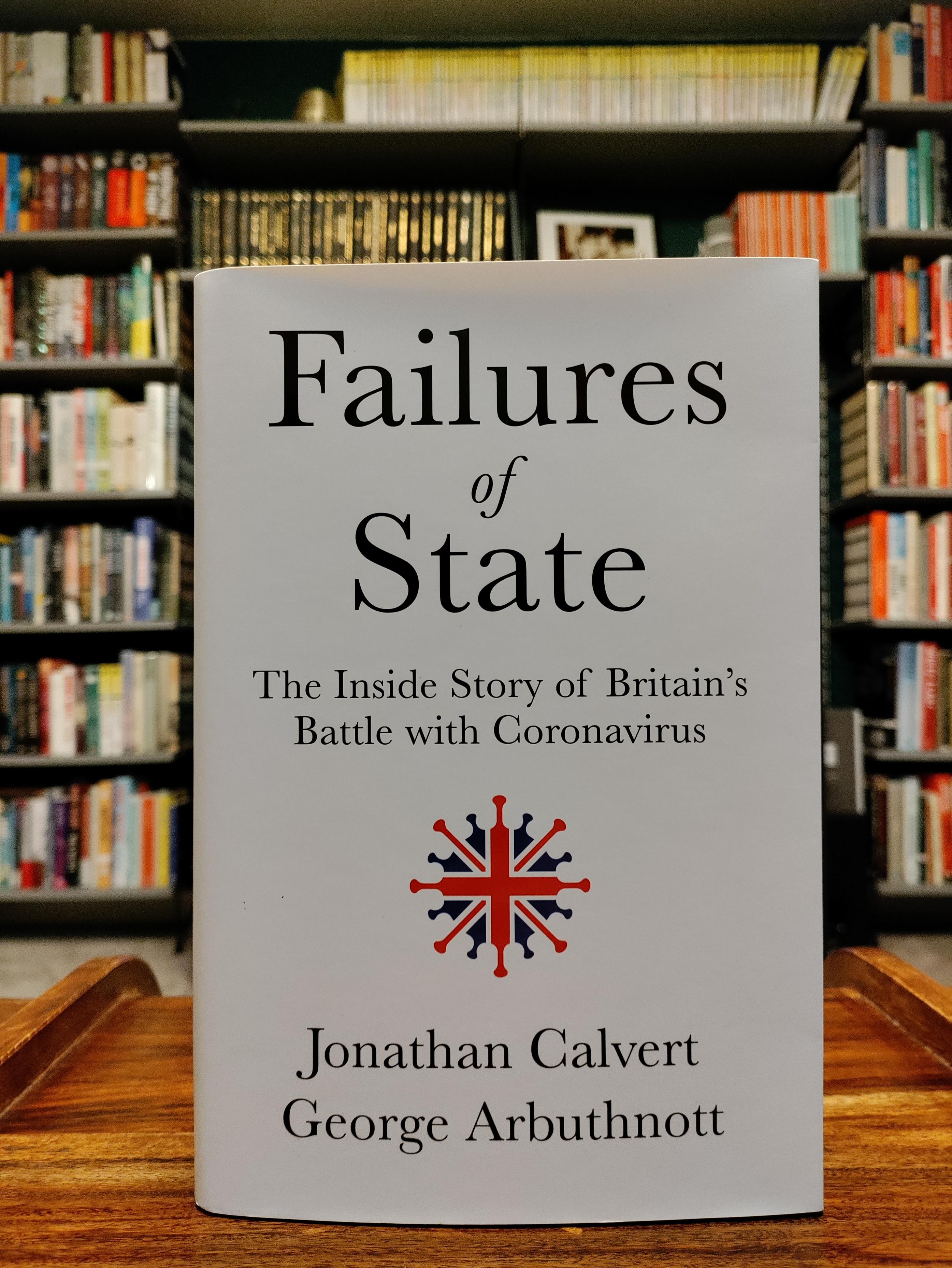
'Failures of State' by Jonathan Calvert and George Arbuthnott


Despite me not being completely ignorant of how bad the UK government's response to the pandemic was, I still found this book shocking. It is a relentless catalogue of bad decisions, made by a government both callous and incompetent. Working in a hospital through COVID, the book put some things I remembered into a wider context.

I remembered colleagues sharing photos of the PPE worn by healthcare staff in other countries, and comparing it to the flimsy aprons we were given. Public Health England downgraded the threat ranking of Covid-19, which meant that only basic PPE needed to be worn, according to health and safety laws, and this was a way of getting around the shortage of PPE caused by the pandemic stockpile being allowed to run down or expire over the austerity decade.

I remembered the mixed messages given about masks, and learnt that there was a government desire early on in the pandemic to minimise the effectiveness of masks to the public, because there were fears that masks might run out if everyone rushed out to get them. The government was trying to buy as many commercially available masks as possible for the NHS, because of the austerity-ravaged stockpile. This then, obviously, backfired later when masks were made mandatory.

What shocked me the most was how much the politicians rejected scientific advice, or never sought it. The scientific advisors first heard about Eat Out To Help Out on the day it was announced to the public. Same with the nonsensical tier system. The government announced many changes to restrictions without asking for any modelling work to estimate the impact on infections or the NHS.

I remember the 'I back Boris 100% he's doing his best in a bad situation' crowd on social media being roundly mocked at the time, but there was nevertheless a sizeable chunk of the population who were sympathetic towards the government, believing them to be doing their best, making tough decisions while following the best scientific advice available. Unfortunately, that is a poisonous fiction.

The UK Covid-19 Inquiry will be the Johnson administration's Chilcott, and hopefully its outcome will have actual consequences for those whose terrible decisions led to tens of thousands of avoidable deaths.

I do recommend this book a lot. I learnt a lot from it, and it has made me even more disillusioned with our political system. 

In a just country, Matt Hancock would at least be a disgraced ex-politician, not a pseudo-celebrity joining a reality TV show while trying to flog a book. In a just country, Rishi Sunak would never have become Prime Minister, and even the thought of Boris Johnson returning as PM would have been anathema to all of the political class. Alas, that is not the country we live in.

Sunday, 14 August 2022

UK Doomsday Preppers

 I watched a documentary on UK Doomsday Preppers this morning, and I was struck by how much the prepper mindset is rooted in, and fuelled by, social isolation and loneliness. The preppers' apocalyptic fantasies either serve as an affirmation of the individual's present isolation, or as an imagined negation of it. 

There are preppers whose fantasies are all about individual survival: a solitary badass macho man, sometimes accompanied by his immediate nuclear family, hiding away from the imagined evils of a society crumbling around them, surviving and thriving due to the Great Man's ingenuity and resourcefulness. Strength in isolation.

One has hidden a large cache in a hut in the Welsh countryside; he gets his family to do drills regularly, where they quickly pack their things, leave their Stockport home, and drive to the Welsh hideaway to practice living simply, away from the society whose imminent collapse they imagine. Really, it's just an elaborate excuse for a camping holiday.

Another has his supplies hidden on a small uninhabited island in the middle of a river, which he can navigate to with a kayak. He imagines he could survive alone on the island for several months, living off either his supplies or the island's flora and fauna. He does not mention the negative psychological consequences of a lack of human interaction, probably because they are such a constant in his present life that he sees them as normal.

On the other extreme, there are the preppers who imagine that the apocalypse would grant them opportunity for socialisation and community that they have been denied under present society. 

One prepper has stocked up on equipment for 'about a dozen like-minded people', who he imagines he will meet in the ruins. Crucially, they are not the friends and family he knows today, but imaginary future friends whom society is currently preventing him from meeting. He also imagines that 'because of [his] resources and knowledge, [he] would probably have leadership thrust upon [him].'

Another, who explains that she lives in an area that is majority Muslim, has several copies of the Qur'an in her doomsday supplies, which she might need to read during the apocalypse in order to fit in with her wider community. 

There's a latent curiosity apparent in this fantasy; she could, of course, read the Qur'an right now, get to know her neighbours, become active in the community, all of her own free will. Literally no one is stopping her but herself. But instead of doing that, she imagines apocalypses which force her to do all those things.

She also has a stockpile of condoms and lube, because sex is one of the few easily accessible comforts during an apocalypse, and you never know you will meet as society collapses, so it's best to be prepared.

Some people would rather spend £1000s on army surplus equipment and non-perishable food, than get therapy or learn social skills. One could also make a wider and deeper point about atomization, the breakdown of community, and the need for greater mental health services and therapy options in our hyper-individualistic capitalist society, but that's not something I can really be bothered going into in this particular Facebook post.

Friday, 1 July 2022

'Pennyblade' by J.L. Worrad

Grimdark is a genre I tend to bounce off, so I was a bit apprehensive going into this, and some quite unpleasant scenes early on were off-putting (there is an attempted sexual assault in the first chapter, and a bit later on some really horrific ableism). However, I am very glad I persevered, because once it really got going I was hooked. The fictional world is well drawn and fascinating. The story has good depth and complexity, with a heartfelt romance at its core, nuanced characters, and insightful-but-not-in-your-face commentary on the real world. 

Masks, literal and metaphorical, play an important role in the story: characters are often hiding their true selves behind superficial facades. And so is the book. As the protagonist's vulgarity and unpleasantness hides her inner sensitivity and vulnerability until her mask slips, so too does the book's gruesomeness obscure the work's emotional core and social commentary, until Worrad chooses to let the mask slip.

Discussing one of his novels, China Mieville said 'Part of the appeal of the fantastic is taking ridiculous ideas very seriously and pretending they’re not absurd.' That quote came back to me while reading Pennyblade. Worrad's fantasy race - the Commrach, elf-like humanoids related to cats - go into heat every year and become sex mad. Worrad has clearly spent a lot of time thinking how this aspect of their biology would affect the culture of an intelligent species as it developed civilisation. He's taken this ridiculous idea very seriously, and created a convincing culture for the Commrach, who are understandably more relaxed about sex compared to humans, and, being cat-like, are very up themselves.

There is a lot of sex in the book, which I would normally find quite tiresome, but I was impressed by the way Worrad described it. At no point did I feel like I was supposed to be getting aroused by what was being described; there was none of the cringe-inducing eroticism I normally expect from sex scenes. Instead, the sex is described with language that is a mixture of bluntly matter-of-fact and oddly poetic, which is at times hilarious, grim-in-a-funny-way. Tellingly, it is only the casual, meaningless sex scenes that are described; hidden 'off camera', but made reference to, are the private, meaningful, intimate acts between two lovers.

After finishing the book I'm better able to reflect on the unpleasant scenes I found off-putting near the beginning. I do think that having an attempted sexual assault in the first chapter was unnecessary and starts the book off on the wrong foot. However, the horrendous ableism serves a greater purpose within the story.

The Commrach civilisation in the book has a belief system like real-world eugenics. They are working towards 'the final countenance', the perfect form, and members of the society see themselves as vessels for the Blood to be passed on to the next generation through selective breeding.

I came to this book having recently read [book:Control: The Dark History and Troubling Present of Eugenics|59693838], so the real world links were very fresh in my mind: eugenicist thoughts and beliefs have scarred our culture and society, and continue to influence those in power. In Britain during the pandemic, eugenicist ideas were being openly discussed and flirted with by people at the top of government. It is probably no coincidence that the virus was largely allowed to run rampant through care homes, and COVID patients with learning disability were often given blanket Do Not Resuscitate notices. 

Worrad does not shy away from showing how unpleasant the eugenicist mindset is, and how damaging it is. These views, espoused early in the novel by the Commrach protagonist, highlight how unpleasant Commrach society is, and forms part of the protagonist's character arc throughout the novel. It also highlights a very real bigotry in our world - a bigotry that is more common than we'd like to believe, and one that is often forgotten. Worrad's fictional eugenicists are used to great effect in one particular scene (when the book's gruesome mask slips) to highlight the implicit eugenics of free market capitalism.

Overall I was extremely impressed by this book, and if you get the audiobook, the narrator does a frankly incredible job. I look forward to Worrad's next one.

Thursday, 24 February 2022

'Flat Earth News' by Nick Davies; 'Bad News' by Mark Pack


Two books on how awful the news industry is, which I read in parallel. 

I was impressed with 'Flat Earth News' (2008) by Nick Davies, which is about how and why so much falsehood ends up in the news. His titular 'flat earth news' refers to stories which appear true but would quickly be shown to be false if anyone bothered to check. It's a book about fake news and the need for fact-checking way before those topics became so massive in the public consciousness, post-2016.

A lot of mainstream coverage of these topics, by journalists not wanting to attack their own profession and colleagues, has pinned the blame on social media. Davies shows that all that falsehood and distortion is a product of decades-long trends in the news industry. The Internet and social media has accelerated those trends, dialling them up to 11.

He opens the book by explaining that a lot of news industry criticism is done by outsiders who don't actually know how the industry works, so their analyses miss an awful lot and tend to focus on a few basics: the influence of advertisers and owners.

Newspapers want to please their advertisers; owners want their papers to push certain lines. As a result, the news industry presents a version of reality that is acceptable to corporate advertisers and billionaire media moguls. Davies accepts that advertisers and owners do influence editorial decisions, but far less than popular media criticism would have you believe.

Advertisers don't care that much about the political stances of where the adverts show up, as long as people are seeing the adverts. The only time that advertisers properly influence the editorial line is when the story is directly about the advertiser - such as when the Daily Telegraph refused to run stories about HSBC's money laundering, because the bank was one of their big advertisers. 

Historically, a lot of newspaper owners wanted their papers to push their political opinions - they were propaganda outlets first and foremost, a way for the wealthy to push for what they thought was positive social and political change. However, through the 20th century, newspapers were bought up by corporate owners who saw the papers primarily as a business which made a profit. They would still influence the paper's line when doing so would benefit the business, but the motivation was profit and business growth - not the desire for particular social and political change.

In order to increase profits, the new owners cut staffing numbers, and wanted the remaining journalists to write more and cheaper stories, which fuelled the rise of 'churnalism' - writing stories based largely on material already written by someone else - and meant a massive reduction in the time that journalists had to properly check their stories. 

The quality and veracity of the stories didn't matter, so long as the paper was making a profit. Reporters were encouraged to make stories out of anything they could to fill space - especially on the local papers. I thought a lot about Nottinghamshire Live when reading this book.

Churnalists are reliant on others having written the stories, and so the majority of news stories are reproductions or slight rewordings of press releases, PR, and stories from news agencies.

Wire agencies are like the news industry wholesalers - they write stories which are then purchased by news outlets to present to the public, either reproduced word-for-word, or altered and expanded upon depending on the outlet. Different papers and websites have almost exactly the same story in almost exactly the same words because they've all purchased the same story from the same wire agency. 

This is far more obvious to see nowadays with online news, but back when people would read just one newspaper, it would be unlikely that the readers would notice that almost the exact same report appeared in multiple papers.

The wire agencies have also suffered from staffing cuts over the years, and the demand for more and cheaper stories has led to a decline in both the range of topics covered and the quality of the stories for sale.

There's an excellent chapter on the various ways the PR industry manipulates and colludes with journalists, and the various tricks PR companies use to create pseudo-news and pseudo-events, with fake grassroots (astro turf) organizations, and fake experts (who are just PR employees). Reporters desperate for stories will happily run something handed to them ready-written by a PR agency and present it as news. Many journalists are in regular contact with PR agencies, requesting stories from them that fit certain themes. 

PR companies understand the time pressures that journalists are under, and know that they are extremely unlikely to check whether the story they're given is true. And so, too, do politicians, government press officers, and the intelligence agencies. 

There's another excellent chapter on media manipulation by intelligence agencies. If you visit some of the more paranoid far-left places on the Internet, you'll likely encounter people who label everything they disagree with as CIA propaganda, and any media figure (incl. YouTubers) or outlet that is insufficiently left-wing will be accused of being CIA-funded. Davies' exploration of Cold War CIA activity shows there is a bit of grounding to this paranoia. 

After 9/11, the US and UK's strategic communications (propaganda) operations were massively expanded. Davies explores this through a few case studies of misinformation, and by attending a conference on the subject and speaking to a lot of people directly involved (on condition that the quotes are not attributed to a name). 

One of his sources paints a hilarious-yet-terrifying picture of state disinformation campaigns: all these different agencies and teams, are each putting out their own misinformation, but doing so in a chaotic, uncoordinated fashion, so that false information put out by one agency, another agency will pick up and treat as legitimate intelligence. And that's before we even start to think about the chaos caused by the misinformation campaigns of hostile regimes.

Journalistic time pressures; the inability to check stories; manipulation by PR, politicians, press officers, and propagandists. These are major systemic causes of the falsehood, distortion, and trivia in the media, which ultimately presents a version of reality favourable towards the powerful and the wealthy. And then we can add in the influence of advertisers, owners, and the fact that most journalists come from similar middle class and upwards backgrounds (because getting into the industry often involves unpaid internships), and we can start to see why news media is so full of falsehood, why the reality it presents is so detached from the lived reality of ordinary people.

I was pleased with this book, it made me even more disillusioned with the news media industry. 

(The final three chapters are, admittedly, weaker than the rest of the book: they are case studies looking at the decline of particular newspapers - The Sunday Times, The Observer, The Daily Mail - and Davies unfortunately gets a bit too personal in his attacks on specific journalists.)

'Bad News' by Mark Pack is a guide to spotting distortion and falsehood when you're reading the news. It is quite handy having all this advice in one book, but the chapters are each broken down into smaller sub-chapters which each feel like the length of a blog post. Pack makes reference to his blog multiple times, and this book unfortunately feels like a series of blog posts but together. Each topic is covered briefly, and there is very little sense of a narrative building throughout the book. The short sub-chapters meant the flow of reading was often interrupted. I found it enjoyable to dip into, but not so enjoyable to read for a prolonged period. The footnotes were also annoying, adding further interruption to the flow (in many cases the information in the footnotes could easily have been omitted, or incorporated into the text proper).