Monday, 24 August 2015

A Ballard Binge

I've read a few J.G. Ballard books recently. Ballard is one of those authors who is not very well known amongst the general public, but is very popular amongst authors and literary peeps. It might help to think of him as the British equivalent to Philip K. Dick. Their books are very weird (although this doesn't tell you very much or prepare you for actually reading them). Ballard's work gave rise to the adjective 'Ballardian'; Dick's work gave rise to the adjective 'Dickian'. Their stories are often about modernity messing with people's heads, but in very different ways. They can both come across as quite pretentious. I'm not sure how much this comparison does either of them justice.


I first decided to read Ballard after Philip Reeve, author of the Mortal Engines series, recommended Ballard's early disaster SF novels while speaking at an event at the University of Nottingham. The three disaster novels are: The Drowned World (1962), about melting polar ice-caps flooding the earth; The Burning World (1964, revised and re-released as The Drought in 1965), about a global water shortage; and The Crystal World (1966), which has a pseudo-scientific explanation worthy of Doctor Who. Time is leaking out of the universe. Matter, once held by time like a saturated solution, is now crystallising across the cosmos. Wibbly-wobbly timey-wimey.

These novels, unlike other disaster novels, focus on the psychological states of the characters rather than the outward effects of the catastrophe. The protagonists are mesmerised by the disaster, undergoing a psychological transformation as they explore the changing world, accepting it as the world to come. Ballard makes the catastrophe into a positive change.

I read The Drowned World in 2013, and found it slightly disappointing. It has its moments, but the story - less than 200 pages - felt like it dragged on and on and on, as though Ballard struggled to make it novel length. The Crystal World I read most recently, and similarly found it slightly disappointing and too long. What is most memorable about both of them is the evocative descriptions of the changed world:

'The road narrowed, avoiding the slope which led up to the house, but its annealed crust, blunted like half-fused quartz, offered a more comfortable surface than the crystal teeth of the lawn. Fifty yards ahead, Dr. Sanders came across what was unmistakably a jewelled rowing boat set solidly into the roadway, a chain of lapis lazuli mooring it to the verge. He realised that he was walking along a small tributary of the river, and that a thin stream of water still ran below the crust. This vestigial motion in some way prevented it from erupting into the spur-like forms of the rest of the forest floor.

As he paused by the boat, feeling the crystals along its sides, a huge four-legged creature half-embedded in the surface lurched forward through the crust, the loosened pieces of lattice attached to its snout and shoulders shaking like a transparent cuirass... Invested by the glittering light that poured from its body, the crocodile resembled a fabulous armoured beast. Its blind eyes had been transformed into immense crystalline rubies.'

- The Crystal World, Chapter 6

Slightly put off by my disappointment with The Drowned World, it was quite a while until I attempted another Ballard. At an event at the University of Nottingham, Christopher Priest, author of The Prestige (1995), recommended Ballard's short stories, saying that he found Ballard's novels disappointing. From my experience with Ballard's work so far, I find myself agreeing with Priest. Ballard's short stories are the shit. I picked up the anthology Myths of the Near Future (1982) at Loncon 3, and was surprised at the quality and diversity of its 10 stories.

In the titular story, humanity is suffering from 'space sickness' after space travel is abandoned. In the collapsed society, handfuls of people still dream of space exploration. Some walk around naked flapping their arms, hoping to transform into birds. The protagonist analyses pornographic imagery, thinking that the images of lustful union hide the key to the secrets of the universe:

'That evening he rested in his chair beside the empty pool, watching the video-cassettes of his wife projected on to the wall at the deep end. Somewhere in these intimate conjunctions of flesh and geometry, of memory, tenderness and desire, was a key to the vivid air, to that new time and space which the first astronauts had unwittingly revealed here at Cape Kennedy.'

Other stories from that collection include Having A Wonderful Time, told as a series of postcards from a woman trapped on a cheap holiday resort, and Theatre of War, a script for TV documentary on a twentieth century British civil war, with all the dialogue having been adapted from coverage of the Vietnam war.

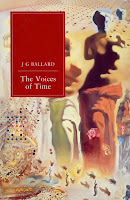
The Voices of Time (1984) contains another 8 stories; The Disaster Area (1967) contains another 9. Vermillion Sands (1971) gets its name from the surreal futuristic holiday resort where its 9 stories - featuring cloud-sculptors, singing plants, living clothing, emotional houses, and more - are set. 

Short story collections are usually hit and miss, but Ballard's misses are at least interesting. His hits are spectacular. Some stories felt rushed. Here are some entertainingly bad sentences from stories that needed a final polish:

'In her face the diagram of bones formed a geometry of murder.'
- The Cloud-Sculptors of Coral D, Vermilion Sands

'"Where, my God, where is he? Where is he?"
Shifting his emphasis from the first of these interrogatories to the second, as if to illustrate that the fruitless search for Hinton's whereabouts had been superseded by an examination of his total existential role in the unhappy farce of which he was the author and principle star, Dr Mellinger turned upon his three breakfastless subordinates.'
- Minus One, The Disaster Area

'Talking to her was like walking across a floor composed of blocks of varying heights, an analogy reinforced by the squares of the terrace, into which her presence had let another random dimension.'
- The Screen Game, Vermilion Sands

These add a bit of comic relief. When the main negative to the anthologies is a few bad sentences, that's got to be a good sign. At some point it would have been cheaper for me to splash out on The Complete Short Stories of J.G. Ballard, but I didn't think I'd want to read that many. Having read four anthologies, I find myself still wanting to read the remaining six: War Fever (1990), The Venus Hunters (1980), Low-Flying Aircraft (1976), The Atrocity Exhibition (1969), The Day of Forever (1967), and The Terminal Beach (1964). I'm taking a break from Ballard so won't be reading those until next year at the earliest.

Enthused by my enjoyment of his short stories, I decided to give his novels another go. Concrete Island (1974) is my favourite so far (it is also Neil Gaiman's favourite; Gaiman wrote the introduction to the latest edition). A man crashes his car and traps himself on a piece of wasteland in the middle of a motorway intersection. This sounds like a stupid idea, but Ballard manages to convince you that it could happen, and therein lies the novel's power. My main criticism of Concrete Island is that the grass does a lot of seething ('they wandered through the seething grass', 'the grass seethed around him', etc).
The Unlimited Dream Company is the most surreal and most disappointing of the four novels I read. The protagonist crashes a light aircraft into the Thames. When he awakes, he may or may not have come back from the dead, may or may not be insane, and may or may not have magical sex powers. A lot happens in the story, but the narration is so monotonous that no matter what's going on - the protagonist transforms into a giant whale, then transforms into a stag and fucks the residents of Shepperton (who have transformed into does), then discovers that his semen causes vegetation to sprout from the ground, etc - it feels like nothing is happening. During the Magic Semen Sequence, the monotonous tone worked well: the narrator's seeming indifference made an entertaining contrast to the weird events described. This effect might have been intended for the whole book, but monotony overshadowed weirdness.


'Leaving the church, I threw the semen on to the cobbled pathway outside the vestry door. As I paused there, looking across the swimming pool at the replica aircraft in the grounds of the film studios, green-fluted plants with milk-red blossoms sprang through the stones at my feet. I stepped among them and set off towards the town, my swollen penis in my hand. As I ran through the trees I thought of Miriam. Again I ejaculated beside the tennis courts, and hurled my semen across the flower-beds.'

- The Unlimited Dream Company, Chapter 22

Of the Ballard books I've read, I highly recommend Concrete Island and all the short story collections. To a lesser degree, I also recommend The Crystal World. Despite my general dissatisfaction with his novels, I'm still tempted to read a few more of them. Those that most interest me are: Crash (1973), High Rise (1975), Empire of the Sun (1984), and The Kindness of Women (1991). I already own copies of Hello America (1981) and Rushing To Paradise (1994), so may as well give them a go too. However, I won't be reading those until next year at the earliest, because I'm having a Ballard break.

Saturday, 25 July 2015

'Downward To The Earth' by Robert Silverberg

'Downward To The Earth' (DTTE) is an SF novel about post-colonial guilt, a tribute to Rudyard Kipling and Joseph Conrad. It is the third Robert Silverberg novel I have read, the others being 'The Book of Skulls' and 'Dying Inside'. Edmund Gunderson, a former colonial administrator, returns to the planet he once administered, seeking redemption for sins committed during the days of Earth's imperialism. 

The title comes from the Bible: 'Who knoweth the spirit of man that goeth upward, and the spirit of the beast that goeth downward to the earth?' (Ecclesiastes 3:21). During his colonial days, Gunderson considered the planet's natives - the Nildoror, who look like green elephants with three tusks, and the Sulidoror, who look like tall furry humans with claws and snouts - mere beasts. Earth relinquished the planet after discovering that the natives were sentient. Because of the natives' appearance, many humans - including Gunderson - still struggle to overcome their prejudice. Gunderson wants to take part in the Nildoror's sacred religious ceremony of rebirth, hoping to gain forgiveness from them and from himself. 

'Thus we refresh our souls by undertaking new lives... To undergo rebirth is to enter a new world, not merely a new life.'

DTTE is a gripping read. The travel across the alien world is engaging and convincingly detailed. There's a good bit of SF mysticism, which I'm very fond of: I have, in the past, found SF imagery conducive to transformative religious experiences. At times I was reminded of my own travels (on Earth, not an alien world); Silverberg got the idea for the novel while travelling in Tanzania. On my travels I was generally very lucky with the people I met. Only a few times did I meet the hideously vacuous tourists personified by Matt Lacey's Gap Yah character. I expect Silverberg met some on his travels:

'The tourists were, in fact, the last species whatever that Gunderson wanted to see at this point. He would have preferred locusts, scorpions, fanged serpents, tyrannosaurs, toads, anything at all. Here he was coming from some sort of mystical experience with the nildoror, the nature of which he barely understood; here, insulated from his own kind, he rode toward the land of rebirth struggling with basic questions of right and wrong, of the nature of intelligence, of the relationship of human to nonhuman and of himself to his own past; only a few moments before he had been forced into an uncomfortable, even painful confrontation with that past by Srin'gahar's casual, artful questions about the souls of elephants; and abruptly Gunderson found himself once more among these empty trivial human beings, these archetypes of the ignorant and the blind tourist, and whatever individuality he had earned in the eyes of his nildor companion vanished instantly as he dropped back into the undifferentiated class of Earthmen.'

I recommend 'Downward To The Earth'. It's a very good read, but it didn't blow my mind. Compared to the other Silverbergs I've read, this one is middling quality:


'The Book of Skulls' is the best of the three. Four American frat boys go on a road trip to find a weird skull-worshipping cult that may or may not exist, and who may or may not hold the secret to immortality. Silverberg manages to make this boring premise very gripping, as the four narrators explore their friendships and aspirations while pondering over mortality.


'Dying Inside' is the worst of the three, though still a very good book. It's the autobiography of David Sellig, a telepath who discovers that he is losing his powers. There's not much of a plot; Sellig tells his life story in a non-linear way, writing about whatever happens to be on his mind. It is a very emotional and intimate book about an alienated lonely loser who has not made much of his life, despite his powers, and realises that he is dying. The story is let down by chapters dedicated to Sellig's 'job': he ekes out a living writing essays for cheating university students. Some of these essays are recited word for word, and they are very boring.


Friday, 24 July 2015

The Predator, The Cyclist, and The Prophet

Three characters from today's walk.

1) I was walking down Market Street, whichw as crowded with shoppers. He was walking towards me with a steady, deliberate gait, like a predator hoping not to startle its prey. He wore a plain hoody. His skin was pale, his hair short and brown. His eyes stared forward, unblinking, while his face betrayed nothing. The gait and the face gave the impression that there was so much rage and hate and murderous lust inside him that his facial expression system had been overloaded and broken, leaving him with the expressionless face of a Passport photo or mug shot. As I walked past him, perhaps less than a meter away, a dreadful shiver went down my spine. I wanted to flee. I have never felt that before from such a brief encounter. It was as though all the hate and rage and murderous lust was, after breaking his facial muscles, being exuded from his pores, creating a terrifying aura around him.

I hope all this was just my imagination; I hope we won't be seeing his face on the news soon, wanted for multiple counts of murder and mutilation.

2) A man rode past me on a bike, on the pavement. He was wearing a grey tracksuit. He rode fast: he needed to get somewhere, or away from somewhere, very quickly. Tattooed across the left side of his neck were the large letters 'MUM'. The letters' prominence and crudity reminded me of cattle branding: was this man in such a hurry because he had just escaped from the chav farm?

3) On his back a cardboard sign advertised 'THE IDIOT'S GUIDE TO THE END OF THE WORLD'; on his front, a similar sign advised  'OBEY GOD'S 4TH COMMANDMENT OR YOU WILL DIE'. Held above his head, was the largest of his signs: 'ALMOST THERE'. He wore a scruffy coat; he was not clean-shaven.

He held out leaflets in his arms. I approached him and collected one. Title: 'THE END OF THE WORLD IS VERY CLOSE NOW'. The man didn't, or couldn't, speak. He showed me another sign: 'WOULD YOU LIKE SOME FREE BOOKS THAT EXPLAIN IT ALL?'. I nodded. The silent preacher-prophet passed me them from his sign-covered trolley. The 'books' are homemade: printed A4 pages stapled together. Title: 'THE HOPE THAT WE HAVE IN JESUS AS THIS WORLD COMES TO AN END', parts 1, 2, and 4. No part 3 for me.

I returned home. Here are some excerpts from the leaflet:

'Something very very big is about to happen to the world towards the end of 2015... Pope Francis has referred to himself as Jesus 2. He has gained territory in Jerusalem in preparation for the supposed joint Jew-Christisn-Islamic rebuilding of the (Satanic) 3rd temple... Is Pope Francis a demon, and the last Pope ever?... The world has been gradually prepared for the arrival of Maitreya for 40 years... Maitreya/Satan says that the start of the rapid change from the old system to the wonderful new system will start towards the end of this year, and that he will appear in person for the 1st time very soon.'

According to Wikipedia, Maitreya is a future incarnation of the Buddha.

'You have been given a temporary body for around 600,000 hours, and we have been put on this world for no other reason than to see if you decide to obey the laws and commandments of the God who created you and put you here. The only purpose for your existence on this planet is to decide the destination for your soul.'

Such a nightmarish idea. Worse than nihilism.

'The world is full of IDIOTIC MORONS WITH A DEATH WISH, and BLIND IGNORANT LOSERS THAT CAN'T SEE WHAT'S RIGHT IN FRONT OF THEM... Today's SLEEP WALKING SHEEPLE fall for all their deceptions, and they can't see that they are living in a world where the satanic authorities regard us as useless eaters that have to be destroyed... Those suffering from A TERMINAL DAFTNESS really do think it is rational to spread Satan's anti biblical propaganda, and people like Stephen Hawkins, Richard Dawkins, David Attenborough and Brian Cox really do believe the rubbish they are peddling to the masses via the TV box. Are you one of the BLIND TERMINAL REJECTS IN THE GAME OF LIFE that believes all of their anti-God propaganda?... Life is a continual battle against evil forces. If we win the battle... we find ourselves in God's world of AWESOMENESS BEYOND OUR IMAGINATION.'

I like the phrase 'a terminal daftness'.

'Have you ever wondered how MAGICIANS defy gravity, cut up their bodies, read people's minds and make things appear and disappear? The magicians have pledged allegiance of their soul to Satan in return for the ability to do party tricks that astound the UNWASHED MASSES THAT CAN'T SEE BEYOND THIS WORLD... Today's DIGITAL TECHNOLOGY is entirely supernatural. Many people in the gadget industries do know that it is mostly SATANIC WITCHCRAFT, and anyone that isn't living in Satan's dark world, and ON THEIR WAY TO LIFE'S GARBAGE HEAP should be able to see that it is beyond the range of what is physically possible... Even the printer that printed most of these books and leaflets is blindingly obviously not of this world... What will you do when the demons that appear to be aliens arrive?'

In Terry Pratchett's Discworld series, demons are used in technology such as watches and cameras. There's a novel by Arthur C. Clarke featuring aliens that look like demons.

The books are too long, and not as entertainingly angry. In them, we learn that supermarkets are part of Satan's plan to make the human population unfit and unhealthy; that medication is evil; that evolution is a satanic lie; that 'the coloured races are expanding, while the white races are diminishing'; that hygiene is evil; that Hitler was the victim of an incredibly successful satanic propaganda campaign; that feminism is evil; that the Devil monitors the internet; that Islam was a Roman Catholic invention.

And that only brings me about halfway through part 1.

That poor man.