Showing posts with label Classics. Show all posts

Saturday, 8 May 2021

'A Very British Coup' by Chris Mullin

This was republished a few years ago with the tagline 'the novel that foretold the rise of Corbyn': it accurately predicted the horror and outrage that many in the political class felt against a genuinely leftwing Labour leader.

The sections dealing with ruthless smear campaigns in the press are especially prescient; indeed, the fictional scenario is arguably calmer than reality, if you think back to how ridiculously hyperbolic the actual coverage of Corbyn often was, which drowned out legitimate and good faith criticisms of his leadership.

As the novel progresses, the specifics of the story become more far-fetched, especially those that lead to the government's inevitable downfall, even if the atmosphere remains believable. The weak characterisation also makes the novel rather shallow: the rightwing characters are all scheming villains in sharp contrast to the righteous leftwingers.

A couple of chapters cover strike action by a union of power workers during winter; this reads very much like the author working over his frustration at the Winter of Discontent (1979). The strike organising union boss is characterised as an establishment figure working with the CIA to bring down Labour.

The most outrageously paranoid and farfetched sentence states that the unions hadn't gone on strike during 10 years of Tory rule (the novel was published in 1982, the story starts in 1989), but as soon as a leftwing Labour government came to power, they were up for striking again to bring down the government.

This is silly enough with the context that the 1974 miner's strike had led to the Conservatives losing power. With the later context of the miner's strike during the Thatcher years, it becomes ridiculous.

A good novel but not a great one. I listened to the audio version - the narrator clearly had an absolute blast doing all the voices, which added a lot to the experience of the story.

Sunday, 22 November 2020

'Sons and Lovers' by D.H. Lawrence

Lawrence is one of those authors who I have labelled in my head as boring, wanky, and pretentious, and there is some truth to that. I enjoyed 'Lady Chatterley's Lover' far more than I expected to, but 'Sons and Lovers' is, in many ways, extremely dull. It is a semi-autobiographical examination of the characters' emotions and relationships over decades, written with a frenetic intensity and energy that can quickly become exhausting if you aren't in the mood for it. Took me quite a while to get through this one.

Paul Morel, our protagonist and Lawrence figure, is an Oedipal mess, whose close relationship with his mother impacts his attempts at romantic love. He could really have done with some counselling or therapy.

The characters and their relationships are very vivid and real, with immense depth - the novel is a success and has considerable merit in this regard. It is also interesting as a realistic portrayal of working class life in the early 20th century, made extra interesting for me because it is largely set around Nottingham - this is his most Nottinghammy novel.

However, I don't find familial and relationship drama in ordinary lives that exciting: the novel is, in many ways, extremely dull. Nothing particularly out of the ordinary happens, but this goes some way to highlighting the depth and complexity in the emotions and relationships of ordinary people.

Here's an example to show how exhausting it can be:

'Miriam went on her knees before one cluster, took a wild-looking daffodil between her hands, turned up its face of gold to her, and bowed down, caressing it with her mouth and cheeks and brow. He stood aside, with his hands in his pockets, watching her. One after another she turned up to him the faces of the yellow, bursten flowers appealingly, fondling them lavishly all the while.

“Aren’t they magnificent?” she murmured.

“Magnificent! It’s a bit thick—they’re pretty!”

She bowed again to her flowers at his censure of her praise. He watched her crouching, sipping the flowers with fervid kisses.

“Why must you always be fondling things?” he said irritably.

“But I love to touch them,” she replied, hurt.

“Can you never like things without clutching them as if you wanted to pull the heart out of them? Why don’t you have a bit more restraint, or reserve, or something?”

She looked up at him full of pain, then continued slowly to stroke her lips against a ruffled flower. Their scent, as she smelled it, was so much kinder than he; it almost made her cry.

“You wheedle the soul out of things,” he said. “I would never wheedle—at any rate, I’d go straight.”

He scarcely knew what he was saying. These things came from him mechanically. She looked at him. His body seemed one weapon, firm and hard against her.

“You’re always begging things to love you,” he said, “as if you were a beggar for love. Even the flowers, you have to fawn on them—”

Rhythmically, Miriam was swaying and stroking the flower with her mouth, inhaling the scent which ever after made her shudder as it came to her nostrils.

“You don’t want to love—your eternal and abnormal craving is to be loved. You aren’t positive, you’re negative. You absorb, absorb, as if you must fill yourself up with love, because you’ve got a shortage somewhere.”

She was stunned by his cruelty, and did not hear. He had not the faintest notion of what he was saying. It was as if his fretted, tortured soul, run hot by thwarted passion, jetted off these sayings like sparks from electricity. She did not grasp anything he said. She only sat crouched beneath his cruelty and his hatred of her. She never realised in a flash. Over everything she brooded and brooded.'

Lawrence is interesting as a radical, boundary-pushing writer, most famously because of the Lady Chatterley Trial. In 'Sons and Lovers', Lawrence describes Paul's sexual feelings and sex life in ways that are sometimes quaint and sometimes still a bit shocking.

Paul and Clara go on a date to the theatre, where Paul is overwhelmed by Clara's proximate beauty, and her bare, naked arm:

'And he was to sit all the evening beside her beautiful naked arm, watching the strong throat rise from the strong chest, watching the breasts under the green stuff, the curve of her limbs in the tight dress. Something in him hated her again for submitting him to this torture of nearness. And he loved her as she balanced her head and stared straight in front of her, pouting, wistful, immobile, as if she yielded herself to her fate because it was too strong for her. She could not help herself; she was in the grip of something bigger than herself. A kind of eternal look about her, as if she were a wistful sphinx, made it necessary for him to kiss her. He dropped his programme, and crouched down on the floor to get it, so that he could kiss her hand and wrist. Her beauty was a torture to him. She sat immobile. Only, when the lights went down, she sank a little against him, and he caressed her hand and arm with his fingers. He could smell her faint perfume. All the time his blood kept sweeping up in great white-hot waves that killed his consciousness momentarily.'

Later, when their relationship is deteriorating, Paul and Clara try having sex in public places to re-invigorate their relationship, but it doesn't work:

Gradually they began to introduce novelties, to get back some of the feeling of satisfaction. They would be very near, almost dangerously near to the river, so that the black water ran not far from his face, and it gave a little thrill; or they loved sometimes in a little hollow below the fence of the path where people were passing occasionally, on the edge of the town, and they heard footsteps coming, almost felt the vibration of the tread, and they heard what the passers-by said—strange little things that were never intended to be heard. And afterwards each of them was rather ashamed, and these things caused a distance between the two of them.

Overall, I can't say I recommend 'Sons and Lovers', except for local historical interest - though I'm pleased I've got through it for what it is. I would, however, read more Lawrence, but probably not until next year.

Monday, 27 November 2017

Revelation 13: The Beasts

Straight after the vision of the Woman and the Dragon (see previous post), John is stood on the coast, watching a beast with 7 heads and 10 horns rise out of the sea. It is like a leopard with the feet of a bear and the mouth of a lion. The dragon (Satan) gives the beast power and authority over the earth.

One of the beast's 7 heads is mortally wounded, but mysteriously heals.

The beast uses its earthy power to spew blasphemies against God and make war on his servants.

John sees a second beast rise from the earth: it is like a horned lamb which speaks like a dragon, and uses the power of the first beast to make the people of earth worship the first beast and blaspheme God. The second beast performs miracles, which convince the people to worship the first beast.

'And he causeth all, both small and great, rich and poor, free and bond, to receive a mark in their right hand, or in their foreheads: and that no man might buy or sell, save he that had the mark, or the name of the beast, or the number of his name. Here is wisdom. Let him that hath understanding count the number of the beast: for it is the number of a man; and his number is Six hundred threescore and six.'

What are we to make of all this?

The Old Testament prophet Daniel has a dream of four beasts rising out of the sea; he is told these beasts represent four kingdoms. A beast like a lion represents the Babylonian Empire. A beast like a bear represents the Persian Empire. A beast like a leopard represents the Greek Empire. The fourth beast, with ten horns, represents the Roman Republic.

Daniel's dream sequence ends with the 'one like the Son of man came with the clouds of heaven... And there was given him dominion, and glory, and a kingdom, that all people, nations, and languages, should serve him: his dominion is an everlasting dominion.' The Messiah descending from Heaven to conquer the world.

The Babylonian Empire (lion) was conquered by the Persians (bear). The Persians were conquered by the Greeks (leopard). And the Greeks were conquered by the Romans (ten horns). The Roman Republic became an empire.

John's Beast from the Sea is a composite of Daniel's four beasts: leopard, bear, lion, ten horns. It represents the new and expanded Roman Empire.

The seven heads represent the emperors who had ruled since the transition from republic to empire: Augustus onwards. Although there is considerable disagreement among scholars as to exactly which emperors they are supposed to represent.

There are some clues that one of emperors is Nero. One of the beast's heads recovers from a mortal wound: there was a popular rumor that Nero had been killed by his own sword. It was a surprise when it turned out false. There is also the numerological evidence: the numbers of the letters in the Hebrew spelling of Nero Caesar add up to 666.

Nero is the emperor most famous for persecuting Christians - he burnt Christians alive as torches to illuminate his garden.

So, the first beast, the Beast of the Sea, is the Roman Empire.

The second beast, the horned lamb performing miracles, is the Roman pagan cult, which treated the emperor as a god. The mark of the beast, without which one cannot buy or sell, could be Roman currency, which was printed with the heads of the emperors. Elaine Pagels, whose book is my main source for the historical context for Revelation, speculates that it could represent some bureaucratic stamps or marks necessary to buy or sell.

I have to go to work now, so am ending this post here!

Saturday, 29 July 2017

'Lady Chatterley's Lover' by D.H. Lawrence

After the bad experience with 'Ilium' by Dan Simmons, one of those books that temporarily puts me off science fiction, I went through my to-read pile looking for something as far from SF as I could get, and decided on 'Lady Chatterley's Lover' by D H Lawrence. Another of those books I've been putting off for ages.

I did not go in with high expectations; I had heard a lot about Lawrence being one of those classic authors who is morbidly dull, despite the famous obscenities. I fully expected to tire of 'Lady Chatterley's Lover' fairly quickly, to abandon it and give my copy to charity (I like to have read at least a few pages of famous books and authors, so I can know their work Not My Thing), so I was very surprised that 'Lady Chatterley's Lover' was not actually terrible - in fact I rather liked it.

Although very conservative in outlook, Lawrence wrote good female characters which are still better than many written nowadays. The sex scenes, while tame and quaint to modern standards, are of course quite funny, and if you read with imagined old fashioned prudishness, they are shocking (the word 'loins' is used far too much; 'cunt' and 'fuck' are far more common than I expected). The story and the characters are all strangely believable; interactions and conversations do not seem unnatural. A scene where two characters get drunk together made me laugh out loud because I felt like I'd overheard their desultory drunk talk in real life. There are discussions about the differences between males and females, the importance of the class system, and how awful the modern world and industrialization are. Lawrence's eloquence here is enjoyable even when you disagree with the view he clearly favours.

D.H. Lawrence was from Nottinghamshire, and this novel is set there. I live in Nottingham. His descriptions of newly industrial Nottinghamshire, of industry destroying the countryside, were an interesting comparison to the current post-industrial reality. Lawrence describes Mansfield as 'that once-romantic, now utterly disheartening colliery town'. Now Mansfield has one of the highest child poverty rates in the county, and about a fifth of its population are unemployed. It is very far from romantic now.

There's a sense of foreboding in the descriptions of the mining industry. Lawrence is sure it must collapse; at times he feels like an apocalyptic prophet warning of civilization's doom. He treats the working classes as almost another species; his descriptions of the pit workers are reminiscent of Tolkien's orcs. His views echo Tolkien's conservatism: the beautiful rural shire is threatened by smoke-billowing industry and its dirty, scruffy workers who don't care for the woods anymore. I wonder how much Lawrence would have loved Thatcher.

'Lady Chatterley's Lover' is a frank story of a difficult extra-marital affair within a strict class system. It's historically interesting, due to the sex scenes and the obscenity trial, due to Lawrence's opinions and his descriptions of Nottinghamshire. It's well-written: the characters are distinct and believable; the prose is pleasant and sometimes beautiful. There's so much to read into it, I now understand why Lawrence is so popular in literature courses. I expect I wouldn't be so enthusiastic about this novel if I had been expecting it to be great. As it is, I was pleasantly surprised and will not rule out reading another of Lawrence's works.

Saturday, 22 April 2017

'The Island of Doctor Moreau' by HG Wells

While simple in terms of plot structure - the protagonist ends up on a strange island where strange things happen - Wells packed a lot of thematic elements into his short 3rd novel. Adam Roberts says in the introduction that the novel is so richly layered it is possible to get too carried away in interpretation; Margaret Atwood listed ten different interpretations in her introduction to another edition. My review focuses on what I think are the three most obvious thematic elements.

The novel is a tale about the dangers of unethical scientific research; Moreau is driven by his research, his attempts to create humans from animals, and cares for nothing else. He is the classic mad scientist, experimenting with lifeforms and indifferent towards the suffering he causes - his operations are carried out sans anesthetic, his home becomes known as the House of Pain. Published in 1896, before animal rights activism really took off, Wells' novel articulates our cultural anxieties about scientific knowledge being pursued unethically, about the suffering of animals in experiments, and remains relevant in our modern world of biological and genetic engineering.

Wells described the book as "an exercise in youthful blasphemy" - it mocks attempts to combine Darwinian evolution with belief in a deity. Moreau is playing God: he is creating imperfect humanoids out of animals, commanding them to resist their animal natures (to uphold 'the Law'), and becoming frustrated and wrathful whenever his imperfect creations do not live up to his high standards. Evolution - 'nature red in tooth and claw' - is a brutal process, full of suffering and death: Moreau the creates his Beast Men through vivisection sans anesthetic, a brutal and painful process. Wells is not kind to Moreau the deity-figure.

And it is about human nature, crafted from the bestial over millennia of evolution. The final chapter is particularly effective on this subject, after the protagonist has returned to civilization:

I could not persuade myself that the men and women I met were not also another, still passably human, Beast People, animals half-wrought into the outward image of human souls, and that they would presently begin to revert, to show first this bestial mark and then that.


The Island of Doctor Moreau is a short novel with a simple plot but compelling symbolism. It has obviously been hugely influential on science fiction and popular culture. I wasn't blown away by it and at times the simplistic plot did bore me - I considered giving it 3 stars rather than 4 - but I'm glad I've finally read it, and would recommend it for a quick read.

Thursday, 8 September 2016

'The Prince of Darkness' by Jeffrey Burton Russell

In The Prince of Darkness (1989), Jeffrey B. Russell has condensed his academic quartet on the history of the concepts of evil and the Devil from antiquity to the modern world - The Devil (1977), Satan (1981), Lucifer (1984), and Mephistopheles (1986) – into one slim book intended for a popular audience. The academic quartet has a total page count of 1223; The Prince of Darkness is only 288 pages including appendices and index. There is an astonishing amount of information in this small volume.

Burton begins with the ancient world mythologies, looking at the elements in them which influenced the Devil concept, such as: the chaos monsters including Leviathan and Tiamat; conflicts between gods, such as the Greek war between the Olympians and the Titans which ended with the Titans imprisoned in Tartarus; gods and spirits of death and destruction; and Zoroastrianism, with its good god and bad god in conflict across the cosmos until the end of time. 

Following this, we get an overview of the ancient Hebrew tradition leading to the development of fallen angels: the early Hebrew monotheists ascribed both good and evil to the One God, but the Jews later wanted to distance evil from the God they worshiped, to absolve him of blame, so they had God delegate some evil to the angels, loyal servants under his command, such as the satan in the Book of Job (this is modern Judaism's view of Satan: a loyal servant of the good-bad God). This delegating God calls for angel volunteers to act as tempters, satans: 1 Kings 22:19-23:

'And Micaiah said, “Therefore hear the word of the LORD: I saw the LORD sitting on his throne, and all the host of heaven standing beside him on his right hand and on his left; and the LORD said, ‘Who will entice Ahab, that he may go up and fall at Ramoth-gilead?’ And one said one thing, and another said another. Then a spirit came forward and stood before the LORD, saying, ‘I will entice him.’ And the LORD said to him, ‘By what means?’ And he said, ‘I will go out, and will be a lying spirit in the mouth of all his prophets.’ And he said, ‘You are to entice him, and you shall succeed; go out and do so.’ Now therefore behold, the LORD has put a lying spirit in the mouth of all these your prophets; the LORD has declared disaster for you.”'

Delegated angels became rebel angels in Judaism's apocalyptic period, when the the Jews were convinced the world was going to end any day now. During this period a lot of texts, now considered apocryphal, developed different versions of the fallen angel myth. In some stories, Satan is kicked out of heaven for refusing to bow to newly created humanity. In others, angels fall to Earth lusting after human women. In others, the evil lord Mastema, Prince of Evil, leads an army of evil against God, constantly trying to thwart God's good plan. 

Early Christianity was a branch of Apocalyptic Judaism; the New Testament further developed apocalyptic and diabolical concepts. The early Christians believed that Satan was ruler of the world, 'the prince of this world', who would be punished at the end of time (any day now) by being shoved into Hell. Jesus' sacrifice had broken Satan's complete hold over humanity: those that turned to Jesus were saved. The pagan gods existed, but they were fallen angels who ruled the Roman empire. In the second century, Justin Martyr developed one of the first fully fleshed-out Christian cosmological worldviews: in it, he described 3 categories of evil beings: Satan, a great angel, who fell from grace through sin at the beginning of time; the rest of the fallen angels, who fell from heaven when they lusted after human women; and demons, the hybrid monsters of illicit angel-human interspecies sex. The evil ones had control over the world; Jesus' first coming signaled the beginning of the end of their reign. At the second coming they would be cast into Hell.

Over the centuries this worldview changed. There were stories about Christ's descent into Hell during the 3 days between death and resurrection: he breached the doors of Hell, preached to the righteous (who were only in there because they happened to be born too soon to convert to Christianity in their lifetimes), and locked Satan&Co up, turning their old Kingdom of the Dead into their prison. Satan&Co did not have complete free reign on earth; they had been imprisoned by Jesus, who would finish the job at the second coming. 

The earlier threefold division between Satan, fallen angels, and demons was abandoned: they all became the same, angels who fell with Satan at the beginning. Satan's power over earth and his imprisonment were combined somewhat contradictorily, both simultaneously occurring straight after his fall: Satan&Co were imprisoned in Hell after their rebellion, but also have considerable powers over the Earth.

There are chapters covering: the entertaining mythologies of Gnosticism and Manichaeism, both dualist cosmologies with a good god and a bad god; early Christian heresies, and how Satan became associated with them; the Desert Fathers, monks who believed the Devil was constantly tempting them; various theologians and how they reconciled evil with a good God – these early theologians culminated in Augustine of Hippo, who synthesized their ideas into the classical view of Western Christianity. 

Medieval Christianity is the next stage of Burton's history. As Christianity became popular, it got mixed up with a lot of pagan traditions (Saturnalia was a pagan festival of gift-giving over the Winter Solstice. Eostre was pagan deity of Spring who had a festival at the Spring Equinox.), and so the Christian Devil got mixed up with a lot of pagan traditions: he gained horns and cloven feet from the god Pan; he enjoys Pagan-style celebrations, sacrifices, the Wild Hunt. Lilith is Lucifer's mother. The Devil of Medieval folklore has a lot of strange similarities to Santa Claus. Throughout history there has been a divide in religions between the popular/folk religion of the masses, and the reasoned out religion of the elites. This divide was far wider in olden days, when literacy levels were extremely low and so the masses could not read sacred texts for themselves. 

We get an overview of Medieval theologians such as Anselm, Eruigena, and Aquinas, and a look at Cathar dualism (a medieval gnostic Christianity). And then along came Dante, who created one of the most important depictions of the Devil: trapped deep in the Earth, at the centre of the universe, farthest from God, in a cold, dark, place; immobile, bestial, pathetic. Dante's Satan is contrasted with the brightness, warmth, and lively mobility of Heaven. To many theologians, evil is nothingness, non-being: Satan's pathetic immobility shows him as the personification of evil as lifeless non-being.

In the Middle Ages, clerics wrote mystery plays to bolster the faith of uneducated laypeople. Some told the stories of Satan's rebellion, Adam and Eve in Eden, and on through Old Testament scenes. The plays end with the passion, and therefore triumph, of Jesus over Satan. Satan in these plays, while evil, is also made into a comically inept supervillain whose plans are foiled by God.

The witch hunting craze influenced popular perception of the Devil. How the Devil was thought of during the Reformation. The early development of the Faust legend; diabolical themes in the plays of Marlowe and Shakespeare (Doctor Faustus and Hamlet, respectively). A whole chapter is devoted to Milton's Paradise Lost, because it is one of the best things ever written and massively important in the history of the Devil idea. 

And then we get to the rise of unbelief in the Age of Enlightenment. Rationalism and empiricism weakened Christianity, belief in God and the Devil. Some branches of Christianity tried to adapt to this by almost eliminating the Devil from their theology. God and the Devil were seen as primitive superstitions. The Marquis de Sade, from whom we get Sadism, used the atheist argument to advocate cruelty and hedonism: if you enjoy torture, do it, because pleasure is good. Geothe wrote Faust, presenting a new Devil for a new world ('Mephistopheles in the most important literary Devil since Milton's, but the difference between Milton's Satan and Goethe's Mephisto is the difference between a basically Christian and a basically secular world view').

A Romantic movement arose in response to the Enlightenment. They valued emotions and feelings over reason and logic. They gave new meaning to traditional symbols. Satan, fighting against Jehovah, was a heroic figure fighting for freedom from illegitimate authority. Jesus, against Satan, was a hero fighting unjust worldly authority. Thus in Romantic eyes Satan could represent heroism, individualism and the strive for freedom, but also isolation and selfishness. The artists of this period played with the Devil concept in interesting but often incoherent way. William Blake's mythology, especially The Marriage of Heaven and Hell. Lord Byron's Cain: A Mystery. Percy Shelley's Prometheus Unbound, which combines the Greek Prometheus with the loving Jesus and the heroic Satan. Mary Shelley's Frankenstein, the first science fiction novel, about a man gaining Godlike powers, creating life: diabolical imagery surrounds the monster, but Frankenstein replaces supernatural horror with scientific horror. Victor Hugo's The End of Satan.

Romanticism split into Naturalism, which spurned the supernatural in favour of realism, and Decadence, an exploration of human sensuality. The latter led to a rise of occultism. Baudelaire's The Flowers of Evil. Lautreamont's The Chants of Maldoror. J-K Huysman investigated the occult Satanism of his day and wrote the novel The Damned, a fictional account of his experiences in this secret world. Huysman was so repelled by what he witnessed that he converted to Catholicism. 

After being attacked on scientific and historical fronts, religion was then attacked by psychologists: Sigmund Freud, Melanie Klein, Carl Jung. Freud argued that the Devil was the personification of repressed unconscious desires. Klein argued that since children easily divide the world between good and bad, while adults learn ambivalence and shades of grey, the religious divide between good and evil is a sign of psychological immaturity. Carl Jung saw the Devil as an important psychological symbol that helped us face up to the existence of evil. Dostoevsky's The Devils and The Brothers Karamazov defends religion while facing up to problem of evil and presenting compelling evil characters. Twentieth century horrors re-emphasized the problem of evil. Satan in modern literature: Tolkien, CS Lewis, Thomas Mann's Doktor Faustus, the short stories of Flannery O'Connor, etc. The Devil in pop culture and music. LaVeyan Satanism ('their Satanic Bible is a melange of hedonistic maxims and incoherent occultism').

Burton believes that a lack of belief in a transcendent evil force makes the world more dangerous, and he looks at the arguments on both sides. My own opinion on this matter is undecided.

This is an astonishingly erudite book, and contains an incredible amount of information for less than 300 pages. My only complaint is that the Devil in Islam is not explored: Burton says in his introduction that this is treated in the Lucifer volume of his original quartet, but I feel like he could have fit even a short chapter on Islam's Devil into this book. Nevertheless, I thoroughly recommend this book for a relatively easy-reading history of the Devil and evil in human thought. 


Saturday, 28 May 2016

Abandoned Money

I read about a third of Money (1984), and found it enjoyable. I wouldn't call it great though, and doubt that I will ever read anything by Martin Amis again. I think Money's problem is that, as Amis has said himself, it is a 'voice novel': almost plotless, a series of debauched anecdotes made entertaining by the amusing narrator-protagonist. However, at 454 pages (I reached page 169), it feels too long a novel to be carried mainly by its voice: I found myself losing interest, thinking Alright, I get it, he drinks a lot and has problems with women, and wants to make lots of money. There are better books out there: I decided to abandon it.

Thursday, 19 May 2016

Paradise Lost (Again)

I've been re-reading 'Paradise Lost', because it's damned good. I felt like writing something about it again, because when I wrote about it two years ago I was still very giddy about how good it is, was still hyper from the discovery that reading a poem could be an immersive cinematic experience, and the thing I wrote back then is very unsatisfying to re-read: my 'ZOMFG I cant tel u how awsum it is' fanboying makes me cringe.

So I started to write about it again, thinking that re-reading it two years on I would be able to do it more justice, perhaps a little calmer, perhaps with some more analysis. For those that don't know: 'Paradise Lost' is a 17th century epic poem by John Milton, which tells 'Of man’s first disobedience, and the fruit of that forbidden tree, whose mortal taste brought death into the world, and all our woe, with loss of Eden'. It is a retelling of the the War in Heaven and creation myths from Judeo-Christian mythology. And it's so good: one of the greatest works of English literature.

There was going to be more to this. I was going to go through the whole thing in a series of posts, perhaps one for each chapter/book that makes up the epic, discussing the scenes and including a few choice quotes.

But I can't do it. I just fanboy over it too much. I want to quote the whole thing. Here's Satan rising out of a lake of fire in the early pages:

'Forthwith upright he rears from off the pool
His mighty stature; on each hand the flames
Driven backward slope their pointing spires, and rolled
In billows, leave i' the midst a horrid vale.'

And then there's the speeches. And the fight scenes. And the sex scene. And the montages (yes, montages: it's a cinematic poem). It's just so good.

ZOMFG I cant tel u how awsum it is.

Best of 2016 (So Far)

My five favourite books of 2016 so far:

'If On A Winter's Night A Traveller' by Italo Calvino is now one of my favourite books of all time, joining the illustrious company of The Picture of Dorian Gray, Star Maker, the Hebrew Bible, and Paradise Lost. A postmodern second-person narrative (You, the Reader, are the protagonist) which explores the acts of reading and writing, and contains ten unfinished novels within it.

'The Revolt of the Angels' by Anatole France. Satirical fantasy that plays with Christian mythology: a Guardian angel in 20th century France spends too much time in a library, studying science, philosophy, and history, which convinces him to join the fallen angels, who have been recast as somewhat comically inept radical left-wing revolutionaries ("we shall carry war into the heavens, where we shall establish a peaceful democracy"). Jokes at the expense of government, hard-left politics, war, religion, and more.

'The Birds' is one of Tarjei Vesaas' two most famous works (the other is 'The Ice Palace'). Vesaas is not well known is the English-speaking world, but is considered one of Norway's greatest writers. The English editions are published by Peter Owen Modern Classics, a family-run independent publisher. So many hipster points for this book. The protagonist is a man with learning difficulties who lives with his sister, and struggles to cope when their situation changes. It's such a beautifully humane story.

'Cosmos, Chaos and the World to Come' by Norman Cohn traces the development of apocalyptic faith - the belief in a perfect future where good has triumphed over evil - from the ancient Mesopotamian, Egyptian and Vedic mythologies, through Zoroastrianism to Judaism and Christianity.

'Sapiens: A Brief History of Humankind' is one of those popular books that you'll probably hate if you're already knowledgeable about the subject. As it is, history is not my strongest subject, so I only found the early chapters on evolution and 'Out of Africa' migrations intensely irritating (I had covered this subject enough during my degree, so reading these chapters felt like a waste of time). It is, of course, a very brief history: an introduction to human history, focusing on general trends and major developments. As an introduction to the topic, it is exemplary.

As If Through A Dense Forest

'The pleasures derived from the use of a paper knife are tactile, auditory, visual, and especially mental. Progress in reading is preceded by an act that traverses the material solidity of the book to allow you access to its incorporeal substance. Penetrating among the pages from below, the blade vehemently moves upward, opening a vertical cut in a flowing succession of slashes that one by one strike the fibers and mow them down—with a friendly and cheery crackling the good paper receives that first visitor, who announces countless turns of the pages stirred by the wind or by a gaze—then the horizontal fold, especially if it is double, opposes greater resistance, because it requires an awkward backhand motion—there the sound is one of muffled laceration, with deeper notes. The margin of the pages is jagged, revealing its fibrous texture; a fine shaving—also known as "curl"—is detached from it, as pretty to see as a wave's foam on the beach. Opening a path for yourself, with a sword's blade, in the barrier of pages becomes linked with the thought of how much the word contains and conceals: you cut your way through your reading as if through a dense forest.'

We do not need paper knives any more: the pages of our books come ready separated. I recently purchased a 1901 omnibus edition of 'Sartor Resartus' and 'Heroes & Hero Worship' by Thomas Carlyle. (It is the 2nd oldest book I own: the oldest is an 1896 edition of The Martyrdom of Man by Winwood Reade.) However many people owned this book before myself, in the 115 years of its existence, none of them read 'Sartor Resartus' to the end. (All the pages of 'Heroes & Hero Worship' have been separated.) They gave up at chapter 10, 'Pause', as though they took its title as an imperative and never returned to finish the job. Cutting through a book, unlocking its words, being the first person to read its virgin pages, as though they have been waiting for me for over a century, has been a fun novelty. It also amuses me to have a big kitchen knife on my bedside for this purpose, because who owns a paper knife these days? I quoted Italo Calvino above, because DAT WRITING.

Thursday, 7 January 2016

'The Revolt of the Angels' by Anatole France


In 1921, Anatole France was awarded the Nobel Prize for Literature. In 1922, the Roman Catholic Church added all of his books to its Index Librorum Prohibitorum (Prohibited Books Index), which was only abolished in 1966. Nowadays, Anatole France is quite unknown in the English-speaking world: of his many books, only two are in print in English: The Gods Will Have Blood (1912), published by Penguin Classics, and The Revolt of the Angels (1914), published by Dover Thrift in 2015. Reading the latter, it becomes obvious why the church banned France's work.

"I am about to reveal to you a secret on which hangs the fate of the Universe. In rebellion against him who you hold to be creator of all things visible and invisible, I am preparing the Revolt of the Angels."

TROTA has a slow opening: we are given the history of a French family and their library, and a mystery of missing books. It is not until chapter 10, page 36 of 165, that the story actually gets going. Maurice d'Esparvieu's guardian angel has been stealing books and educating himself. The angel has studied the Bible and the Talmud, and the scholarship surrounding them; has "devoured the works of theologians, philosophers, physicists, geologists, and naturalists"; has read and re-read Lucretius; and has concluded that God is a lying tyrant. Reaching this conclusion, and grasping the scale of the deception, turns Arcade into a revolutionist.

"I believe in the God of the Jews and the Christians. But I deny that he created the world; at the most he organised but an inferior part of it, and all that he touched bears the mark of his rough and unforeseeing touch. I do not think he is either eternal or infinite, for it is absurd to conceive of a being who is not bounded by space or time. I believe him limited, even very limited. I no longer believe him to be the only God. For a long time he did not believe it himself; in the beginning he was a polytheist; later, his pride and the flattery of his worshipers made him a monotheist. His ideas have little connection; He is less powerful than he is thought to be. And, to speak candidly, he is not so much a God as a vain and ignorant demiurge. Those who, like myself, know his true nature, call him Ialdabaoth."

The angel abandons his post as Maurice's guardian to begin his new life as a rebel. He meets other fallen angels to organize a second revolt against God. They plan to smuggle propaganda into Heaven, to spread knowledge of evolution and cosmology among the loyal angels ("It is certainly no light task, because the Kingdom of Heaven is a military autocracy and there is no public opinion in it."). They purchase weapons, make bombs, and ready themselves for all-out war with Heaven ("we shall carry war into the heavens, where we shall establish a peaceful democracy"). Four middle chapters tell the history of Heaven and Earth from a fallen angel perspective, with the rise of Christianity being a very negative event ("The Christians burnt books, overthrew temples, set fire to the towns, and carried out their ravages as far as the deserts.").

One can see why the Catholic Church banned France's work.

I enjoyed this book a lot, but then I can sympathize with Arcade. Reading the Bible made me respect it as literature - at its best, very beautiful literature - but the gaping plot chasms and inconsistencies were too infuriating to take it seriously as history or cosmology. I have also read and re-read Lucretius. I have read and written a bit about the polytheistic origins of the Bible. It probably also helps that I am quite a fan of Milton's Paradise Lost, which is a big influence on TROTA, and of Christopher Hitchens, who compared monotheistic beliefs to totalitarianism.


Studying the Bible also drew me towards Gnosticism, although I have not read as much about it as I would like. In the early centuries of the Common Era, Christianity spread rapidly throughout the Roman Empire, mainly amongst illiterate non-Jews who had little to no knowledge of the Jewish scriptures that their new faith was supposed to be concluding. When more Christians got access to these scriptures, they were a tad surprised at they found. Why was the loving God of love, as represented by Jesus, being such a prick? Why was he advocating and committing genocide? Why had he not fixed the world, if he was supposedly all-powerful? Why was there so much evil in the world?

Gnosticism resolved these plot holes. The Jewish God was insane, had limited power over the material world, and wrongly believed himself to be the One True God (and was rather insecure about this). The true God, represented by Jesus, was immaterial and had no power over the material world, ruled by the Jewish God and his angels. The Gnostics gave the insane god the name Ialdabaoth. It's a fun mythology; I should read its scriptures sometime. Orthodox Christians persecuted the shit out of the Gnostics after the Council of Nicaea; in 1208, Pope Innocent III declared a crusade against a surviving group of Gnostic Christians - the Cathars - found living in France, who were then annihilated.

Gnostic digression over: back to TROTA. Overall, the novel is very good. There is a sometimes bleak, sometimes cheeky humor throughout. After the slow beginning, the story advances at a decent pace. I thought the final chapter was superb. My only gripe is that the stories of the human characters (Maurice's family and associates) are not as interesting as the growing angel rebellion: I found myself wanting to skip the human sections, even though these provided most of the cheeky humor. I recommend this novel, and would read more of Anatole France's work.

Wednesday, 23 September 2015

Five Disappointments

I have been very unimpressed by many of the books I've been reading recently. I have given up on on five of them. Three were SF Masterworks:

1) The Sea and Summer (1987) by George Turner opened well: an unspecified time in the future, a scholar and a playwright wander around some ruined, partially-submerged 21st century tower blocks, complete with faded graffiti murals:

'The subject common to graffiti the world over appeared again and again in blatant crudity and total lack of draftsmanship, but the finest example, drawn over all the rest and pristine in reproduction, graced the door of the corner flat. In brilliant, impertinent white a huge penis stretched most of the height of the door, balanced on a pair of gargantuan testicles.'

But then we move onto the story proper, which the scholar has reconstructed from historical records:

'"It is not an imagined fiction. It is researched. All the characters lived and left records on tape and in data banks. There are descriptions, even pictures and police recordings providing every detail."
...
The screen turned black and the first dull yellow letters appeared:


The Sea and Summer

A Historical Reconstruction
by
Lenna Williams'


And that's when it gets boring. One could argue that Turner deliberately made the main story boring because it's supposed to be a scholar's historical reconstruction, not an artist's fantasy, but I'm not giving him that. The characters narrate with almost identical voices, and they each narrate the same events. It's so slow. I gave up when a third character started narrating events which had already been described to me by two other characters.

I read in one review that The Sea and Summer may only have been included in the SF Masterworks because the collection is short on Australian authors. I think it's more likely that it was included because the story is, in some ways, eerily prescient:

After a global financial crisis, a lot of the population becomes unemployed and has to live off inadequate state benefits. Those living on benefits are demonised by the media and generally ignored by people still living comfortably, such as the Conway family.

But then Mr Conway is made redundant. He commits suicide because he knows he won't get another job. His wife and two sons, now living off benefits, move to a rougher area and start hanging around with other people living off benefits. Boring things happen. One of the sons is good at maths. The other goes to a fancy academy for clever people. The mother gets romantically involved with someone. I gave up after 154 pages.

The Sea and Summer, like Stand on Zanzibar (1968), presents a dystopian 21st century future which is not as engrossing or terrifying as our dystopian 21st century present. 


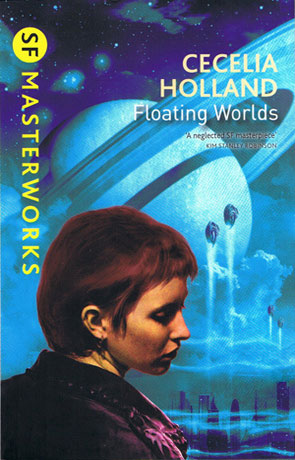
2) Floating Worlds (1976) by Cecelia Holland is, apparently, a very influential space opera, 'a neglected SF masterpiece.' Set an unspecified time in the future, it opens with the protagonist wandering round the ruins of Manhattan as a tourist:

'From here she could see through the broken walls to the next row of ruins, and through them to the next, all huge, the biggest buildings she had ever seen. The people who had built this city had dominated earth for three centuries, by money, by force, and by guile; they had colonized Mars, reached as far as Uranus, cracked atoms and made whole cities out of polymer, and Manhattan had been the heart of that empire.
...
"Did they live here? In glass buildings?" Some fable moved elusively at the edge of her memory.
"No. They lived somewhere else and came in here during the day."
"Now tell me the truth."
"I'm sorry, kitch, that is the truth."
She stood looking up at the glass. Maybe in those days glass had been more common than it was now. Waves of stain crossed it, traces of dry dust like tracks from the time when the ruins had been under water.'

In this distant future, Earth is an anarchist state, Mars is consumerist, Luna (the Moon) is fascist, while the moons of Uranus and Saturn make up the Styth Empire. The Styths are a mutant race of humans who believe they should conquer everything.

The protagonist, Paula Mendoza, is hired by the Committee for the Revolution, a sort-of vestigial government which oversees the Earth's anarchy, to negotiate a truce with Styths, because she happens to speak their language. Paula doesn't really care about the job:

'She had already decided not to put anything on the walls since she was keeping the job only until she found other work... She felt herself being forced into a role. Her life was closing in on her. She hated the Committee job, even the Styth case bored her, but it paid well and she kept putting off quitting because she liked the money.'

Holland's prose is very terse: she uses a lot of short sentences. This makes everything feel like the tense build-up to some climactic revelation or catastrophe:

'Paula took the midnight train to New York. Walking up the aisle of the car, she saw Bunker sitting next to the window on a forward bench. After a moment she put her bag on a rack over his head and sat down opposite him He had a book plug in his ear; he ignored her. She stretched her legs out before her. The train was almost empty. The lights flashed on and off, and the bench under her jerked forward. She braced herself. The train bounded forward, stopped cold, and started up again. They rolled off into the dark.'

Paula and Bunker proceed to have a short, boring conversation, and then Paula goes home.

Fifty pages in, at the end of chapter one, Paula is summoned to Mars to chat with some Styth negotiators. Throughout chapter two she has boring conversations with people on Mars, and then decides to fuck one of the top Styths:

'He straightened up on his arms. She could scarcely breathe in the dense fragrance he was giving off. When she kissed him again, his skin was warm, almost feverish. They got up and undressed. His body was perfect. Dressed, he simply looked massive. His broad chest swelled into his back, the muscle and bone smoothly shaped down to his long waist. He had an erection. They lay down side by side on the couch. His skin warmed her. While she explored him with her hands and her mouth she tried to get used to his scent. All in silence they joined together. His eyes closed, as if he were doing it alone. She rubbed herself down on his thick stalk, her hand on his hip, intent on the swelling tension in her groin.'

Floating Worlds feels like a trashy soap opera... in space!

I gave up when the big reveal at the end of chapter two, 105 pages in, was OH NO! SHE'S PREGNANT WITH HIS BABY!

Not my thing.

3) Synners (1991) by Pat Cadigan. I did not get very far with this one. I found Cadigan's writing extremely irritating. I felt like she was trying too hard to be cool, down with the kids. The story is about tattooed druggie hackers who listen to rock music and go against a big corporate record label, or something. 

At the start of chapter 2, one character (who is of course very cool) is in court, wondering whether she will be found guilty of anything and charged. The speculation concludes with:

'Fuck it, what difference did one more charge make, anyway? The fines would clean her out and then some, one more garnishment on her wages, so-fucking-what. All she cared about now was getting back on the street'

Later, she wonders what her BFF Mark is doing:

'But the best question was what the fuck was Mark doing there all on his own without a word to her. She and Mark were in it together, always had been. They'd been in it together in the beginning, and when Galen had bought most of the video-production company out from under the Beater, and they'd been in it together when Galen had let the monster conglomerate take EyeTraxx over from him, and they were supposed to be in it together the day after tomorrow, when they were due to show up for their first full day working for the monster conglomerate.'

Cadigan is so fucking cool that she italicises the word 'fuck'.

I gave up at page 36. Not my thing.

The other two disappointments were Fatherland (1992) by Robert Harris and Naked Lunch (1959) by William Burroughs.

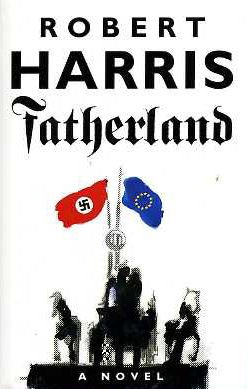
Fatherland came across as a cliché detective thriller with an alternate history gimmick: in 1960s Nazi Germany, loner cop Xavier March investigates a brutal murder, which leads him to discover a terrifying conspiracy going right up to the highest echelons of government..

I didn't reach the end, but I could see where it was going and couldn't be bothered sitting it out. I checked Wikipedia.

SPOILER ALERT.

March discovers that the Holocaust happened.

Naked Lunch is a very unpleasant and nonsensical read. There's no real plot. The chapters can be read in any order. Drug addiction and homosexuality are recurring themes. I gave up when I realised that if I was reading this on the internet, not in a 'Modern Classics' edition, I would have given up far sooner.

E.g.:

'The boy crumples to his knees with a long "OOOOOOOOH", shitting and pissing in terror. He feels the shit warm between his thighs. A great wave of hot blood swells his lips and throat. His body contracts into a foetal position and sperm spurts hot into his face. The Mugwump dips hot perfumed water from alabaster bowl, pensively washes the boy's ass and cock, drying him with a soft blue towel. A warm wind play over the boy's body and the hairs flat free. The Mugwump put a hand under the boy's chest and pulls him to his feet. Holding him by both pinioned elbows, propels him up the steps and under the noose. He stands in front of the boy holding the noose in both hands.'

Or:

"Darling, I want to rim you," she whispers.
"No. Not now."
"Please, I want to."
"Well, all right. I'll go wash my ass."
"No, I'll wash it."
"Aw shucks now, it ain't dirty."
"Yes it is. Come on now, Johnny boy."
She leads him into the bathroom. "All right, get down." He gets down on his knees and leans forward, with his chin on the bath mat. "Allah," he says. He lookd back and grins at her. She washes his ass with soap and hot water sticking her finger up it.
"Does that hurt?"
"Noooooooooooooo."

Not my thing.

Hopefully the books that I'm currently reading won't be so disappointing: Orlando (1928) by Virginia Woolf, Arguably (2011) by Christoper Hitchens, Bridget Jones' Diary (1996) by Helen Fielding, and The Scar (2002) by China Mieville. So far, I am enjoying them all.

Monday, 24 August 2015

A Ballard Binge

I've read a few J.G. Ballard books recently. Ballard is one of those authors who is not very well known amongst the general public, but is very popular amongst authors and literary peeps. It might help to think of him as the British equivalent to Philip K. Dick. Their books are very weird (although this doesn't tell you very much or prepare you for actually reading them). Ballard's work gave rise to the adjective 'Ballardian'; Dick's work gave rise to the adjective 'Dickian'. Their stories are often about modernity messing with people's heads, but in very different ways. They can both come across as quite pretentious. I'm not sure how much this comparison does either of them justice.


I first decided to read Ballard after Philip Reeve, author of the Mortal Engines series, recommended Ballard's early disaster SF novels while speaking at an event at the University of Nottingham. The three disaster novels are: The Drowned World (1962), about melting polar ice-caps flooding the earth; The Burning World (1964, revised and re-released as The Drought in 1965), about a global water shortage; and The Crystal World (1966), which has a pseudo-scientific explanation worthy of Doctor Who. Time is leaking out of the universe. Matter, once held by time like a saturated solution, is now crystallising across the cosmos. Wibbly-wobbly timey-wimey.

These novels, unlike other disaster novels, focus on the psychological states of the characters rather than the outward effects of the catastrophe. The protagonists are mesmerised by the disaster, undergoing a psychological transformation as they explore the changing world, accepting it as the world to come. Ballard makes the catastrophe into a positive change.

I read The Drowned World in 2013, and found it slightly disappointing. It has its moments, but the story - less than 200 pages - felt like it dragged on and on and on, as though Ballard struggled to make it novel length. The Crystal World I read most recently, and similarly found it slightly disappointing and too long. What is most memorable about both of them is the evocative descriptions of the changed world:

'The road narrowed, avoiding the slope which led up to the house, but its annealed crust, blunted like half-fused quartz, offered a more comfortable surface than the crystal teeth of the lawn. Fifty yards ahead, Dr. Sanders came across what was unmistakably a jewelled rowing boat set solidly into the roadway, a chain of lapis lazuli mooring it to the verge. He realised that he was walking along a small tributary of the river, and that a thin stream of water still ran below the crust. This vestigial motion in some way prevented it from erupting into the spur-like forms of the rest of the forest floor.

As he paused by the boat, feeling the crystals along its sides, a huge four-legged creature half-embedded in the surface lurched forward through the crust, the loosened pieces of lattice attached to its snout and shoulders shaking like a transparent cuirass... Invested by the glittering light that poured from its body, the crocodile resembled a fabulous armoured beast. Its blind eyes had been transformed into immense crystalline rubies.'

- The Crystal World, Chapter 6

Slightly put off by my disappointment with The Drowned World, it was quite a while until I attempted another Ballard. At an event at the University of Nottingham, Christopher Priest, author of The Prestige (1995), recommended Ballard's short stories, saying that he found Ballard's novels disappointing. From my experience with Ballard's work so far, I find myself agreeing with Priest. Ballard's short stories are the shit. I picked up the anthology Myths of the Near Future (1982) at Loncon 3, and was surprised at the quality and diversity of its 10 stories.

In the titular story, humanity is suffering from 'space sickness' after space travel is abandoned. In the collapsed society, handfuls of people still dream of space exploration. Some walk around naked flapping their arms, hoping to transform into birds. The protagonist analyses pornographic imagery, thinking that the images of lustful union hide the key to the secrets of the universe:

'That evening he rested in his chair beside the empty pool, watching the video-cassettes of his wife projected on to the wall at the deep end. Somewhere in these intimate conjunctions of flesh and geometry, of memory, tenderness and desire, was a key to the vivid air, to that new time and space which the first astronauts had unwittingly revealed here at Cape Kennedy.'

Other stories from that collection include Having A Wonderful Time, told as a series of postcards from a woman trapped on a cheap holiday resort, and Theatre of War, a script for TV documentary on a twentieth century British civil war, with all the dialogue having been adapted from coverage of the Vietnam war.


The Voices of Time (1984) contains another 8 stories; The Disaster Area (1967) contains another 9. Vermillion Sands (1971) gets its name from the surreal futuristic holiday resort where its 9 stories - featuring cloud-sculptors, singing plants, living clothing, emotional houses, and more - are set. 

Short story collections are usually hit and miss, but Ballard's misses are at least interesting. His hits are spectacular. Some stories felt rushed. Here are some entertainingly bad sentences from stories that needed a final polish:

'In her face the diagram of bones formed a geometry of murder.'
- The Cloud-Sculptors of Coral D, Vermilion Sands

'"Where, my God, where is he? Where is he?"
Shifting his emphasis from the first of these interrogatories to the second, as if to illustrate that the fruitless search for Hinton's whereabouts had been superseded by an examination of his total existential role in the unhappy farce of which he was the author and principle star, Dr Mellinger turned upon his three breakfastless subordinates.'
- Minus One, The Disaster Area

'Talking to her was like walking across a floor composed of blocks of varying heights, an analogy reinforced by the squares of the terrace, into which her presence had let another random dimension.'
- The Screen Game, Vermilion Sands

These add a bit of comic relief. When the main negative to the anthologies is a few bad sentences, that's got to be a good sign. At some point it would have been cheaper for me to splash out on The Complete Short Stories of J.G. Ballard, but I didn't think I'd want to read that many. Having read four anthologies, I find myself still wanting to read the remaining six: War Fever (1990), The Venus Hunters (1980), Low-Flying Aircraft (1976), The Atrocity Exhibition (1969), The Day of Forever (1967), and The Terminal Beach (1964). I'm taking a break from Ballard so won't be reading those until next year at the earliest.

Enthused by my enjoyment of his short stories, I decided to give his novels another go. Concrete Island (1974) is my favourite so far (it is also Neil Gaiman's favourite; Gaiman wrote the introduction to the latest edition). A man crashes his car and traps himself on a piece of wasteland in the middle of a motorway intersection. This sounds like a stupid idea, but Ballard manages to convince you that it could happen, and therein lies the novel's power. My main criticism of Concrete Island is that the grass does a lot of seething ('they wandered through the seething grass', 'the grass seethed around him', etc).
The Unlimited Dream Company is the most surreal and most disappointing of the four novels I read. The protagonist crashes a light aircraft into the Thames. When he awakes, he may or may not have come back from the dead, may or may not be insane, and may or may not have magical sex powers. A lot happens in the story, but the narration is so monotonous that no matter what's going on - the protagonist transforms into a giant whale, then transforms into a stag and fucks the residents of Shepperton (who have transformed into does), then discovers that his semen causes vegetation to sprout from the ground, etc - it feels like nothing is happening. During the Magic Semen Sequence, the monotonous tone worked well: the narrator's seeming indifference made an entertaining contrast to the weird events described. This effect might have been intended for the whole book, but monotony overshadowed weirdness.


'Leaving the church, I threw the semen on to the cobbled pathway outside the vestry door. As I paused there, looking across the swimming pool at the replica aircraft in the grounds of the film studios, green-fluted plants with milk-red blossoms sprang through the stones at my feet. I stepped among them and set off towards the town, my swollen penis in my hand. As I ran through the trees I thought of Miriam. Again I ejaculated beside the tennis courts, and hurled my semen across the flower-beds.'

- The Unlimited Dream Company, Chapter 22

Of the Ballard books I've read, I highly recommend Concrete Island and all the short story collections. To a lesser degree, I also recommend The Crystal World. Despite my general dissatisfaction with his novels, I'm still tempted to read a few more of them. Those that most interest me are: Crash (1973), High Rise (1975), Empire of the Sun (1984), and The Kindness of Women (1991). I already own copies of Hello America (1981) and Rushing To Paradise (1994), so may as well give them a go too. However, I won't be reading those until next year at the earliest, because I'm having a Ballard break.

Wednesday, 17 June 2015

'The Art of Happiness' by Epicurus

I have been getting quite impatient with the Qur'an (because it's tedious drivel), so have taken a break from it to read the extant writings of Epicurus, who lived 341-271 BCE. The religion he founded, Epicureanism, is like Hellenism's equivalent to Buddhism. Sort of. Maybe. Here are some of the things he says:

'The blessed and indestructible being of the divine has no concerns of its own, nor does it make trouble for others. It is not affected by feelings of anger or benevolence, because these are found where there is lack of strength.'

'Death means nothing to us, because that which has been broken down into atoms has no sensation and that which has no sensation is no concern of ours. It is possible to get protection from other things, but when it comes to death, all us humans live in a city without walls. We must try to make the latter part of the journey better than the first; and when we reach the end, we must keep an even keel and remain cheerful.'

'We are born once. We cannot be born a second time, and throughout eternity we shall of necessity no longer exist. You have no power over the morrow, and yet you put off your pleasure. Life is ruined by procrastination, and every one of us dies deep in his affairs.'

'Of all the things that wisdom provides for the happiness of the whole man, by far the most important is the acquisition of friendship. Every friendship is desirable for itself, but it has its origin in personal advantage. Friendship dances around the world, summoning every one of us to the gospel of the happy life.'

'Some desires are (1) natural and necessary, others (2) natural but not necessary, still others (3) neither natural nor necessary but generated by senseless whims. No pleasure is bad in itself, but the things which make for pleasure in certain cases entail disturbances many times greater than the pleasures themselves.'

'Justice is a kind of agreement not to harm or be harmed, made when men associate with each other at any time and in communities of any size. If somebody lays down a law and it does not prove to be of advantage in human relations, then such a law no longer has the true character of justice.'

'It is impossible to get rid of our anxieties about essentials if we do not understand the nature of the universe and are apprehensive about some of the theological accounts. Hence it is impossible to enjoy our pleasures unadulterated without science. There is no advantage in gaining security with regard to other people if phenomena occurring above and beneath the earth - in a word, everything in the infinite universe - are objects of anxiety.'


I could go on. Epicurus > Muhammad. In the first century BCE, an Epicurean called Lucretius wrote a poem attacking the polytheist religions of the Roman Empire and explaining natural phenomena using (now adorably outdated) scientific explanations. He sometimes sounds quite Dawkinsesque:

'Some people who know nothing of matter believe that nature without the guidance of the gods could not bring round the changing seasons in such perfect conformity to human needs, creating the crops and those other blessings that mortals are led to enjoy by the guide of life, pleasure. Obviously, in imagining that the gods established everything for the sake of men, they have stumbled in all respects far from the path of truth. Even if I knew nothing of atoms, I would venture to assert on the evidence of the celestial phenomena themselves, supported by many other arguments, that the universe was certainly not created for us by divine power; it is so full of imperfections.'