Showing posts with label SF Masterworks. Show all posts

Thursday, 10 June 2021

'City' by Clifford D. Simak

'City' is a fun collection of retro SF written in the 1940s and 50s, charting the future of the earth from the 1990s to thousands of years in the future when humanity is gone and intelligent Dogs consider Man a myth.

The stories are presented as mythological tales popular in Dog culture and each are accompanied by a brief introduction discussing the potential historicity of the story and the various disputes and interpretations among Dog academics (some of the Dog scholars mentioned have names such as Bounce and Rover).

The stories are very retro, though the first page of the first story did give me the feeling of reading a rough draft of the present: a man sits on his lawn while a robot lawn mower cuts his grass, while a kid 'settles down for a twitch session'. The stories exhibit many of the flaws typical SF from the period. There are no women characters that I can recall.

However, unlike many retro SF stories, these do have a lot of emotion in them. Simak was entering middle age when writing these stories, and the emotions he was feeling about his youth gone and old age approaching oversaturate the book. Each story has a character, usually the protagonist, who is middle age and is constantly reflecting on things past and things to come; in later stories the Middle Aged Man archetype takes the form of a rusting robot and then a middle aged Dog. This does make the stories rather repetitive, but also adds to their charm.

Simak is one of those authors who was popular and influential in his day but is not so widely read nowadays. The influence of his Dogs can be felt in the various 'intelligent pet descendants' across SF - the Cats of 'Red Dwarf' spring to mind, and I have a vague recollection of an episode of 'Samurai Jack' featuring Dog academics trying to learn about their ancestors who were pets to humans.

I would recommend this book for those interested in the history of SF, and those who find retro SF a tasty and comforting literary snack.

Saturday, 12 December 2020

'Now Wait For Last Year' by Philip K. Dick

 A second tier PKD novel involving a few of the his regulars: reality and unreality, time travel, drug use/abuse, etc. Enjoyable, but not one I'd recommend to newbies.


A slow first half - introducing the characters, the future Earth caught in a galactic war, the novel's magic drug - leads to a frenetic second half, whose manic energy reminded me of a Rick & Morty episode, or one of the Doctor Who episodes which tried to do too much in too little time: TIME TRAVEL! ALIENS! PARALLEL WORLDS! ALTERNATE SELVES! LET'S CHANGE HISTORY! MORE ALIENS! FUTURE SELVES!


As well as all the good fun pulpy sf stuff, there's reflections on middle age, relationships, and divorce. Clearly Dick was middle aged and going through one of his many divorces while writing this, and directed a lot of his bitterness into his women characters: there is more misogyny here than your average PKD novel. Part of the charm of PKD's work is that he relates the emotions he felt while writing it in a very raw way: you can feel the bitterness that made him write unpleasantly, you can feel his angst about getting older and fatter. As well as being a fun and silly SF novel, it is also about getting older, reflecting on your life so far, and living with your choices. It comes to a surprisingly affective ending.

'Now Wait for Last Year' by Philip K Dick

A second tier PKD novel involving a few of the his regulars: reality and unreality, time travel, drug use/abuse, etc. Enjoyable, but not one I'd recommend to newbies.

A slow first half - introducing the characters, the future Earth caught in a galactic war, the novel's magic drug - leads to a frenetic second half, whose manic energy reminded me of a Rick & Morty episode, or one of the Doctor Who episodes which tried to do too much in too little time: TIME TRAVEL! ALIENS! PARALLEL WORLDS! ALTERNATE SELVES! LET'S CHANGE HISTORY! MORE ALIENS! FUTURE SELVES!

As well as all the good fun pulpy sf stuff, there's reflections on middle age, relationships, and divorce. Clearly Dick was middle aged and going through one of his many divorces while writing this, and directed a lot of his bitterness at his women characters: there is more misogyny here than your average PKD novel. PKD relates the emotions he felt while writing in a very raw way: you can feel the bitterness that made him write unpleasantly, you can feel his angst about getting older and fatter. As well as being a fun and silly SF novel, it is also about getting older, reflecting on your life so far, and living with your choices. It comes to a surprisingly affective ending.

Saturday, 8 February 2020

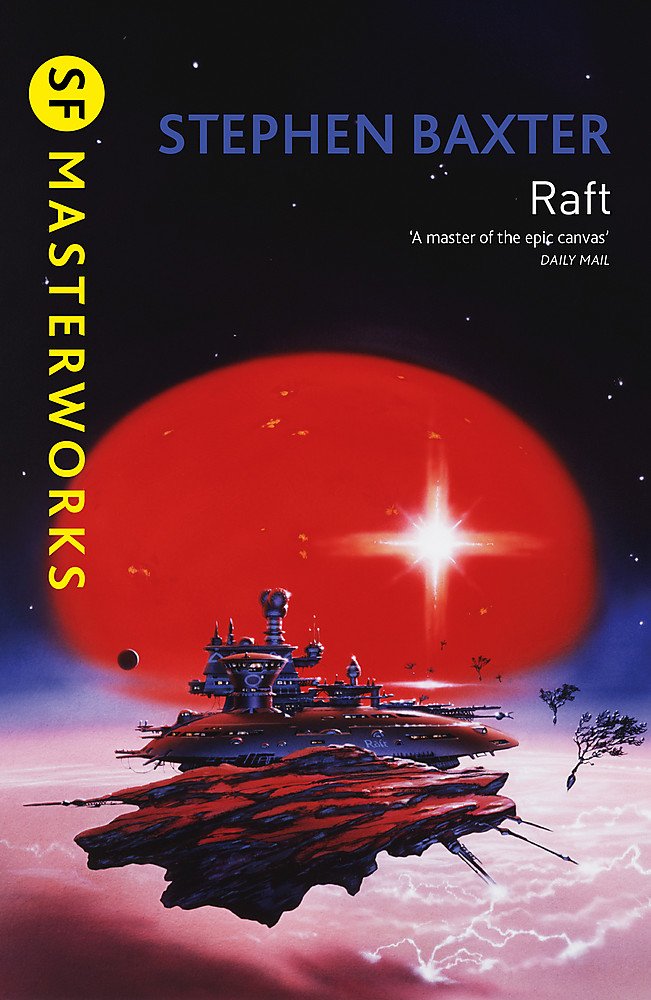
'Raft' by Stephen Baxter


This was an entertaining and fairly short read, about a human society that develops after a spaceship accidentally ends up in another universe with much higher gravity than our own, which means the universe is VERY different to ours in various entertaining ways.

At its best, the story has a mythological feel to it, and at times there's decent opportunities to read deeper meaning into the text. At its worst, the characters are explaining maths to each other. Hard SF is not really my kind of SF, but I enjoyed this more than the likes of Tau Zero and Mission of Gravity - if those deserve to be to be SF Masterworks, then Raft certainly does.

Rees, our protagonist, is a miner living in bad conditions on the Belt, a sort of space station. Precociously intelligent and curious about the universe, he manages to travel to the Raft, a sort of city built around the original spaceship. Here he discovers that the Raft-dwellers have a rigid class system, which is increasingly causing discontent among the lower orders, and that miners from the Belt are looked down on as a wretched underclass, almost as another species.

Rees' intelligence gains him the favour of the Scientists, stuffy academics who decide to raise him as their own.

The early chapters of the novel, where Rees is an adolescent in Science School, feel like adolescent's school-time power fantasy. Rees is a kid from a poor background who ends up at a posh school, and is picked on by classist bullies. However, since he was raised as a miner, he is extremely strong compared to the pampered Raft folk, so can beat them with both brains and brawn.

The classism of his colleagues irks him, and he becomes aware and affected by the injustices of Raft society - but science is his passion, and here he spends his time and energy, and here he succeeds.

Years later, the Raft is rocked by revolution. Without a shred of self-awareness, Rees yells at the other scientists for being solely focused on science and not doing anything about the decades of injustice that have led to this revolution.

The first half of the novel, adolescent power fantasy aside, has an entertaining critique of the class system and the ivory towers of academia. The setting - the alternate universe and its society - is a fun one to explore, and you can tell Baxter had fun thinking it up and is eager to show you around it. The characters are, however, very bland and one dimensional. Rees is kind of interesting in the first half because of the class consciousness which gets abandoned once he's successful, but for the rest of the novel he's a super-intelligent strongman, and the plot is just a series of events that enable a tour of the setting. Good job it's an interesting setting.

This is the first Baxter novel I have read. I wouldn't be averse to reading another, but nor am I in a rush to get a hold of one. I've heard that Timelike Infinity is a better novel than this, and is perhaps more deserving of masterwork status. I might read it one day.

Saturday, 14 September 2019

'Random Acts of Senseless Violence' by Jack Womack

Image may contain: textOn the one hand, this novel is a very impressive achievement, an extremely believable tale of a family descending into poverty as society collapses, told as 6 months of diary entries written by a 12-year old girl. The way the language shifts over the course of the novel is incredibly, masterfully done - from plain and simple English written by a girl doing well at school and living in a nice area, to paragraphs of street slang written by a girl struggling to get by as her life collapses.

On the other hand, this is an extremely believable tale of a family descending into poverty as society collapses. It's not a fun book; it's so bleak. I can appreciate it as a technical and imaginative achievement but I can't really say I enjoyed reading it, especially in the current political climate.

Bit too real.

Tuesday, 22 August 2017

Brian Aldiss

Years ago, during my first term at university, when I was just starting to become an avid SF reader, I read Brian Aldiss' novel 'Non-Stop'. It was one of the first SF Masterworks I read, perhaps the 3rd or 4th. I have very fond memories of it; it contributed to my new and burgeoning enthusiasm for SF and the SF Masterworks series (I have now read about 90 of them). I remember describing 'Non-Stop' to someone who'd popped in to visit, and them saying "That's a very Michael book, isn't it."

A few years later, I read 'Greybeard' on a long train journey in America. My copy was a very ugly old copy which had been a duplicate in the university Science Fiction & Fantasy Society's library. The spine was a strange, perhaps light-damaged, grey-purple colour. The cover image was of a deranged-looking old man with a wispy white beard, one squinting eye, one wide eye, and a strange tusk-like growth emerging from his cheek. A raven or crow on his shoulder smiled with a human mouth, and its head was angled in a way that suggested he was turning to a camera. The combination was like an odd family portrait, and I still don't know its significance to the book. It jarred with the story itself, which was far more somber and melancholic, being about old age and infertility. I don't recall any smiling ravens at all.

(I have since replaced both my 'Greybeard' and 'Non-Stop' with nice new editions.)

Aldiss was a guiding Wise Man on my journey to become an Olaf Stapledon super fanboy. He introduced me to Stapledon's magnum opus; as in, he wrote the introduction to it. I reread that introduction many times, trying to sort out my own thoughts on the book: reading it had been like a visionary experience, a religious conversion, a life-changing event. (Those who knew me at that time will likely remember my incessant 'Star Maker' evangelizing.) It is still one of books that has had the biggest impact on me, and Aldiss is caught up in that.

When we read, the writer's voice in our head can become like a companion. And so, Aldiss' friendly, witty voice introduced me to Stapledon's lesser known 'Nebula Maker' and 'Four Encounters', and to Robert Crossley's Stapledon biography, making me feel like I was becoming part of some small esoteric group of Stapledon superfans. In the 'Star Maker' introduction, he lists the little-known 'The Martyrdom of Man' by Winwood Reade as one of Stapledon's influences, and quotes a passage from it, because: "I hope to find others to share my enthusiasm for Winwood Reade."

The oldest book I own is an 1896 edition of 'The Martyrdom of Man'. It is like a prequel to Stapledon's two great works, covering human history from evolutionary origins to the present, with some minor proto-SF speculation about the near future, in a prose style very similar to Stapledon's: sweeping, grand, poetic. I read it while on a two-day boat journey down the Mekong river is Laos: the scenery, the prose, the subject matter, the journey - all made it a very personal experience; visionary, like a mystical pilgrimage. There are passages in which Reade guides you down 'the River of Time'. These are extremely evocative in themselves: reading them while on an actual river with Cretaceous-looking jungle surrounding you is on a whole other level. This experience was Aldiss' fault; he'd recommended it to me.

Later that year I attended my first Worldcon, Loncon3. One of the programme items was Brian Aldiss and David Wingrove in conversation. Aldiss talked about book covers, writing, reading, publishing, drinking with Kingsley Amis, experiences in World War 2, and so much more. At the end he did a signing - the queue was rather large, of course. I had with me the SF Masterworks edition of 'Helliconia' (which I still haven't read because it's an intimidating 1300-page beast), and my 1896 'The Martyrdom of Man'. After we exchanged a few words (me very nervous), he signed both of them, and with the latter scribble it felt like he was approving my membership of the weird group of Stapledon superfans.

Earlier this year I read 'Trillion Year Spree', Aldiss' history of science fiction. I would thrust it into the hands of any SF fan. It is one of my favourite books of the year. It was a joy having that familiar Aldiss voice, the Stapledon-introducing voice, enthusiastically, wittily, knowledgeably chatting away about so many books. His enthusiasm is infectious; I came away from it both more knowledgeable and more enthusiastic about SF than ever before. Seven years after 'Non-Stop' swelled my budding enthusiasm for SF, his work is still making that love grow.

The obituaries in The Bookseller and The Guardian show how obscenely accomplished his career has been, how enormously talented he was. I must read more of his work. When I got home from work last night I scrolled through the titles in Harper's 'Brian Aldiss Collection'. So many books. So many to buy. So many to read. Fantasies, comedies, autobiographies, historical fiction, short stories, "weird" books, essays. So much to discover.

I should probably start with 'Helliconia'.

Tuesday, 25 July 2017

Summary-Review: 'Ilium' by Dan Simmons

This book is such a mess. Here is how I imagined Simmons talking to himself when coming up with the ideas for it:

"I want to write another science fiction story. Something truly ground-breaking; clever science fiction which shows the world how clever and knowledgeable about literature I am. Hmm... what should I write? Hmm... something that shows I know Great Literature...

I could write Homer's Iliad... in space! No; the Iliad... on Mars! A far-future terraformed Mars, with the Greek gods as super technologically advanced post-humans living on Olympus Mons, who for some reason are recreating the events of the Iliad.

Yes, that's fucking great.

The protagonist could be a 20th century Iliad scholar whose consciousness has been artificially preserved, and whose task is to monitor the Iliad events on Mars and compare them to Homer's account, for some reason. This way the reader will know that when I'm deviating from Homer's version, I'm fully aware of it and doing it deliberately. The scholar protagonist can also quote the Iliad while watching the events and talk about the merits of different translations and interpretations; fuck, that'll show 'em how clever I am!

SF fans reading it may be reminded of Roger Zelazny's 'Lord of Light', in which super technologically advanced post-humans recreate Hindu mythology on a colony planet in order to keep the masses under strict control. But I'll go one further than Zelazny and have my post-humans recreating Greek mythology for no obvious or believable reason except FOR TEH LOLS, and cos I'm clever.

That would certainly show people that I know my classical literature - but would they know I love more modern stuff too?

Hmmm... I've done "Canterbury Tales in Space" and "John Keats in Space", and soon "Iliad on Mars"... Hmmm... What else to do?

Nabokov... in space? No; 'Lolita'... on the Moon? No.

'Ada, or Ardor'... on a far-future earth? YES: on a far-future Earth reminiscent of Michael Moorcock's 'The Dancers At The End of Time' - because Moorcock's story also features incest. Fucking yes - I am on to a winner with this one!

I will retell Nabokov's story of incestuous lovers struggling to reconcile their feelings for each other with the social taboo... on a far future earth in which that social taboo no longer exists!

So while Nabokov's story is an intense and uncomfortable psychological study, and Moorcock used incest - once - for shock value, to highlight the decadence of End of Time society, I will do none of that. My incestuous character shall not be conflicted or feel guilty about lusting over his cousin; he must comment in every chapter on how sexy his cousin's tits are, to the point where the reader finds him tedious and wishes for him to have any psychological depth whatsoever, yearns for him to have any motivation beyond seducing his cousin. I shall make the reader bored of his incestuous lustings, to show that incest is a normal, boring part of this far-future society, or at least that's what my fans might say, I dunno. I'm so clever.

That would show I know and appreciate 20th century literature, but what about all the good stuff between Homer and Nabokov?

Readers must know I am well-read in this too.

I've got it.

There will be super intelligent, biomechanical constructs who live on the Moons of Jupiter.

One of them will be an amateur Shakespeare scholar; another shall be an amateur Proust scholar. These constructs can chat to each other about how great Shakespeare and Proust are, and refer to the theories of various 20th century literary critics. They can quote extensively, perhaps even whole pages of Proust to show the reader I really know my shit.

Later on I can probably work in a retelling of Shakespeare's 'The Tempest' or something, to really hammer it home. I'll figure something out.

All that will show people how well-read and clever I am.

I'm a fucking genius."

This book is so bad in so many ways. I was tempted to give up on it multiple times, but I was interested enough in the story to keep going. Had I found a decent online summary, I would probably have happily given up; alas, I found none and persevered. My review will therefore summarize the whole story, perhaps saving some people from the effort of reading its 500+ pages. Spoilers ahead.

So, 'The Iliad on Mars'. Thomas Hockenberry is a scholic, a 20th century scholar whose job is to monitor the recreated Iliad events and report to the gods on how accurately they match Homer's descriptions. Perhaps there is an explanation in the sequel as to why this job is a thing. Hock is an extremely bland character, an observer not a doer. For most of his story he feels like an empty space for the reader to insert himself: he watches the story, or has it imposed on him, and doesn't start to drive it until one pivotal scene, which I shall describe later. When he starts to have character, he becomes quite unpleasant: he remembers his old 20th/21st century life, and moans about the 'Political Correctness Brigade' having so much sway back then. I'm fine with unpleasant protagonists, but he's unpleasant in an extremely boring way.

While observing, the scholics use 'Morphing Bracelets' to disguise themselves as a Greek or Trojan character of their choosing. There is a bullshit quantum science explanation as to how this works.

Hock's story is narrated in first person. He spends his first few chapters simply watching events, introducing the Greek and Trojan characters to the reader, and reflecting on his life as a scholic.

Aphrodite, Goddess of Love, chooses Hockenberry for a special task: to kill Athena, Goddess of Wisdom, for some reason. Perhaps the reasons (a) why she chose Hockenberry in particular, and (b) why she wants Athena dead, are given in the sequel. We are given nothing convincing in this book; we accept and move on. To aid him, the goddess gives him three useful magic-science items: a levitation harness, a Quantum Teleportation (QT) Medallion, and the Hades Helmet. 

The gods use Quantum Teleportation to travel around Earth-Mars, to instantaneously go from Olympus Mons to Troy - now Hockenberry has this power, and, because this medallion is special, his "QT trail" can only be tracked by Aphrodite. There is a bullshit quantum science explanation as to how this works.

The Hades Helmet makes the wearer invisible to everyone except Aphrodite (we can assume she stole it off Hades and changed the settings). The fact that the gods have invisibility technology, and the means to select who it doesn't work with, makes me wonder why the gods didn't just make the scholics invisible to humans but not gods. The scholics are supposed to observe and report, not interfere, yet we are told that because of the bullshit quantum science behind morphing, this can and does interfere with events - so why not just make them invisible? I suppose the morphing is important for plot reasons.

Aphrodite is seriously wounded in combat by the Trojan warrior Diomedes. She is out of action, cooped up in a healing tank in the Infirmary of the Gods.

The gods can't track or see him; Hockenberry is free to do as he pleases.

And what shall his first act of freedom and self-determination be?

He teleports to Helen of Troy's apartment, morphs into Paris, and has sex with her.

Yep, he rapes her.

Post-rape, Helen confronts Hockenberry with a dagger, asking who he really is. "A woman may forget the color of her lover's eyes, the tone of his voice, even the details of his smile or form, but she cannot forget how her husband fucks." Hock reveals his true form, feels pathetic, and...

"Your penis is larger [than Paris']."

And after rebuking him for raping her via deception, Helen... invites him to bed again for more sex.

Let's just go through that scene again. Hock, a gawky scholar character, is now invisible and untraceable to divine authority, free to do as he pleases. So he disguises himself as the husband of the Most Beautiful Woman in the World and tricks her into having sex with him. While she rebukes him for raping her, Helen compliments Hock's big cock and says he was 'earnest' and 'sincere' during sex - she then invites him to bed for more sex. This is so crass and awful it sounds like a rape-fantasy porn scene. 

Hock doesn't feel very guilty about deceiving Helen. He rapes her and feels alright about it afterwards. I know rape occurs a lot in Greek mythology, and it's probably been included here to echo the Greek gods raping mortals so often, but it's handled so badly. It feels more like a creepy adolescent fantasy than a wry comment on the prevalence of rape in classical myths.

And Helen becomes his quasi love interest for the remainder of the book.

After this act of male empowerment, after his rape victim decides she does want to have sex with him anyway, Hock feels like he should do other things with his power to evade the gods. He is upset by the thought of Helen's fate in the Iliad, so decides to change events to save her and all of the people who will suffer because of the fall of Troy.

He decides to unite the Greek and the Trojans against a common enemy: the Gods of Olympos.

We will return to Hockenberry & Co later, but now we must turn our attention to "Ada in the Future".

Ugh.

Daeman is a womanizing knobhead, off to a party where his objective for the evening is to seduce his cousin Ada. That's his motivation for the whole story. After a few chapters it seems even Simmons got bored of one-note incest Daeman and relegated him to a background character role. It is quickly established that incest is not a taboo on this future Earth - Daeman even comments at one point along the lines of "it's weird to think incest used to be taboo" - so there is nothing interesting about Daeman, no psychological conflict or guilt or shame. As far as he is concerned, he is just lusting after an attractive female - her being his cousin makes literally no difference to him. It feels like the whole point of 'Ada in the Future' thing is ruined within a few chapters, and Simmons moves on and almost forgets about it - Daeman's incestuous ambitions are barely mentioned for the remainder of the book.

At the party, he fails to seduce Ada, but meets Harman and Hannah. Harman is an older man approaching the maximum lifespan allowed: he wants to fly a spaceship to the space stations in orbit where the post-humans who govern the Earth supposedly live, so he can beg for a longer lifespan. Hannah is so bland I could have forgotten she was in this book.

The 4 of them - Harman, Hannah, Daeman, and Ada - go on a little trip to try to find a spaceship, They meet Savi, the Wandering Jew, a mysterious old woman who seems to know a lot about what's going on, and Odysseus, the Greek hero. The group of 6 travel around Future Earth in Savi's 'sonie' - an aerial vehicle - to look at things and have boring conversations.

The general population of Future Earth have no culture or literature or education, and are completely ignorant of how the technology they use works. Harman is the only person in the society who can read, and he can only read slowly, mouthing the words as he goes.

So, as they're travelling around and having conversations, the four ignorant people often ask Savi or Odysseus about their world and the technology in it. They invariably reply in a vague way which leaves the four just as confused and ignorant as before, but allows the reader - who can understand big words and has been reading the novel's other two storylines - to get a better idea of the world and what's going on. When one of the ignorants respond with "I don't understand" - a phrase repeated so often it seems to have become a joke even to Simmons by the end - the knowledgeable one replies with some variant of "Ah, but you will soon!" or "Yeah I know but it's fun talking in this vague way lol". They are so blatantly talking for the reader's, not their companions', benefit. The conversations are painfully artificial.

What's more, when an ignorant one asks about something which the reader will already know about - how a compass works, for example - the knowledgeable one will not bother explaining, simply saying "It doesn't matter" or "By magic", because the reader needs no explanation. So Savi will give a long bullshit quantum science explanation for some technology they encounter, which goes completely over the heads of her companions but may benefit the reader, but refuses to explain simpler things which may actually be understood by her companions. (Given how thoroughly bullshit the quantum science explanations are, "By magic!" would also be a more honest and accurate answer.) It left me wondering why any of them trust her when, as far they're concerned, she is talking complete nonsense. Harman wants a spaceship and thinks she's the means to find one. Ada fancies Harman. Hannah...? And Daeman... fancies Ada? You could almost forget Daeman was still with them, so little he contributes to the group's adventures and conversations.

After plenty of conversations and the occasional action set-piece, the group splits. Ada, Hannah, and Odysseus return to Ada's home - Odysseus begins preaching and teaching, becoming a sort of cult figure. Harman, Savi, and Daeman fly to the 'Mediterranean Basin' (the inland sea has been drained), to find a way to get to the orbital space stations. Daeman's reasons for joining Harman and Savi are very weak: he is afraid of the Allosaurs living in the forests by Ada's home, and doesn't want to teleport from Ada's home to his own because now he understands the technology a little more: Savi had explained it involves destroying his old self and creating a copy elsewhere - Daeman finds this disconcerting. He decides to join the crazy quest rather than ask to be dropped off at his own home on the way to the Mediterranean (Ada lives in North America, Daeman in Paris).

Now we must leave the Earthlings and turn to our third storyline.

Mahnmut and Orphu are moravecs, autonomous biomechanical beings living on the moons of Jupiter (there are also moravecs living on asteroids). They are recruited by the Five Moons Consortium, along with a bunch of other moravecs, to go on a mission to terraformed Mars. Their objective: place and activate a mysterious Device on Olympus Mons.

Mahnmut is roughly humanoid in shape and is an amateur Shakespeare scholar. Orphu is like a giant crab, and is very enthusiastic about the works of Marcel Proust. The two of them converse about their literary heroes, discussing 20th century critics, quoting huge passages, and generally having a great time nerding out together. (I wasn't joking earlier when I said whole pages of Proust are quoted.)

The other moravecs are given no personality - which is lucky for the reader because they may otherwise have cared when they all died when the ship gets shot down as it approaches Mars. M&O crash into the Tethys Sea on Mars, and spend several chapters trying to make it to shore while also chatting about human literature. Although Simmons tries to amp up the tension here, the whole 'Trying To Get To Shore' section is overlong and dull. Since Simmons clearly enjoys writing their smartypants Shakespeare-Proust conversations, and has invested in the characters by giving them personality - they are perhaps the best characters in the novel - there is no real sense of danger in their story. I didn't believe Simmons would be willing to kill either of them off, especially not so early in the story, so this section just drags on and on. 'WILL THEY MAKE IT TO SHORE?' the narrative asks, again and again. Of course they will, and they do.

Once ashore, they encounter a photosynthetic species, the Little Green Men, who conveniently have a fleet of ships and can spare one for the moravecs' journey to Olympos. A storm hits while they sail, and the two moravecs quote The Tempest at each other, and Simmons explains some of the unfamiliar terms for the reader's benefit.

Oh, the Little Green Men are servants of Prospero, the wizard from The Tempest.

During this story we are treated to the Most Thoroughly Bullshit quantum science conversation in the whole book, and possibly in all literature. Ey m8, says Orphu (I'm paraphrasing heavily), you know cos consciousness is a quantum wavelength, what if the literary greats of the past, with the force of their quantum consciousness imagination, created new quantum universes? What if quantum technology is the reason the Greek Gods, and Shakespeare's characters, are coming in to the world? The barriers between this world and quantum universes are weakening and allowing the fictional to become the real. I reckon that is totes what's hapnin.

Not only is this thoroughly bullshit, it makes the book feel so much cheaper, like cheesy crossover fanfic or The Pagemaster for adults.

Eventually, M&O board a fancy hot air balloon and start flying to Olympos. They are captured by the gods and taken to Zeus for questioning.

This all covers the first 300 pages; now the 3 stories start to converge and get more exciting. Or rather, it now feels like the stories are actually beginning. The chapters covering Hock's efforts to unite the Trojans and Greeks are done relatively well. Conveniently for M&O, Hock turns up at Olympos just as Mahnmut is being questioned, so helps them escape. Mahnmut borrows the Invisibility Helmet in order to plant the Device secretly, then joins Hock in Troy. The gods learn of the Greek-Trojan alliance and decide to bomb Troy to show off their power; Hock compares the carnage during the bombardment to news footage he remembers of 9/11 and the Iraq War - these paragraphs felt very jarring, like they were thrown in for topicality.

Once the extremely slow build-up is over, Ilium feels like a trashy yet very entertaining action movie. During the chaos, with explosions and screaming civilians around them, Helen finds Hock and kisses him goodbye and good luck before he teleports away, in a scene that would definitely be accompanied by suddenly emotional music in a movie adaptation, and would perhaps be in slow motion.

(I forgot to mention earlier, there is a scene where Hock gets captured and interrogated by a group of women. One of them holds a knife to his testicles to get him to talk. Hock describes this knife as a 'feminist blade'.)

The Device activates. Imagination supplies the soundtrack 'I am the Doctor' https://www.youtube.com/watch?v=K7VmOZ4Ppj8

In Troy, portals open up in the sky and on the ground, through which Olympos is visible. The converse occurs around Olympos. We learn that Troy was not on Mars after all - it is a version of Earth, connected to Mars with quantum tunneling or something. (No doubt the sequel will confirm Troy's Earth is in the quantum reality created by Homer.)

Strange tripods emerge from some of the portals.

"I think I know who these guys are," says Orphu.

At this point I'm ready to throw the book across the room if the tripods are Martians from a quantum reality created by H.G. Wells. Thankfully they are not: it is an army of moravecs, here to lay siege to Olympos. They join with the Greek-Trojan alliance, and march through the portals towards the home of the gods. The Little Green Men also show up and join the alliance. Zeus erects a huge force field to protect Olympos.

The stage is set for the sequel, the siege of Olympos.

Meanwhile, back on Earth, Daeman & Co visit Jerusalem, where the sonie is captured by strange robotic things called Voynix. The group escape in a vehicle called a crawler. In the Mediterranean, they find strange chairs which enable them to travel up to a space station, and then break.

The reader is treated to an extended horror sequence, which is done rather well but is overlong. The group explore the space station, floating zero G past bodies and severed limbs and ruined technology.

They encounter Caliban, a strange lizard monster who speaks in a vaguely Shakespearean way. Savi is killed but we don't care because she was little more than a mouthpiece for Simmons to explain things to the reader. Daeman and Harman wander round the space station, eating little, growing their facial hair, and wondering if they'll be killed by Caliban or find some way to escape.

The spacestation is Prospero's island - we are now at The Tempest in Space.

Prospero, an AI hologram, explains that Ariel, a mysterious entity on Earth, saved Savi's Sonie from the Voynix and programmed it to rescue them from the space station. It is parked outside. Turns out the sonie was a spaceship after all and if Savi had been aware of this they could have skipped a lot of the wandering around. The characters accept this revelation calmly, not freaking out at all at the pointlessness of their earlier travels. It feels a very lazy way to get them to escape. Prospero even jokes that it is "another deux ex machina."

They plan to destroy the space station - but wait, what about all the people in the infirmary!? For when a human on Earth gets ill or injured, they are sent up here for recovery!

So rather than a fast escape sequence we get a long admin sequence in which Daeman and Harman travel to the infirmary, fiddle around with the functioning technology to send the recovering people back to Earth. The power cuts out - Caliban is out to get them - and there's one person still in the healing tanks: Hannah. The bland character from earlier returns as the bland damsel in distress. This sequence becomes even longer.

So yeah, eventually they all escape and return to Earth. Odysseus vaguely and ominously speaks about the need for everyone to prepare for the Ultimate War spreading to this Earth. Obviously none of the characters have a clue what he's on about, but the reader does.

In the final chapter, Hock visits a character in hiding who he knew earlier in the story and updates him on the Troy-Olympos situation, about the Greek-Trojan alliance, about the Moravecs and the Little Green Men, about the War Against The Gods.

"Are you shitting me?" the character asks.
"I shit thee not," Hock replies.

END OF BOOK

The mostly action-packed final 200 pages of this book almost, almost made me want to read the sequel. However, there are plenty of negative reviews of Olympos from people who thought Ilium was a masterpiece, so I won't be bothering.

There is a decent, entertaining novel hidden within Ilium, which could be revealed by a determined editor. In an interview I heard Dan Simmons say that when you're starting off as an author you can't publish big tomes; they can only come once you're established. Ilium has led me to believe that many editors must give up once an author is established enough to sell by name alone; the quality of the product doesn't matter so much once author's brand is well known.

Much of the first 300 pages could be removed. The long multi-chapter travel sequences (Mahnmut and Orphu travelling to shore, Daeman & Co wandering round the Earth) could be more effectively told in one or two chapters. Hock doesn't need to spend so much time watching the Iliad events before gaining agency. The incest aspect could be entirely removed; Daeman could be removed, leaving Harman as a more interesting protagonist. Unnecessary Nabokov references are unnecessary.

I like literary allusions and references, but I don't like them smashed into my face while I read. Simmons seems to throw in as many quotes and references as he can to pad it out. I wonder whether he does this when he isn't confident in his own story, or when he's overconfident and is feeling super clever. This was one of the problems I had with The Fall of Hyperion, and it is far worse in Ilium. The Shakespeare-Proust conversations could be cut heavily, as could Hock's Iliad scholarship talk.

Ilium is blatantly soft science fiction, science fantasy. The technology is magic. I like soft science fiction; I am quite happy for a story to use 'By science!' instead of 'By magic!', as long as it accepts that that is what it is doing. Ilium does not do this; with the bullshit quantum explanations, Simmons is trying to convince you it is serious, hard science fiction. With the aggressive literary references and allusions, Simmons is trying to convince you Ilium is serious, Great Literature.

It all has an air of desperation about it. Ilium obviously invites comparison to Roger Zelazny's Lord of Light, mentioned earlier. Zelazny does not try to explain how his gods' technology works; he confidently states what the technology does, trusts the reader to accept it, and gets on with the story. Zelazny is also not aggressive with his allusions; the focus is on his own story and characters. Read Lord of Light; give Ilium a miss. There are better ways to spend your time and money.

I loved Hyperion, and persevered through its disappointing sequel. After reading Ilium, I probably won't touch another Dan Simmons novel. Maybe, just maybe, I'll read Song of Kali, his shortish debut novel sometime, from back when his editor probably cared more about the quality. Maybe.

Tuesday, 23 May 2017

'Rogue Moon' by Algis Budrys

Another SF Masterwork which didn't impress me very much, though I can see it has some merit and has been influential. Scientists, led by Dr Hawks, are investigating a strange alien artifact on the moon which kills people in grotesque and arbitrary ways. Volunteers explore it using a matter transmitter that creates an almost-identical copy who can go inside to explore a bit before dying, while another copy back on earth remembers what happened and so can try again. The Tom Cruise film 'Edge of Tomorrow' springs to mind, and any other story in which a character dies repeatedly because of some SF gimmick.

The SF aspect of the novel is done reasonably well. Dr Hawks is driven to solve the mysteries of the artifact which kills so indifferently; the machine symbolizes the universe, indifferent to human life. The novel is very much about death: it was originally going to be titled 'The Death Machine'. Characters discuss the deaths of people and the inevitable death of the universe. Cheery stuff.

There is a nice passage describing the artifact:

"Perhaps it's the alien equivalent of a discarded tomato can. Does a beetle know why it can enter the can only from one end as it lies across the trail to the beetle's burrow? Does the beetle understand why it is harder to climb to the left or right, inside the can, than it is to follow a straight line? Would the beetle be a fool to assume the human race put the can there to torment it — or an egomaniac to believe the can was manufactured only to mystify it? It would be best for the beetle to study the can in terms of the can's logic, to the limit of the beetle's ability. In that way, at least, the beetle can proceed intelligently. It may even grasp some hint of the can's maker. Any other approach is either folly or madness."

This passage, the sequences set in the artifact, and the novel's bleakness reminded me of Roadside Picnic. As the volunteers explore the artifact using trial and error, passing the bodies of older volunteer-copies, the Stalkers of Roadside Picnic explore the Zones using trial and error, the ruined bodies of earlier stalkers littering the floor. The absent aliens of both novels are indifferent to humanity, and through them we are shown a universe in which humans are tiny and insignificant, grasping at what little knowledge they can.

I preferred Roadside Picnic.

The best I can say about Rogue Moon is that it is an ambitious novel with a great SF concept which is sadly not pulled off very well. A lot of it is just so tedious - I almost gave up on it, but it's a short read so I pushed on. Most of the book is character driven, and the characters are monstrously dull and uninteresting. They spend an awful lot of time making long speeches psychoanalyzing each other and interacting in other extremely boring ways. There's a romantic subplot which is somewhat sweet but really quite unbelievable.

I cannot bring myself to recommend Rogue Moon. The SF concept is good, but there are better novels out there

Saturday, 22 April 2017

'Dark Benediction' by Walter Miller Jr

A short story collection that deserves its place in the SF Masterworks collection. Miller's short stories focus on character and emotion rather than technology, and so while the imagined futures are quite retro and a bit dated, they still make compelling reading. There is some very memorable imagery which makes the stories feel quite cinematic; I could easily imagine them being adapted into an impressive anthology TV series.

The titular story is a post-apocalypse with some similarities to Richard Matheson's I Am Legend, though with better drawn characters and a far stranger plague. My favourite stories were 'The Big Hunger', a history of human space travel and galactic conquest written in a somewhat biblical style, and 'Conditionally Human', about a man whose job is killing animals who have been artificially granted intelligence through genetic engineering - the story has many layers, touches many subjects, making a very impressive 58 pages.

Subject matter is varied, though is sometimes quite typical of the time period. Two stories explore 1950s anxieties over increasing automation: 'The Darfsteller', which won a Hugo award, about an aging actor who can't move with the times when theatres become automated - while I could tell it was a well-constructed and well-written story, I didn't find it especially engaging. 'Dumb Waiter' is a post-apocalyptic story in which the protagonist explores an abandoned automated city: it's all still functioning and running as normal, but there are no people. 'The Will' is a simple and uplifting time-travel story. 'I, Dreamer' is about a sentient spaceship. 'You Triflin' Skunk!' is a jokey alien invasion tale. 'Anybody else Like me?', about human mutation, packs a surprisingly powerful emotional punch for only being 18 pages. 'Blood Bank' is a far-future space opera.

Two stories are set on Mars: 'Crucifixus Etiam' and 'Big Joe and the Nth Generation'. These were relatively weak, though still entertaining: Mars colonization has been done to death in SF, so the subject feels quite cliche now.

'Vengeance for Nikolai' is set during an invasion of Soviet Russia by American fascists ('blueshirts') who greet each other by saluting and saying, "America first!" 

Anthologies tend to be hit and miss, but I only actively disliked one story here: 'The Lineman', which featured truly appalling misogyny. This is 50s SF, so the gender politics is obviously quite dated: the female characters in most of the stories were badly drawn, and the male characters were often casually misogynist, but 'The Lineman' took it to another level. Minor spoiler: (view spoiler) I do not think this story should have been included.

Overall though, I thoroughly recommend this collection if you're wanting some good retro SF.

I've given the collection a 4 star rating. I rated each of the stories separately as I was reading:

'You Triflin' Skunk' 4/5
'The Will' 4/5
'Anybody else Like me?' 4/5
'Crucifixus Etiam' 3/5
'I, Dreamer' 4/5
'Dumb Waiter' - 4/5
'Blood Bank' - 4/5
'Big Joe and the Nth Generation' - 3/5
'The Big Hunger' - 5/5
'Conditionally Human' - 5/5
'The Darfstellar' - 3/5
'Dark Benediction' - 4/5
'The Lineman' - 1/5
'Vengence for Nikolai' - 3/5

Average rating: 3.64
Average excluding 'The Lineman': 3.85

'The Island of Doctor Moreau' by HG Wells

While simple in terms of plot structure - the protagonist ends up on a strange island where strange things happen - Wells packed a lot of thematic elements into his short 3rd novel. Adam Roberts says in the introduction that the novel is so richly layered it is possible to get too carried away in interpretation; Margaret Atwood listed ten different interpretations in her introduction to another edition. My review focuses on what I think are the three most obvious thematic elements.

The novel is a tale about the dangers of unethical scientific research; Moreau is driven by his research, his attempts to create humans from animals, and cares for nothing else. He is the classic mad scientist, experimenting with lifeforms and indifferent towards the suffering he causes - his operations are carried out sans anesthetic, his home becomes known as the House of Pain. Published in 1896, before animal rights activism really took off, Wells' novel articulates our cultural anxieties about scientific knowledge being pursued unethically, about the suffering of animals in experiments, and remains relevant in our modern world of biological and genetic engineering.

Wells described the book as "an exercise in youthful blasphemy" - it mocks attempts to combine Darwinian evolution with belief in a deity. Moreau is playing God: he is creating imperfect humanoids out of animals, commanding them to resist their animal natures (to uphold 'the Law'), and becoming frustrated and wrathful whenever his imperfect creations do not live up to his high standards. Evolution - 'nature red in tooth and claw' - is a brutal process, full of suffering and death: Moreau the creates his Beast Men through vivisection sans anesthetic, a brutal and painful process. Wells is not kind to Moreau the deity-figure.

And it is about human nature, crafted from the bestial over millennia of evolution. The final chapter is particularly effective on this subject, after the protagonist has returned to civilization:

I could not persuade myself that the men and women I met were not also another, still passably human, Beast People, animals half-wrought into the outward image of human souls, and that they would presently begin to revert, to show first this bestial mark and then that.


The Island of Doctor Moreau is a short novel with a simple plot but compelling symbolism. It has obviously been hugely influential on science fiction and popular culture. I wasn't blown away by it and at times the simplistic plot did bore me - I considered giving it 3 stars rather than 4 - but I'm glad I've finally read it, and would recommend it for a quick read.

Sunday, 29 January 2017

'Roadside Picnic' by Arkady & Boris Strugatsky

This is my second Strugatsky book, and it's made me think that their work just might not be my kind of thing. I found myself not really enjoying the novel while reading it, but appreciating it somewhat more on reflection. I valued the reading experience, but it isn't one I find myself wanting to recommend. I like the memory of having read it more than I liked actually reading it - does this make sense?

Aliens have briefly visited the Earth, for a "roadside picnic" - they landed for a bit, then left, leaving their landing area polluted and full of alien garbage. Humanity cordons off the landing areas, the Zones, to keep people safe and so scientists can investigate. Stalkers are people who sneak in to the Zones to find alien artifacts to sell on the black market. 

The story takes place over a few years, and during that time the existence of alien tech and polluted landing zones becomes a mere fact of life, an everyday occurrence to the people living near the Zones. After the initial shock and surprise at the realization that We Are Not Alone, life goes on similar to before. For the majority of the novel, the alien tech and the strange effects of the Zone on the town are in the background: the story focuses on the dreary and grim lives of those involved in the black market for alien tech, "swag". 

The novel has an oppressive, bleak, and claustrophobic atmosphere. The characters' lives are very insular, intent on their next payday so they can provide for their families - the significance of alien contact does not matter to the majority of humanity, who are just working to survive. The Zones are dangerous, and their dangers little understood. There are rough methods for navigating them, made by trial and error - the ruined and desiccated corpses of dead stalkers litter the floor. The stalkers could die at any moment, if their instincts slip up. The world is brutal and uncaring. The aliens' indifference to humanity further adds to the novel's grimness: they never bothered to establish contact, just landed, made a mess, and flew off again. The human scientists experiment with the alien tech but have no understanding of how it works; the aliens are so technologically superior to us that we are like monkeys trying to reverse engineer the latest iPhone.

The characters are, for the most part, ordinary folk living out their ordinary lives - lives which just happen to involve alien technology. Familiarity breeds indifference; humanity accepts the amazing technology and advances of the modern world as a fact of everyday life. SF stories tend to treat Alien First Contact as a momentous world-changing event; Roadside Picnic goes further: world-changing events become the new normal.

I find it hard to rate this novel. I didn't enjoy it very much while reading it, but it has a grim realism to it which is impressive and evocative. I can see that the novel has its merits, and am glad I read it. Roadside Picnic is certainly an SF classic, but I don't think it's my kind of SF classic.

Thursday, 28 July 2016

'The Man Who Fell To Earth' by Walter Tevis

I started this book while waiting for a bus, read while on the bus, then continued reading when walking through town, eyes focused on the pages as though the text guided me to my destination. I can't remember the last time I read a fiction book while walking around.

Having a lot of work the last few days, I've only just got round to finishing the last few chapters. I've never seen the film adaptation, and didn't know anything about the story beyond the titular man falls to earth, and was pleasantly surprised by this elegant little SF classic (first published 1963). I was gripped by the story of Thomas Jerome Newton going native on Earth: Thomas and I panicked together during a particularly distressing scene, and I shared in his melancholy.

I don't know where I'm was going to go with this. There's a nice new edition out if you want to read it yourself, and don't want a old movie tie-in edition from the days before they could print photographs on book covers.


Thursday, 2 June 2016

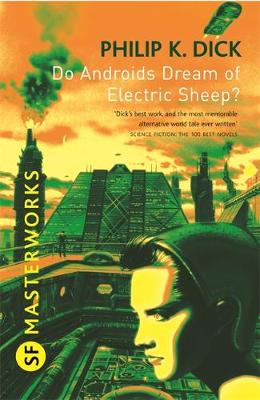
Rereading 'Do Androids Dream...?'

I decided to re-read Philip K. Dick's Do Androids Dream of Electric Sheep? (1968) because I could barely remember it (I remembered the basic plot and that Deckard climbs a hill at some point: the significance of this ascent eluded me). My younger self was amazed by the novel: I was only just starting to read avidly then, and it was my first PKD novel. I've read a lot since then (including 9 more PKD novels), and become a lot more critical of what I read.

From the opening paragraph I guessed that I wasn't going to be as impressed this time:

'A merry little surge of electricity piped by automatic alarm from the mood organ beside his bed awakened Rick Deckard. Surprised - it always surprised him to find himself awake without prior notice - he rose from the bed, stood up in his multicoloured pyjamas, and stretched. Now, in her bed, his wife Iran opened her gray, unmerry eyes, blinked, then groaned and shut her eyes again.'

However, I still enjoyed it and rate it highly as a PKD novel: it's not up there with A Scanner Darkly (1977) or VALIS (1981) - both of these are based on Dick's personal experiences, and so are far more personal and emotionally involving works - but I still consider it one of his best. If you can forgive the terrible prose, the ideas and plot make an engaging read.

PKD's work invites analysis and exegesis: his ideas and imagery are interesting and compelling, but suffer from often not being developed into entirely satisfying stories. Do Android's Dream...? is a very important and influential novel in the canon of stories exploring What is human? and What makes a fake fake? (other notable examples from this canon are R.U.R. (1920) by Karel Capek, the play from which we get the word 'robot', and Battlestar Galactica (2004-2009), etc). Fakery abounds in the novel: there's mood organs, which allow characters to artificially control their emotions; there's Deckard's electric sheep, munching grass on the rooftop; and, of course, there's the androids, the fake humans.

A comparison is made between the androids and the 'specials' (people who have been damaged by radiation exposure). The former - 'great intellect, ability to accomplish much, but also this [coldness]' - are hunted down as a danger to humanity, and are identified by failing an empathy test. The latter - fully empathic - are banned from reproducing or leaving Earth ('a menace to the pristine heredity of the race... ceased, in effect, to be part of mankind'), and are identified by failing genetic and IQ tests. The androids are getting so close to the real thing that the empathy test is the only remaining way to tell them apart, but it's implied early on that certain humans, psychopaths, could fail the empathy test, leading to their execution. The specials have been dehumanized by their society, perceived as having lost their humanity through radiation damage, but they have retained (perhaps even increased) their empathy. 

Mood organ allows people to alter their emotions artificially, yet this fakery is accepted and normal: why not the artificial emotions of the androids? Why not their fear, anger, and ambition? The artificial animals even look ill when they break (''disease' circuits built in... when a primary component misfired, the whole thing appeared - not broken - but organically ill'), and require as much care as real animals. When does the fake become reality? What traits make a human human? Is the distinction between real and fake simply part of our shared imagination, our human desire to categorize? What's so bad about the fakes? (I am reminded of art forgeries: specifically the tale of the Nazi who found out all his great art was forged, and was heartbroken - if anyone can remember the full details of this story, please help me out). Etc, etc, Dickian mindfuckery, analysis, exegesis, etc, etc. Fun book.

PKD's stories frequently contain religious themes: from the simple Platonic-Gnostic allusions in The Penultimate Truth (1964) through the spiritual conflict and shared hallucinations of The Three Stigmata of Palmer Eldritch (1965) we come to Mercerism and its conflict with the TV presenter Buster Friendly in Do Androids Dream...? From here Dick went on to invent a fictional theology in A Maze of Death (1970) and then went full gnostic after a mental breakdown/divine revelation in 1974, an experience explored in his VALIS trilogy: VALIS, The Divine Invasion (1981), and The Transmigration of Timothy Archer (1982).

(In The Penultimate Truth most humans live underground in nuclear bunkers, convinced by propaganda videos that a colossal war is occurring on the surface; but there is no war, the world is at peace: the ruling elite are working together to keep the masses controlled and afraid. The Three Stigmata... is about the rivalry between two companies selling rival escapist drugs: one which grants shared hallucinations between users, the other gives the user a private hallucination so vivid that it cannot be distinguished from reality.)

Mercerism is a religion of the shared experience of suffering: it enhances empathy, making its adherents more concerned about their fellow men. Buster Friendly and His Friendly Friends provide simple entertainment and distraction, giving the sad people of Earth the illusion of friendship and warmth. The dualism here is an improved subtilised version of the earlier spiritual conflict in The Three Stigmata..., and does not take center-stage in the plot. (It was completely omitted from the film adaptation.)

The plot is fairly well sustained to the end: it is ambiguous on some fronts, but satisfying enough overall: the protagonist has developed, his life and world has changed, etc. I have a tendency to dislike Dick's endings: Ubik (1969), A Maze of Death, and Flow My Tears, The Policeman Said (1974) each have annoying endings. The first two can be forgiven: they have been very influential, have been absorbed into SF to such an extent that the originals can feel tacky. Flow My Tears..., however, I will not forgive: it starts off so promising, the plot-train gliding along at a pleasant pace; then parts start to fall off and are left behind; it rattles and shakes, suggesting hasty ill-planned construction; and then derails, smashing into the ground. As you crawl out from the flaming wreckage and look upon the ruined carriages that promised a fascinating destination, you regret boarding in the first place.

Sunday, 22 May 2016

Four Christopher Priest Novels

After owning a copy for over 3 years, and meeting the author 3 times, I have finally got round to reading The Prestige (1995). It is the fourth Priest novel I have read, following The Affirmation (1981), Inverted World (1974), and Fugue for a Darkening Island (1972) - I read these three way back in 2012, so they are not quite fresh in my mind.

Fake cover, featuring Escher's Drawing Hands
The Affirmation was my first Priest novel, and it remains my favourite. Drawing Hands by M.C. Escher would be a perfect cover image for this novel which contains two parallel stories: one set in 'our' world, the other set in a 'fictional' world. Both protagonists attempt, for differing reasons, to write autobiographies, but end up retelling their life stories in a fictional setting. The two autobiographies/fantasies blend in to each other, and the reader is left wondering which world is supposed to be 'real'. It's a very clever, very artistic mindfuck of a novel. Priest describes it as his 'key' novel: when his writing became obviously unique, Priestian, with its unreliable narrator(s) and narrative shocks.

'This is the book CP regards as his ‘key’ novel: all the novels before it lead towards The Affirmation, none of the ones that follow could have been written without it. It is deceptive in form, not only in the way the protagonist’s story is told, but also in the way it is presented.' (source)


Inverted World is the best of Priest's pre-Affirmation novels, when his work still resembled traditional SF, and has one of the most famous opening lines in all SF:


'I had reached the age of six hundred and fifty miles.'

The characters of Inverted World live in an ever-moving city, fleeing from a destructive gravitational field. In front of the city engineers are constantly placing railway tracks; behind, the old tracks are being pulled up. The protagonist, Helward Mann, comes of age and joins one of city's guilds. Through him we learn about the city and the wider world. Some of the imagery of Inverted World is quite trippy and psychedelic. I remember the second half not being as satisfying as the first, but it is still a very good book and certainly worth reading.


Fugue for a Darkening Island is one of Priest's lesser known works. Events since its publication have made the work appear more sinister than was intended. When first published it received praise for being progressive and anti-racist, but when re-released and re-reviewed a few decades later the same magazines considered it very backwards and racist. The description on Wikipedia certainly makes it sounds like a Daily Mail nightmare:


'First published in 1972, it deals with a man's struggle to protect his family and himself in a near future England ravaged by civil war brought about by the failings of a Conservative government and a massive influx of African refugees.'

Fugue focuses on the changes to the protagonist's character over the course of the disaster by telling the story achronologically. The narrative jumps around between time periods to show us the different 'versions' of the character, contrasting their different perspectives. This novel does not compare well against the other Priest novels I've read: it's a very early work, his second novel, from when he was just starting out as a writer.

And then we come, over 3 years later, to The Prestige, which was made into a film by Christopher Nolan and is therefore Priest's most famous novel.

(Spoiler for the movie ahead)

The action takes place in two time periods: the majority of the book tells the story of a rivalry between two Victorian stage magicians, while the frame-story, narrated by the magicians' grandchildren, explores the legacy of the feud to the present day. This novel is obsessed with doubles, and the very structure of the novel reflects this: each time period gets two narrators, each telling their side of the story.

The book is very different to the movie, which builds up to a Big Reveal where the magicians explain their secrets to each other. A magician never reveals his secrets: there is no Big Reveal in the book. 

I'm getting tired, and feel if I write any more about The Prestige I may spoil some of the differences between the book and the movie, or spoil too much of the movie, so I'm going to leave it there. It's a very well constructed novel, still packed with surprises for those who have seen Nolan's adaptation. 

I own copies of 3 more Priest books, which I've already owned for over 3 years: The Dream Archipelago (1999), The Separation (2002), and The Islanders (2011). I wonder how long before get round to reading these.

Wednesday, 18 May 2016

'The Continuous Katherine Mortenhoe' by D.G. Compton

I have not had much luck with my SF Masterworks reading recently. Synners (1991) by Pat Cadigan, The Sea and Summer (1987) by George Turner, Floating Worlds (1976) by Cecelia Holland, and Unquenchable Fire (1988) by Rachel Pollack were all so boring that I gave up on them. Babel-17 (1966) by Samuel R. Delany, A Maze of Death (1970) by Philip K. Dick, The Fountains of Paradise (1979) by Arthur C. Clarke, and Cat's Cradle (1963) by Kurt Vonnegut were each entertaining but to varying degrees disappointing. I have read better books by Clarke, Dick, and Vonnegut.

The Continuous Katherine Mortenhoe (1973) by D.G. Compton is the best SF Masterwork I've read in months.

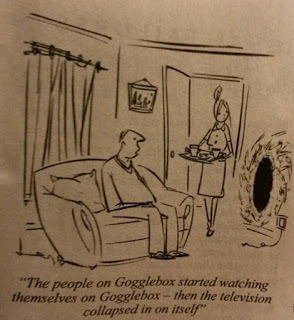
Reality TV is very popular these days. We can, if so inclined, choose to watch real people: competing over performance skills (The X Factor, Britain's Got Talent, etc), being affluent housewives (The Real Housewives of Cheshire, etc), working in a kitchen (Jamie's Kitchen, Kitchen Nightmares, etc), working in a tattoo shop (Miami Ink, etc), driving on icy roads (Ice Road Truckers, etc), coping with teenage pregnancy and motherhood (16 and Pregnant, Teen Mom, etc), buying and selling antiques (Bargain Hunt, etc), being affluent youngsters (Made in Chelsea, etc), going on dates (First Dates, The Undateables, etc), cleaning houses (How Clean Is Your House?, Obsessive Compulsive Cleaners, etc), being poor (Benefits Britain, Benefits Street, Skint, etc), sharing a house (Big Brother), being in an airport and or on a plane (Airport, Airline, etc), buying and selling houses (Location, Location, Location, etc), being in hospital (24 Hours in A&E, etc), losing weight (The Biggest Loser, etc), or coping with medical problems (Embarrassing Bodies, etc). If that's all too exciting for us, we can instead watch people watching TV (Gogglebox).

From Private Eye 1406
I don't watch much TV; I don't have a TV license; I use DVDs, Netflix, 4OD, and BBC iPlayer if there's something I really want to watch. I had to use Wikipedia's lists of reality TV shows to research the above paragraph.

Back in the 70s, when Compton was writing The Continuous Katherine Mortenhoe, reality TV was only just appearing with a few experimental shows. These had a powerful effect on the popular imagination of the time, inspiring a range of SF writers, such as Compton.

In Katherine Mortenhoe's world, medical science has cured most illnesses, so most people die of old age or serious injuries (such as car crashes). Terminal illnesses are rare anomalies, and there's money to be made in filming rare anomalies and selling it to the public. Katherine is diagnosed with a terminal illness at the age of 44, giving her only 28 days to live, and must make tough choices about what to do with her remaining days, knowing that her privacy will be destroyed. It's quite a bleak book.

Compton writes well, and - to make a good point about the fake reality of reality TV - switches between third and first person narration: Katherine's story is narrated in the third person, telling us her actions but little of her thoughts; Roddie - 'The Man with the TV Eyes', a reporter with cameras in his eyes - narrates in the first person, giving his thoughts and his interpretation of Katherine's actions. Thus, Katherine's true character, her thoughts and goals, her inner life, are hidden from us: we have to figure it our for ourselves. The reader, like Roddie, like the viewers of reality TV, see only the external reality, missing out on all the inner complexity that makes people who they are. Our eyes may process the same images, but how we interpret them will differ.

'You see, beauty isn't in the eye of the beholder. Neither is compassion, or love, or even common human decency. They're not of the eye, but of the mind behind the eye.'

The story is gripping and well-written. The premise is brilliantly bleak. The main characters are well-rounded and memorable. The anti-TV message is one I can get behind. It is a very good book.

However, the novel's world is rather shallow: there are brief mentions of Privacy Laws (relating to when and where reporters can film), fringies (people who live on benefits on the fringes of society), Computabooks (computer-generated books), and various political protest marches occurring, but it is not explored in depth. We are given no clues as to what country, or how far in the future, the story is set. Beyond the TV Eyes, advanced medical science, and Computabooks, there is little to no mention of technological progress. This all dates the novel: with those few exceptions, our dystopian present looks far more futuristic than Mortenhoe's world. Perhaps the list of reality TV shows above demonstrates that our dystopian present is also more terrifying than Mortenhoe's world...

But this is not a book about a dystopian society, and should not be read as such. It is, and succeeds as, a story about a woman coming to terms with her imminent death, and a man trying to understand her. Recommended.

Wednesday, 28 October 2015

Gods and Spaceships: Religion in Science Fiction

Science fiction, at its best, explores human nature, our place in the cosmos, etc - life, the universe, and everything - in a way that rivals the myths of the traditional religions. As rationalism wore away at belief in gods, as science started illuminating the mysteries of the universe, as technology changed the world, something was needed to fill the humanity's need for myths. SF was one of the substitutes that arose. Mary Shelley's Frankenstein, arguably the first SF novel, is explicitly about humans having the power of gods: creating life. The myths of the old religions told of the past; SF gives us a mythology of the coming future. Like the best religious myths, the best SF stories last not because they are literally true (SF is awful at accurate prediction), but because they seem to awaken you to greater percipience of who we are, of what we have become, of where we were, of wherein we are hastening, etc.

I can easily see myself being deeply religious - in the traditional sense, of being a devout believer in a deity - had I been born earlier, or had my life gone in another direction. I find religion fascinating. I once loved science, but I was scienced out by the time I graduated from university. I still love science fiction. Observing SF writers and fans, I can't help but imagine them as prophets and adherents of of a modern pseudo-religion, with its own rituals, jargon, pilgrimages, canon disputes, divisions, etc.

Given the origins of SF as a substitute for religious myths, it is unsurprising that SF stories are often hostile towards the traditional religions. When SF author explore religious themes positively, they tend to be rather unorthodox in their conclusions.

Arthur C. Clake, the 'Prophet of the Space Age', described himself as an atheist 'fascinated by the concept of God'; he left very specific instructions for his funeral: "Absolutely no religious rites of any kind, relating to any religious faith, should be associated with my funeral." In his work, he often displayed contempt for religion:

The City and The Stars (1956) - my favourite of Clarke's novels - is set on a dried-up Earth one billion years in the future, where the last remnants of humanity live under a giant dome in the city of Diaspar. About halfway through, Clarke lets you know what he thinks about religion:

'Throughout the earlier part of its history, the human race had brought forth an endless succession of prophets, seers, messiahs, and evangelists who convinced themselves and their followers that to them alone were the secrets of the universe revealed. Some of them succeeded in establishing religions which survived for many generations and influenced billions of men; others were forgotten even before their deaths.

The rise of science, which with monotonous regularity refuted the cosmologies of the prophets and produced miracles which they could never match, eventually destroyed all these faiths. It did not destroy the awe, nor the reverence and humility, which all intelligent beings felt as they contemplated the stupendous universe in which they found themselves. What it did weaken, and finally obliterate, were the countless religions each of which claimed with unbelievable arrogance, that it was the sole repository of the truth and that its millions of rivals and predecessors were all mistaken.'
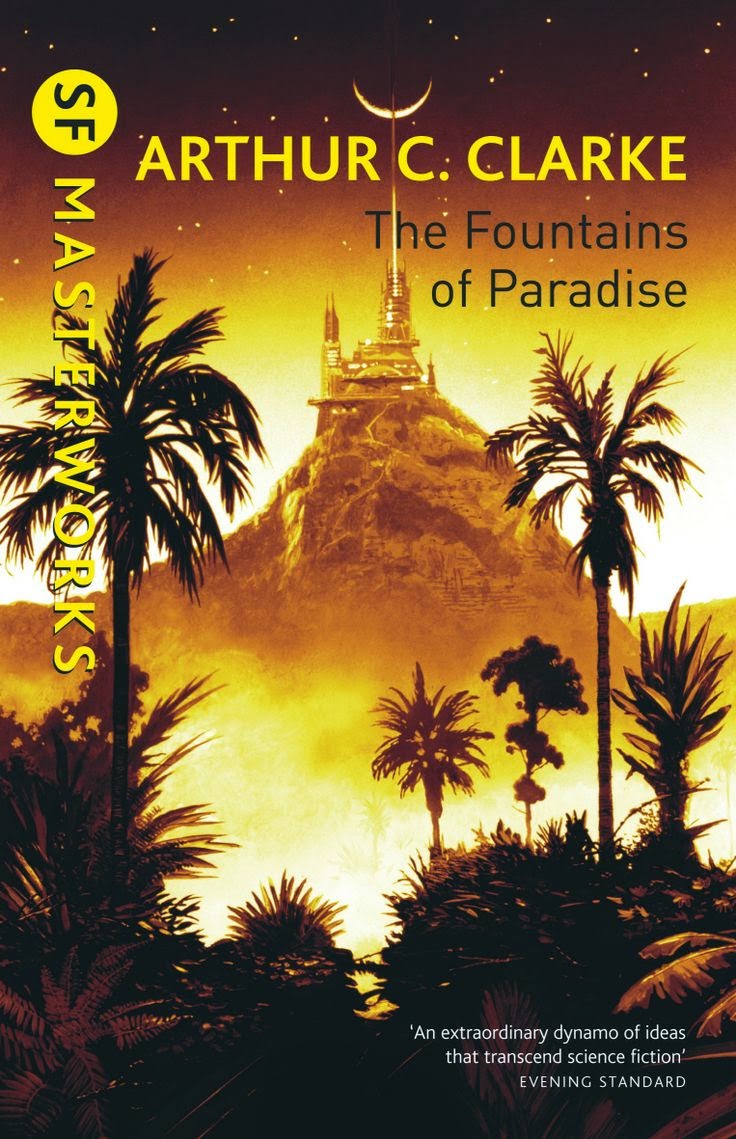
In his later novel The Fountains of Paradise (1979) Clarke is even more anti-religious. The novel's 22nd century hero demolishes an ancient monastery to build a space elevator: the old faiths are to be swept away to make room for the splendors of science:

'Already, it was the greatest wonder of the world. Until Morgan put his foot down and restricted the site to essential engineering staff, there was a continual flood of visitors - "pilgrims", someone had ironically called them - paying homage to the sacred mountain's last miracle.'

Just in case the reader is in any doubt about who the hero is, Clarke includes a small subplot about humanity's first encounter with an alien intelligence having a devastating effect on religion ('It had put an end to the billions of words of pious gibberish with which apparently intelligent men had addled their minds for centuries.'). After absorbing the entire Encyclopedia Terrae, the alien intelligence informs humanity that the 'God hypothesis' only arises among species with two-parent reproduction...

(Clarke also quotes Freud:

'While the different religions wrangle with one another as to which of them is in possession of the truth, in our view the truth of religion may be altogether disregarded... If one attempts to assign religion its place in man's evolution, it seems not so much to be a lasting acquisition, as a parallel to the neurosis  which the civilized individual must pass through on his way from childhood to maturity.' )

... And proceeds to demolish it in the manner of Dawkins, Grayling, or Hitchens:

'The hypothesis you refer to as God, though not disprovable by logic alone, is unnecessary for the following reason.
If you assume that the universe can be quote explained unquote as the creation of an entity known as God, he must obviously be of a higher degree of organisation than his product. Thus you have more than doubled the size of the original problem, and have taken the first step on a diverging infinite regress. William of Ockham pointed out as recently as your fourteenth century that entities should not be multiplied unnecessarily. I cannot therefore understand why this debate continues.'

But TFOP also features a scientist character who says "Now that Starglider has effectively destroyed all traditional religions, we can at last pay serious attention to the concept of God".

Clarke named Olaf Stapledon as his biggest influence. Stapledon's Star Maker (1937) is perhaps the ultimate science fiction novel dealing with religious themes. The narrator astral projects into space and travels across the entire history of the universe, witnessing civilizations rise and fall, culminating in a meeting with the titular Star Maker, the creator of the universe, God. In an early draft of Star Maker, posthumously published as Nebula Maker (1976), Stapledon referred to the maker as God throughout: I expect, in the later drafts, he decided against this in order to distance himself from the traditional religions.


Stapledon advocated 'agnostic mysticism': he found theistic religion too obviously false, but scientific materialism did not satisfy his religious yearnings. If you find yourself torn between skepticism and mysticism, as I do, then reading Star Maker might be, like it was for me, a conversionary religious experience - turning me into a Stapledonian evangelist, going on about Star Maker until my friends were sick of it.

'Overhead, obscurity unveiled a star. One tremulous arrow of light, projected how many thousands of years ago, now stung my nerves with vision, and my heart with fear. For in such a universe as this what significance could there be in our fortuitous, our frail, our evanescent community?

But now irrationally I was seized with a strange worship, not, surely of the star, that mere furnace which mere distance falsely sanctified, but of something other, which the dire contrast of the star and us signified to the heart. Yet what, what could thus be signified? Intellect, peering beyond the star, discovered no Star Maker, but only darkness; no Love, no Power even, but only Nothing. And yet the heart praised.'

Star Maker is perhaps the most ambitious book you will ever read: billions of years of universal history condensed into less than 300 pages. Stapledon shows you things that you would never have imagined yourself: that is his power.

"Judged by the standards of the novel, it is remarkably bad. In fact, it is no novel at all," Stapledon admitted in his preface to the first edition. This is no character driven plotted story, it is a tour of the universe, a sacred pilgrimage through time and space:

'The sustaining motive of our pilgrimage had been the hunger which formerly drove men on Earth in search of God. Yes, we had one and all left our native planets in order to discover whether, regarding the cosmos as a whole, the spirit which we all in our hearts obscurely knew and haltingly prized, the spirit which on Earth we sometimes call humane, was Lord of the Universe, or outlaw; almighty, or crucified. And now it was becoming clear to us that if the cosmos had any lord at all, he was not that spirit but some other, whose purpose in creating the endless fountain of worlds was not fatherly toward the beings that he had made, but alien, inhuman, dark.

Yet while we felt dismay, we felt also increasingly the hunger to see and to face fearlessly whatever spirit was indeed the spirit of this cosmos. For as we pursued our pilgrimage, passing again and again from tragedy to farce, from farce to glory, from glory often to final tragedy, we felt increasingly the sense that some terrible, some holy, yet at the same time unimaginably outrageous and lethal, secret lay just beyond our reach. Again and again we were torn between horror and fascination, between moral rage against the universe (or the Star Maker) and unreasonable worship.

This same conflict was to be observed in all those worlds that were of our own mental stature. Observing these worlds and the phases of their past growth, and groping as best we might toward the next plane of spiritual development, we came at last to see plainly the first stages of any world's pilgrimage. Even in the most primitive ages of every normal intelligent world there existed in some minds the impulse to seek and to praise some universal thing. At first this impulse was confused with the craving for protection by some mighty power. Inevitably the beings theorized that the admired thing must be Power, and that worship was mere propitiation. Thus they came to conceive the almighty tyrant of the universe, with themselves as his favored children. But in time it became clear to their prophets that mere Power was not what the praiseful heart adored. Then theory enthroned Wisdom, or Law, or Righteousness. And after an age of obedience to some phantom lawgiver, or to divine legality itself, the beings found that these concepts too were inadequate to describe the indescribable glory that the heart confronted in all things, and mutely prized in all things.'

One of the worlds visited is the 'Other Earth', whose inhabitants are basically weird-looking humans with poor vision and hearing ('Music, such as we know, never developed in this world.'), but enhanced scent and taste ('These beings tasted not only with their mouths, but with their moist black hands and with their feet. Thus they were afforded an extraordinarily rich and intimate experience of their planet.') This, of course, means that their cultures place greater emphasis on scent and taste than ours do, and so with their theology:

'Tribal gods had of course been endowed with the taste-characters most moving to the tribe's own members. Later, when monotheisms arose, descriptions of God's power, his wisdom, his justice,
his benevolence, were accompanied by descriptions of his taste. In mystical literature God was often likened to an ancient and mellow wine; and some reports of religious experience suggested that this gustatory-ecstasy was in many ways akin to the reverent zest of our own wine-tasters, savoring some rare vintage.

Unfortunately, owing to the diversity of gustatory human types, there had seldom been any widespread agreement as to the taste of God. Religious wars had been waged to decide whether he was in the main sweet or salt, or whether his preponderant flavor was one of the many gustatory characters which my own race cannot conceive. Some teachers insisted that only the feet could taste him, others only the hands or the mouth, others that he could be experienced only in the subtle complex of gustatory flavors known as the immaculate union, which was a sensual, and mainly sexual, ecstasy induced by contemplation of intercourse with the deity.

Other teachers declared that, though God was indeed tasty, it was not through any bodily instrument but to the naked spirit that his essence was revealed; and that his was a flavor more subtle and delicious than the flavor of the beloved, since it included all that was most fragrant and spiritual in man, and infinitely more. Some went so far as to declare that God should be thought of not as a person at all but as actually being this flavor...

Though all were devout, and blasphemy was regarded with horror, the general attitude to the deity was one of blasphemous commercialism. Men assumed that the flavor of deity could be bought for all eternity with money or with ritual. Further, the God whom they worshiped with the superb and heart-searching language of an earlier age was now conceived either as a just but jealous employer or as an indulgent parent, or else as sheer physical energy. The crowning vulgarity was the conviction that in no earlier age had religion been so widespread and so enlightened. It was almost universally agreed that the profound teachings of the prophetic era were only now being understood in the sense in which they had originally been intended by the prophets themselves.'

As you can see, Stapledon uses the Other Earth to critique Our Earth. Stapledon's descriptions of the Star Maker bring to mind the apophatic theology of Pseudo-Dionysius the Areopagite, who wrote that God was so ineffable that all descriptions of God must be negative. God is not great, God is not love, God is not truth, God is not power, God is not life, God is not divine. We cannot even say that God 'exists', because our experience of existence is based solely on individual, finite beings whose mode of being bears no relation to being itself. God is not one of the things that are; God is all things in everything and nothing in anything:

'I was indeed confronted by the Star Maker, but the Star Maker was now revealed as more than the creative and therefore finite spirit. He now appeared as the eternal and perfect spirit which comprises all things and all times, and contemplates timelessly the infinitely diverse host which it comprises. The illumination which flooded in on me and struck me down to blind worship was a glimmer, so it seemed to me, of the eternal spirit's own all-penetrating experience. 

It was with anguish and horror, and yet with acquiescence, even with praise, that I felt or seemed to feel something of the eternal spirit's temper as it apprehended in one intuitive and timeless vision all our lives. Here was no pity, no proffer of salvation, no kindly aid. Or here were all pity and all love, but mastered by a frosty ecstasy. Our broken lives, our loves, our follies, our betrayals, our forlorn and gallant defenses, were one and all calmly anatomized, assessed, and placed. True, they were one and all lived through with complete understanding, with insight and full sympathy, even with passion. But sympathy was not ultimate in the temper of the eternal spirit; contemplation was. Love was not absolute; contemplation was. And though there was love, there was also hate comprised within the spirit's temper, for there was cruel delight in the contemplation of every horror, and glee in the downfall of the virtuous. All passions, it seemed, were comprised within the spirit's temper; but mastered, icily gripped within the cold, clear, crystal ecstasy of contemplation.

But this was not the worst. For in saying that the spirit's temper was contemplation, I imputed to it a finite human experience, and an emotion; thereby comforting myself, even though with cold comfort. But in truth the eternal spirit was ineffable. Nothing whatever could be truly said about it. Even to name it "spirit" was perhaps to say more than was justified. Yet to deny it that name would be no less mistaken; for whatever it was, it was more, not less, than spirit, more, not less, than any possible human meaning of that word. And from the human level, even from the level of a cosmical mind, this "more," obscurely and agonizingly glimpsed, was a dread mystery, compelling adoration.'

C.S. Lewis called Star Maker 'sheer devil worship', and wrote an entire trilogy of SF novels in response. Lewis was getting annoyed that space stories were generally anti-religious:

'I like the whole interplanetary ideas as a mythology and simply wished to conquer for my own (Christian) point of view what has always hitherto been used by the opposite side.'

- Lewis, in a letter to Roger Lancelyn Green

I have not yet ready any of the Space Trilogy: Out of the Silent Planet (1938), Perelandra (1943), and That Hideous Strength (1945). I am interested in Lewis' take on Christian SF, but have forbidden myself from purchasing any more books until my current to-read pile has been exhausted. 

It is worth pointing out that, despite his hostility towards religion, Stapledon accepted that Christianity was a positive force for a lot of people. The first encounter of Four Encounters (1976), 'A Christian', ends with Stapledon deciding not to argue back:

'I was preparing to do battle against his proselytizing, and to conquer his faith. But his eyes checked me. For his Christ had indeed saved him from his self-loving despair; and without his Christ he might be lost. In his present state of partial waking (so I told myself, perhaps complacently) he could not endure the severer vision.

So I said, "You have been very good to me, and very patient. But the upshot is that your way is not mine. You need belief; for me it is unnecessary. Without it I travel lighter, yes and perhaps farther. Strangely, in my unbelief I gain full peace, the peace that passes understanding. And joy too. I have found joy in the sheer given reality, with all its dark-bright beauty. Light has come to you in one way, to me in another. And though you have not won me, I am grateful to you. Let neither of us grudge the other his vision."

He was silent for some time. Then in a low voice he said, "I think you do not fully know what suffering is, and the illumination that it brings. May God take all joy from you, may he torment you as he tormented me, so that at last your eyes may be opened, and the true light may save you."'

I consider that a rather dickish response from the Christian, but that's me.

From one unconventional encounter with the divine to another: VALIS (1981) by Philip K. Dick. Starting in 1974, Dick underwent a period of revelation/mental breakdown, during which he thought that God, or an artificial intelligence from the future, was sending him messages using a beam of pink light. VALIS is a third-person fictionalized account of this period, with the Dick character being called Horselover Fat. As Dick/Fat tried to make sense of his experiences, he found the usual view of God - the all-knowing, all-powerful, all-seeing king of the universe - unsatisfying:

'You cannot say that an encounter with God is to mental illness what death is to cancer: the logical outcome of a deteriorating illness process. The technical term - theological technical term, not psychiatric - is theophany. A theophany consists of a self-disclosure from the divine. It does not consist of something the percipient does; it consists of something the divine - the God or gods, the higher power - does. How are we to distinguish a genuine theophany from a mere hallucination on the part of the percipient?
...
If you grant the possibility of a divine entity, you cannot deny it the power of self-disclosure; obviously any entity or being worthy of the term 'god' would possess, without effort, that ability. The real question (as I see it) is not, Why theophanies? but, Why aren't there more? The key concept to account for this is the idea of the deus absconditus, the hidden, concealed, secret or unknown god.... if God exists, he must be a deus absconditus - with the exception of his rare theophanies, or else he does not exist at all. The latter view makes more sense, except for the theophanies, rare though they be. All that is required is one absolutely verified theophany and the latter view is voided... The vividness of the impression which a supposed theophany makes on the percipient is no proof of authenticity.'

And was irritated by the hypocrisy of the traditional religions:

'It took hours to find the citation in Luke; finally he had it, to set before Sherri.
"I'll ask Larry if that's one of the corrupt parts of the Bible," Sherri said.
Pissed off, Fat said, "Sherri, why don't you cut out all the sections of the Bible you agree with and paste them together? And not have to deal with the rest."'

Dick wrote hundred of thousands of words of exegesis, theorizing about the nature of God, developing his own cosmology. He moved further away from traditional views of God towards Gnosticism, and further into madness. Entry #51 from his exegesis:

'#51. The primordial source of all religions lies with the ancestors of the Dogon tribe, who got their cosmogony and cosmology directly from the three-eyed invaders who visited long ago. The three-eyed invaders are mute and deaf and telepathic, could not breathe in our atmosphere, had the elongated misshapen skull of Ikhnaton and emanated from a planet in the star-system Sirius. Although they had no hands but had, instead, pincer claws such as a crab has, they were great builders. They covertly influence our history towards a fruitful end.

By now Fat had totally lost touch with reality.'

There are several competing theories about when and how Gnosticism originated. Some argue that it is pre-Christian, having its roots in ancient shamanism, others argue that it began with Christianity. In Christianity's early years, there was no established canon, literacy rates were low, and the Gentile Christians - often from poor backgrounds - had almost no knowledge of the Jewish scriptures that their beliefs were supposed to be continuing. When some early Christians got round to reading the Hebrew scriptures, they were very confused. Why was the loving God of love, as represented by Jesus, being such a prick? Why was he advocating and committing genocide? Why had he not fixed the world, if he was supposedly all-powerful? Why was there so much evil in the world? Gnostic Christians resolved these gaping plot chasms in what became mainstream Christianity. The true God was immaterial and had no power over the material world. During the creation of the material world, the true God was broken, with parts of God being imprisoned in material bodies. The material world is ruled over by an insane false god who believes that he is the One True God. The true, immaterial God is in conflict with material creator, trying to be re-united with the God-fragments trapped in material bodies. It's a fun mythology.

Dick explored Gnosticism in two further novels (which I haven't read): The Divine Invasion (1980) and The Transmigration of Timothy Archer (1981). An earlier novel, A Maze of Death (1970), is set in a future with an entirely fictional theology. Dick's words:

'The theology in this novel is not an analogue of any known religion. It stems from an attempt made by William Sarill and myself to develop an abstract, logical system of religious thought, based on the arbitrary postulate that God exists.'

This post is getting rather long. My theory is that SF, with notable exceptions, is anti-religious or advocates an unorthodox. Clarke thought that science would supplant religion, but found the idea of God fascinating. Stapledon thought orthodox theology was obviously false, but advocated an 'agnostic mysticism' with similarities to the apophatic theologies of Pseudo-Dionysius the Areopagite, Moses Maimonides, and other mystical theologians (apophatic theology is arguably more traditional than imagining God as an anthropomorphic divine dictator). Dick underwent a religious experience, gradually losing touch with reality, and arrived at a Gnostic theology which slammed together various religious traditions and SF ideas.

Hopefully I will write a sequel to this post. There are many other works I would like to look at to further explore this theory, for example:

  • The Christian SF novels of C.S. Lewis
  • The other two Gnostic novels of Philip K. Dick
  • A Canticle For Leibowitz (1960) by Walter M. Miller, about a Catholic monastery in a post-apocalyptic world
  • Behold The Man (1969) by Michael Moorcock, about a time-traveller who meets Jesus of Nazareth, and is very disappointed
  • The Handmaid's Tale (1985) by Margaret Atwood, about a totalitarian Christian theocracy in near-future America
  • Lord of Light (1967) by Roger Zelazny, about a human colony ruled by Hindu deities
  • Hard To Be A God (1964) by Arkady and Boris Strugatsky, about a human observing a primitive alien society, and struggling not to intervene to prevent suffering
  • Wandering Stars (1974) and More Wandering Stars (1981), anthologies of Jewish SF

And, of course, Jesus On Mars (1979) by Philip José Farmer: