Showing posts with label History. Show all posts

Tuesday, 10 October 2023

'Strange Rites' by Tara Isabella Burton

Of the books I read during my Religion Phase, 'The Case for God' by Karen Armstrong was one of my favourites. It was marketed as a rebuttal to the various New Atheist books in vogue at the time; the cover is similar to that for 'The God Delusion' by Richard Dawkins, but blue where Dawkins is red. I imagined the books battling each other to the sound of Star Wars' 'Duel of the Fates' whenever I left the room.

However, the book largely sidesteps, or indeed implicitly agrees with, many of the New Atheist arguments. Instead, via a potted history of religion and theology, mainly focused on the Judeo-Christian traditions, the book argues that religiosity is an incredibly important part of human nature, going far beyond the crude literalism attacked by the New Atheists, whose understanding of theology she derides as 'poor' but also 'not radical enough'. For Armstrong, supernatural entities are not the basis of religion: the search for transcendence is.

As much as I liked the book, I also found it frustrating because it was, ironically, not radical enough. A former nun, Armstrong's immersion in the traditional religions had left her oblivious to the various ways the religious behaviours she celebrates are expressed by the nominally irreligious. I wanted her to go further in exploring religiosity as human nature, but at the time I could find no book that delivered on what I wanted. I remember finding a conference on the subject, but being unable to attend due to my limited budget. George Steiner's 'Nostalgia for the Absolute' scratched the itch a bit, but it wasn't enough.

Eight years later, I've found the book I wanted: 'Strange Rites' by Tara Isabella Burton. I first heard about the book and its core argument via the BBC Sounds podcast 'The New Gurus', on which the author was a guest (the podcasts cover art also uses a similar stained-glass art-style to the book cover). 

Burton compares the World Wide Web to the printing press which was the essential catalyst behind the Protestant Reformation in Europe: those who disagreed with the established church could print and propagate their ideas, leading to Christianity fragmenting into many smaller sects. The World Wide Web is like a Super Printing Press, enabling everyone with access the ability to spread their own ideas, or find whatever beliefs suit them. Together with cultural shifts towards individualism, emphasizing the importance of the self and growing distrust of institutions, this has led to us living through a Super Reformation (or, to use Burton's more America-focused term, a new Great Awakening), in which an increasing number of people are 'religiously remixed', combining ancient and modern beliefs and practices in heavily individualised ways.

An early chapter establishes Burton's understanding of what religion is, based on the works of sociologists Emile Durkheim, Peter Berger, and Clifford Geertz. For Burton, religions fulfil four needs: meaning, purpose, community, and ritual.  

The grand narratives of religion provide an explanation as to why things are the way they are, imbuing reality with meaning and putting adherents lives into a wider context. Adherents are also given a role, a purpose, in the grand narrative, and asked to change their behaviour in various ways: personal decision-making, for even the small and mundane, is linked to and influenced by the universe-spanning narrative. Groups of adherents together form a community (physical or online), with all the psychological benefits that belonging to a community brings. Rituals help re-affirm the grand narrative, bind the community together, and mark the passage of time. 

A single religion in a person's life can cover all four needs, as historically was the norm, but modern individualism encourages a more 'pick and mix' approach to cover all the bases. For example, someone could pray to the Christian God on Sundays, practice meditation on Mondays, go to a Yoga class on Wednesdays, profess a belief in Karma, and make changes to their diet based on the perceived 'Vibrational Energy' of the food.  Religions have always influenced each other, sharing ideas and practices, or splintering into new sects, but the process is happening faster than ever before, in our Internet-connected globalised world. (I once knew someone who believed that Jesus went to India and learnt Yoga during the 'Missing Years' not covered by the Bible.)

The bulk of the book then explores various modern religions identified by the author: fandoms, with particular emphasis on the extremes of the Harry Potter fandom ('Snapewives'); Wellness culture, which utilises spiritual and religious practices to sell products and create a loyal customer base; modern Witchcraft; sexual subcultures; social justice activism; techno-utopianism; and the many regressive, atavistic online cultures from across the online 'Manosphere'. The chapters are engaging but somewhat superficial, giving an overview with varying amounts of depth, but paint a convincing picture of these subcultures as neo-religions.

There's an interesting comment in the chapter on social justice activism about how its opponents deride it as a religion, without realising how accurate they may be, and I would have preferred this to lead into a greater examination of the religious nature of political ideologies more generally. In popular parlance that nature is usually only identified by opponents: socialists and communists deride capitalism and neoliberalism as religions which put their faith in the Invisible Hand.

It's a relatively short book, so an easy criticism is that there is plenty more which could have been included, but I prefer a book to leave me broadly satisfied if eager for more, to one that overstays its welcome. I'm extremely happy to have got hold of this, and highly recommend it, especially if combined with the other titles mentioned at the start of this review.

Sunday, 3 September 2023

'Ultra-Processed People' by Chris van Tulleken

Over the past two years I've got into cooking using a bunch of cookbooks, which has massive changed my relationship to food and had a huge impact on my wellbeing. I now get so much joy from cooking and eating as multisensory experiences: the intermingling of sounds, smells, and textures. 

For Phase Two of my food journey, I've decided to learn more about food and the food industry, and this book, which has had a lot of buzz and marketing around it, seemed like a good place to start. The book builds on various other work van Tulleken has done exploring Ultra-Processed Food (UPF), including a podcast (which I listened to beforehand) and various TV documentaries.

The term UPF comes from a food classification system proposed in 2010, which divides food into four groups:

1) Unprocessed or minimally processed food (such as raw kitchen ingredients)

2) Processed culinary ingredients (such as butter, honey, oils, vinegar, etc)

3) Processed food (such as tinned vegetables or fruit, cured meats, etc)

4) Ultra-Processed Food

The full definition of UPF is quite long, but the key points are that UBF is designed to be convenient and highly profitable, and is made using chemical ingredients that would not be encountered in a domestic kitchen. There is acknowledgement in the book that the definition can get a bit woolly around the edges, and there is disagreement over its usefulness. I'm personally quite happy with this breakdown, particularly with the emphasis on profitability over nutrition as the food's raison d'etre: the food is designed to encourage overconsumption. 

I had previously found complaints about "processed foods" quite tedious, and was pleased that van Tulleken took time to explain that most foods require some form of processing to be edible. There is a good discussion about how cooking is part of being human: over the course of our evolution, humans have used fire to externalised part of our digestive system. We cook food to make it is easier for us to digest; or, we cook food to partially digest it before it reaches our mouths.

(I was reminded of the various vegetarian/vegan memes which argue that since we find raw meat disgusting, this is evidence that humans shouldn't eat meat. It's certainly evidence that we shouldn't eat raw meat.)

We have complex sensory apparatus to help us detect both when something is safe to eat, and the nutrients it may contain. The chapters which explore the various ways UPF tricks our bodies into wanting more of it ('Once you pop you can't stop!') are the most eye-opening. Tastes and textures prime our digestive and metabolic systems into expecting certain nutrients: if something tastes umami or meaty, our bodies prepare to digest food rich in protein; creamy textures prime us to digest fat; sweetness signals an incoming sugar boost.

UPF tricks our bodies by dissociating these sensory inputs from the promised nutrients, leaving our digestive system unsatisfied, our metabolic system confused, and us craving more food. So we reach for another crisp, and still feel hungry after a UPF meal with 1000 calories. Fibre, very important in signalling fullness, is also largely stripped from UPF during its manufacture. When your diet is largely UPF, it is very difficult to regulate your eating behaviour. The book opens with a warning that UPF now makes up 60% of the average diet in the UK.

In addition to making me think more about ingredients and UPF deceptions, I was particularly affected by descriptions of the microbiome: the microorganisms that live in our guts symbiotically with us. We provide them with nutrients; they help our digestion. Our body is the vehicle that transports them through space. I have often felt disconnected from my body due to my less than stellar coordination; I feel like my consciousness is a pilot awkwardly controlling a vehicle, rather than being one with it. Now I feel like I have a duty to keep my microbiome passengers safe (and in turn they won't make me ill). UPF additives harm the microbiome in various ways.

The book is written in a very chatty and light style that is easy to understand and read. There were times when I personally got frustrated that the book didn't go as in depth as I'd wanted, but I was pleased it did expand on the science presented in the podcast, and there are copious references for further reading.

The writing is occasionally stylistically conflicted. The author has clearly done a lot of reading about the topic, and often writes with authority; but at other times, he presents himself as an everyman going on a journey of discovery about the topic, interviewing various experts, in the style of the documentary TV and podcasts that preceded the book. This means that parts of the book feel like an urgent and in-depth investigation into a mounting crisis, whereas other parts feel more like light-hearted gonzo journalism (à la Jon Ronson). The transitions between these parts are often jarring.

As much as it is easy to read, there are also parts where it felt like van Tulleken struggled to balance the need to simplify for a lay audience with the desire to go more in depth with the science. This peaks with a particularly overly convoluted section explaining how our bodies utilise chemical energy from food via ATP; it is simultaneously extremely simplistic yet crammed with detail and similes which make it irritating when you know more about the topic (even if you're rusty like me), and largely incomprehensible if you don't. What's most irritating is that I don't think this sequence adds anything particularly useful to the book: it just shouldn't be there.

There are plenty of other things that could have been removed to make the book better. Mainly, footnotes. There are a lot of footnotes throughout, the contents of which should either have been incorporated into the body of the text or removed because they add little of value. Most of the footnotes felt like notes on a draft; combined with the stylistic shifts mentioned above, this made the book feel unfinished, in need of some more polishing and tidying.

Early chapters also have a tendency to imply that those working in the food industry are cackling cartoon villains. I know, because I've done it, how easy it is to imagine those you disagree with as simplistic villains (and, to be honest, there are a lot of people in the world who do talk like cartoon villains), but this tendency is often unhelpful since it does not help us to understand the incentives that drive their behaviour. I was pleased, however, that as the book approaches its end it does touch on a more nuanced and systemic critique of the food industry. 

To stop eating UPF, van Tulleken does not advise just quitting and going cold turkey. Instead, he recommends eating along but consciously thinking about the UPF as you eat it. How it is tricking your body, how it messes with your body, and as you do this you will develop a disgust response and learn to not want it. Shaming people to change their diet does not work - a subject covered extensively in the 'Addicted to Food' podcast and repeated in this book. Turning UPF into a taboo will give it the allure of the forbidden; you have to learn to not want it, and for many people on lower incomes, food that isn't UPF simply isn't affordable enough to eat regularly. Alleviating poverty is the path to improving people's diets and health. 

Despite my occasional irritations with the writing in this book, I did thoroughly enjoy it and found it revelatory. The information in this book is extremely important and I highly recommend it. It was a good choice to start with for Phase Two of my food journey. 

Next up, I have a couple of books about meat eating and the meat industry.

Saturday, 29 July 2023

'Fighting for Life' by Isabel Hardman

This year is the 75th anniversary of the NHS, so naturally a few books have been published to commemorate the occasion. Hardman's 'Fighting for Life' is a pop history of the institution, framed around 12 battles which shaped the NHS into what we have today. I would recommend it, with caveats, to those who work in or with the NHS, or use its services regularly. 

I found it an enlightening reading experience which helped me contextualise my working life into the story of the NHS. Hardman is a political journalist - her previous book, 'Why We Get The Wrong Politicians', is excellent and one I include in my canon of 'Books That Exacerbated My Disillusionment With British Politics' - but this means her NHS book is largely focused on the political personalities and arguments within government and parliament about NHS reforms. While I personally was engrossed (in another life I could imagine myself as a policy wonk), I imagine many people would find this political focus quite boring, especially if they don't go into the book with some pre-existing knowledge about UK politics.

The NHS is a political football; Hardman deftly shows the various ways all political parties have, often hypocritically, attacked each other over the NHS. She explores the realities and misunderstandings behind the fear, present since the inception of the service, that there is a secret plot to dismantle or privatise the NHS, and replace it with an American-style system. Like any good conspiracy theory, there are grains of truth to it: a small faction of the Conservative party does admire the American system, but are aware that going down that route in Britain would be political and electoral suicide on a truly colossal scale. 

Politicians are often frustrated that popular political discussions about healthcare in Britain are framed around, and therefore extremely limited by, the false dichotomy between the state-run NHS model and the American-style private hellscape, ignoring the myriad other ways that countries fund and manage their healthcare. Both Labour and Conservative governments have increased private sector involvement in the NHS and added charges, though Labour tends to get away with it because they are more trusted on the NHS.

Across the 12 battles, which range from early arguments over whether there should be an NHS and how it should be structured and funded, through many reforms and modernisations, to the COVID pandemic and the many crises that face the post-pandemic service, we learn about the origins of prescription charges and CQC inspections,; the uses and abuses of performance targets; why maternity units are particularly scandal-prone; the growth of the culture of cover-ups, bullying and blame; the many arguments between Health Secretaries and Chancellors over funding; and much, much, much more. 

The picture that emerges is of a vast, complex, bureaucratic system that is slow to change but has changed so much. A service which very few people even begin to understand, even as they claim to adore it. An institution that is extremely impressive and successful, but creaking, straining, and intensely suffering from deep seated problems exacerbated by recent systemic shocks. 

The final chapter ends with an attack on the shallowness of current NHS discourse, and a call for action for someone, or several someones, to actually do something about it:

'There has been enough lovebombing from politicians too fearful or lazy to confront the truth about the state of the service and what it needs. Now, it needs someone who knows what they are really fighting for. Depending on how well they fight, it could either be the latest or the last battle of the NHS's long struggle to exist'.

Monday, 7 November 2022

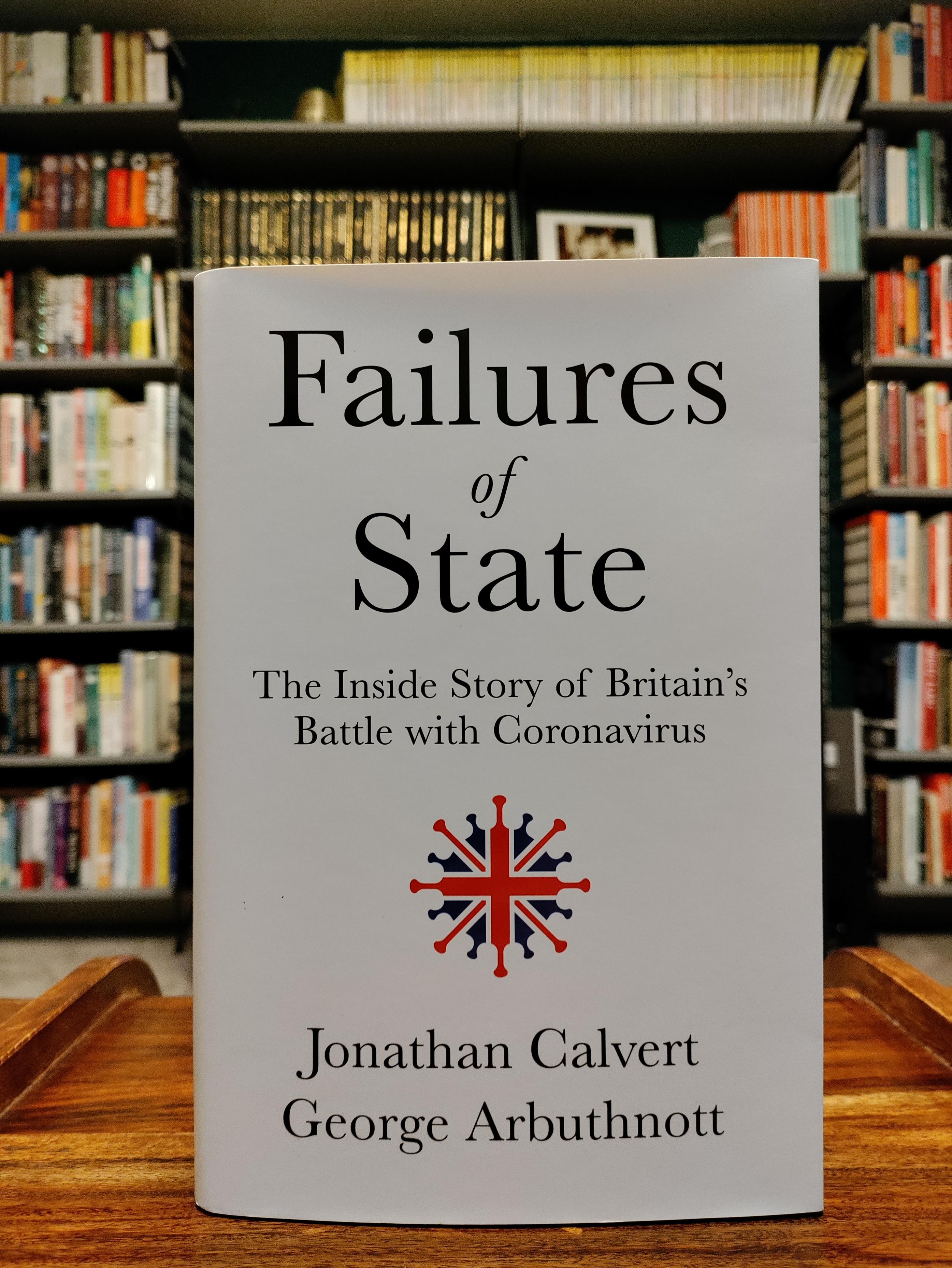
'Failures of State' by Jonathan Calvert and George Arbuthnott


Despite me not being completely ignorant of how bad the UK government's response to the pandemic was, I still found this book shocking. It is a relentless catalogue of bad decisions, made by a government both callous and incompetent. Working in a hospital through COVID, the book put some things I remembered into a wider context.

I remembered colleagues sharing photos of the PPE worn by healthcare staff in other countries, and comparing it to the flimsy aprons we were given. Public Health England downgraded the threat ranking of Covid-19, which meant that only basic PPE needed to be worn, according to health and safety laws, and this was a way of getting around the shortage of PPE caused by the pandemic stockpile being allowed to run down or expire over the austerity decade.

I remembered the mixed messages given about masks, and learnt that there was a government desire early on in the pandemic to minimise the effectiveness of masks to the public, because there were fears that masks might run out if everyone rushed out to get them. The government was trying to buy as many commercially available masks as possible for the NHS, because of the austerity-ravaged stockpile. This then, obviously, backfired later when masks were made mandatory.

What shocked me the most was how much the politicians rejected scientific advice, or never sought it. The scientific advisors first heard about Eat Out To Help Out on the day it was announced to the public. Same with the nonsensical tier system. The government announced many changes to restrictions without asking for any modelling work to estimate the impact on infections or the NHS.

I remember the 'I back Boris 100% he's doing his best in a bad situation' crowd on social media being roundly mocked at the time, but there was nevertheless a sizeable chunk of the population who were sympathetic towards the government, believing them to be doing their best, making tough decisions while following the best scientific advice available. Unfortunately, that is a poisonous fiction.

The UK Covid-19 Inquiry will be the Johnson administration's Chilcott, and hopefully its outcome will have actual consequences for those whose terrible decisions led to tens of thousands of avoidable deaths.

I do recommend this book a lot. I learnt a lot from it, and it has made me even more disillusioned with our political system. 

In a just country, Matt Hancock would at least be a disgraced ex-politician, not a pseudo-celebrity joining a reality TV show while trying to flog a book. In a just country, Rishi Sunak would never have become Prime Minister, and even the thought of Boris Johnson returning as PM would have been anathema to all of the political class. Alas, that is not the country we live in.

Sunday, 4 July 2021

'Red Famine' by Anne Applebaum

My grandparents came from Ukraine, arriving in Britain after WW2. I went to Ukrainian school on Saturdays until I was 12, though I hated it: I was consistently the worst in my class, by a huge margin, largely because outside of Ukrainian school I would not be speaking Ukrainian, while many of the other children would be speaking Ukrainian a lot at home with their parents. I felt like my Saturdays were being wasted on a humiliating and dispiriting chore which made me feel stupid (the impatience of the teachers at my struggling didn’t help). I was overjoyed when I was finally able to stop going.

(I credit the disparity between doing well at English school and doing poorly at Ukrainian to in some part to making me less arrogant than I may otherwise have been, and more able to empathize with those who struggled to understand things that came quite easily to me.)


On the odd occasions when we went to church, the services were in Ukrainian, and so I had no idea what the priest was talking about, and it felt like we were just arbitrarily standing up and sitting down. It all felt very confusing and pointless.

Consequently, I have generally felt quite disconnected from my Ukrainian heritage; it has basically been reduced to it being a fun fact about the origin of my surname. I have never been to Ukraine, don’t know much about it, and “Ukrainianness” became a very, very, very small part of my identity as I grew up. I can read Cyrillic, and I know some words and phrases, but I never got more than an extremely basic grasp of the language – and that has since faded. I celebrate Ukrainian Christmas and occasionally eat verenyky (potato dumplings), and that’s about it – other than a lingering sense that I should know about Ukraine, its history and culture.

My grandparents didn’t talk much about their experiences before coming to Britain. I know they were peasants in Ukraine, and that some relatives had died in the Holodomor, the Soviet famine in Ukraine in the 1930s. After the Nazis conquered Ukraine in WW2, my grandparents were moved to Germany as forced labourers, and ended up in an area controlled by Britain when the war ended. Britain was in ruins and had a significant labour shortage – a large proportion of its working age people had died in the war – so workers were being imported. And so my grandparents came to Britain.

Anne Applebaum’s ‘Red Famine’ was a revelatory book for me, putting my upbringing and what little I know of my family history into a proper context.

Soviet terror in Ukraine was especially brutal; the Communist Party believed that a successful nationalist, separatist movement in Ukraine would precipitate the collapse of the USSR, and therefore it must absolutely be crushed. The Ukrainian language was suppressed, Ukrainian churches destroyed, village dancing banned. The Soviets wanted to wipe out Ukrainian culture to destroy the national movement and with it the threat of separatism; the old backward peasant culture would be replaced with a new Soviet culture that wouldn’t threaten the bloc’s stability.

Ukraine is an extremely fertile country, but a series of decisions by the Communist party meant that very little food was produced 1931-33, and most of what was produced was seized and exported to Russia or abroad: Moscow needed money, and wanted to have large food exports to show the West how successful communism was. The severity of the famine was denied and downplayed, and efforts at famine relief were blocked. The peasantry that were dying, the communists told themselves, were counter-revolutionaries who deserved their fate.

Applebaum’s chapters on the peak of the famine are very hard-hitting. She blends the overarching narrative of the huge, widespread Terror-Famine, which is difficult to comprehend in its scale and callousness, with witness testimonies which bring it down to a brutal, understandable human level of everyday horror in the famine years, when bodies littered the streets and people resorted to cannibalism.

Allegedly, it was Stalin, referring to the famine in Ukraine, who said, “If only one man dies of hunger, that is a tragedy. If millions die, that’s only statistics.” Applebaum ensures that you do not lose sight of all the manifold individual tragedies that occurred in Ukraine during the famine, which is a difficult thing to achieve when talking about deaths and horror at such scale.

It is no wonder my grandparents did not talk much about their lives before they came to Britain.

Friday, 26 March 2021

'The Prince' by Machiavelli


So, I read Machiavelli (1469-1527).

Through real politicians and fictional villains, Machiavelli's influence on culture is huge. This is a fascinating little book, more nuanced than I expected from Machiavillian pop culture villains, but still a rather bleak book of realpolitik.

'Many writers have dreamed up republics and kingdoms that bear no resemblance to experience and never existed in reality; there is such a gap between how people actually live and how they ought to live that anyone who declines to behave as people do, in order to behave as they should, is schooling himself for catastrophe: if you always want to play the good man in a world where most people are not good, you'll end up badly.'

There are a number of passages that resonate with contemporary debates over fiscal policy. Machiavelli recommends tax cuts rather than public spending: tax cuts can make you appear generous to those you are taking less from, while those that receive less from you as a result are a minority who's goodwill can be sacrificed to boost your popularity among those benefitting from the tax cuts.

You can't please everyone.

'If a ruler can't avoid hatred altogether, he must try to avoid the hatred of the country as a whole, and when that proves impossible he must do everything he can to escape the hatred of the classes that wield the most power.'

And don't forget that we want to reward hard work and aspiration: 'A ruler must show that he admires achievement in others... he should reassure his subjects that they can go about their business without worrying that if they increase their wealth they'll be in danger of having it taken away from them, or that if they start up a business they'll be punitively taxed.'

This Penguin edition has an excellent introduction that puts the book in historical context, and a surprisingly fascinating discussion on the difficulties of translating the work into contemporary English.

Saturday, 14 September 2019

'A History of Modern Britain' by Andrew Marr


This will probably be the thickest book I read this year.

Similar to my experience reading 'Cameron at 10' last year, learning about modern British history made me feel like I was at that bit of an SFF novel where a character learns about the background of their world and how the current crises have come about. Britain's confused relationships with America and continental Europe are a major thread throughout our post-WW2 history.

Major catastrophes such as the Second World War cause major changes: class barriers had been broken down as people from all backgrounds came to together to either fight and die as soldiers, or worked together on the home front. The different classes began to understand their differences were mainly material, and there was greater awareness of poverty and a desire to do something about it. Government wartime control of health, transport, food (the diets of a lot of poor people actually improved during the war years - the meager rations they received were more food than they could have afforded before the war), and other industries, combined with the wartime ideals of Britons all working together to help each other out and fight a common enemy, was like a trial run for socialism.

And so, after the war, there was landslide victory for Attlee's Labour party, who had campaigned along the lines of (I'm paraphrasing), "Let's use state planning, which helped us win the fight against fascism, to win the fight against poverty and illness."

The Attlee government created the NHS and massively expanded the welfare state, causing a huge increase in living standards across the country. It is a shame such a government would probably not have been elected if it weren't for the horrors of World War 2. 

(The First World War had a similar effect: in its immediate aftermath, the government extended suffrage and embarked on a huge social housing policy, to make the country "fit for heroes who had won the war" - without these policies, many of the soldiers would have returned from the war to live in slums and been unable to vote for their government.)

Reading about how the Attlee government was made possible by WW2, I now understand (and further abhor) the 'Lexit' argument that did the rounds a bit back in 2016: the Left should vote for Brexit because it will be a disaster that would force the country to come together in crisis, and make a leftwing government more likely as a result. Even among those ostensibly on the right, those that think No-Deal Brexit would be a disaster in the short term seem to think the cost is worth it if in the longer term the country is brought together through hardship. How often is the Blitz and WW2 mentioned in discussions of Brexit? We survived the Blitz, we can survive Brexit! Brexit will be tough, but it'll bring some wartime spirit to the country and bring us together!

Are the people craving Brexit and the (idealised) wartime spirit really craving a socialist government, without realizing it or wanting to realize it?

Britain was triumphant in WW2, but it was ruined economically and literally. Post-war governments were not honest with the electorate about how weak the country was after war: they had a "don't talk about it in front of the children/voters" approach. They didn't want to ruin the triumphant, positive mood winning the war had instilled in the populace. The crumbling British Empire was no longer a superpower, and was dependent on American aid for years after the war. To keep the aid coming, Britain became the more subservient partner in the "special relationship".

Having defeated an extremely racist ideology in World War 2, with a lot of help from colonial soldiers, the British government thought of Britain as the opposite of the Nazis, i.e. not racist (obviously, there was a lot of racism in Britain). British citizenship was extended across the colonies: colonial subjects were now British citizens who could move to Britain if they so wished, and would be welcomed with open arms. There was also plenty of work that needed doing to rebuild the country. This was essentially freedom of movement across the commonwealth; however, transport was expensive so not as many people could afford as would do today. Nevertheless, a lot of people did come.

One of the first ships of immigrants to arrive was the HMT Empire Windrush, from which the Windrush Generation gets its name. Symbolically, the ship was a re-purposed Germany Navy Troopship captured during the war. Knowing this, reflect on the recent Windrush scandal and what it says about the current state of our nation.

The Suez Crisis of 1956 is often seen as the time when Britain proved to the world that it was no longer a superpower. The Egyptian president nationalized the Suez Canal, which had been under Anglo-French control. The British and the French wanted to invade to retake the canal, but America and the USSR had other ideas. Both knew that if the British and French were kept out of Egypt, all of the old colonial powers would be out of the Middle East, leaving it open for them to influence. It was the only time during the Cold War that America sided with the USSR against its supposed allies. International pressure and domestic anti-war protest led to the invasion force being withdrawn before they had recaptured the canal. Britain and France humiliated on the world stage.

The French government learnt from this that America could not be trusted: they would betray their allies in a heartbeat if it benefited them. France turned away from the US to focus on its continental allies, to build what would become the EU. Britain was unsure what to do: it was stung by the betrayal, but had been dependent on America since WW2 and wanted to maintain the "special relationship". British governments since WW2 have been divided over whether Britain should be closer to America, or closer to Europe, and this constant division has meant that Britain has never been as close as it could have been with either.

When Britain was first trying to join the EEC (which became the EU), it was blocked twice, with the French president De Gaulle being the most vocal opponent of Britain joining. The European nations were worried that Britain was too close to America, the Betrayer, and would be a Trojan horse for American interests in Europe. They were also deeply concerned about Britain dragging the Commonwealth into Europe with it, especially with the 'freedom of movement' mentioned above (tighter immigration controls were later introduced). Continental Europe was more racist than Britain, and didn't want all those non-white, non-European people from Britain's colonies getting to the mainland.

Britain joined the EEC in the 70s, under the Conservative government of Edward Heath. The next Labour government held a referendum on whether the populace actually wanted to be in it (the referendum had been Tony Benn's idea: he wanted Britain out).

The campaigns on both sides focused on how food pricing was affected by membership: both sides claimed their option would result in cheaper food. Prior to joining, Britain had imported most of its food from the Commonwealth, now it was getting it from the continent. The Yes campaigners said European food was cheaper; the No, that Commonwealth food would be cheaper. Neither campaign really talked about the ways the EEC was planning to develop and grow over the decades, becoming increasingly a federal Europe. Neither side seemed to think that was important. Both Labour and Conservatives were divided over EEC membership: neither was a 100% Yes or No party.

(I spoke to a man from New Zealand the other week, who said that a lot of people in New Zealand and Australia had been disappointed when Britain went closer to Europe and away from the Commonwealth. Their trade with Britain decreased, and they had to find new markets to sell their food.)

Many Brexit supporters have said they would have voted No in 1975 had the campaigns mentioned the plans of a closer union; many felt betrayed and lied to, when the EEC became more than a trading arrangement: when it became the EU.

Britain's early years in the EEC coincided with a bunch of other major changes to the country, which in some minds were causally linked to EEC membership. Decimalization of currency meant coins such as shillings and farthings, which went back to Anglo-Saxon times, were replaced by the more rational system of pounds and pence we have today - Britain's history and tradition was being eroded, thought some, leaving them with a sense of alienation. Industries declined and industrial strife increased. The government went to the IMF for a loan to help its finances. The oil crisis of '73 and '79 caused huge disruptions, especially when combined with the more frequent strikes... leading to the Winter of Discontent, and the election of Margaret Thatcher.

Thatcher's reforms were... divisive, to say the least.

Paradoxically, she privatized a lot of public services, while also increasing central government control of others and removed powers from local authorities. Prior to the Thatcher years, local elections had been about the local candidates and how they would use local powers to improve local areas. As local powers were taken away by central government, local elections increasingly became a proxy vote on the government in power.

She crushed the unions and allowed industries to die. The state would interfere less in business: the Market would reign. Mass unemployment arrived in modern Britain for the first time: this shifted power away from workers towards employers. When employment is high, workers are in demand and have greater power to push for better pay: when there's always a significant number of people unemployed but wanting a job... well, we can just hire one of the other people if you don't want low pay.

Mass debt also arrived. Right to Buy meant council tenants could buy their homes at a massively reduced price. The deregulated financial sector was happy to lend mortgage money. Britain's obsession with house prices and house buying was born. At the time Thatcher came to power, a greater proportion of Brits lived in social housing than in many communist countries. Now it's less than 20% and there are endless headlines about the housing crisis. The government doesn't build much social housing, and the private sector is incentivised to build and sell slowly to keep prices high.

While Thatcher had been pro-Europe to start with, she increasingly became anti-Europe during her time in office, as the federal project accelerated. The big disagreement came over the European Exchange Rate Mechanism (ERM) - the different European currencies would work towards maintaining agreed exchange rates with the German Deutcshmark through monetary policy: this would make the planned transition to a single currency easier. Thatcher hated this idea, but the Treasury and much of her party was broadly in favour, which combined with the Poll Tax fiasco brought about her downfall.

Thus, the Conservative party divide between what would become Leavers and Remainers grew, and soon it would grow again.

In 1992, Germany was going through an economic boom after reunification. Britain, not so booming, was struggling to keep the pound up to the value of the Deutschmark. The German government didn't want to ruin the boom because it needed money to help former East Germany. John Major's government kept pushing up interest rates until homeowners and businesses were in danger of defaulting. Major wanted to ride out the storm, keep Britain in the ERM, so the country could be at the heart of the developing union.

But it was not to be. The government cracked, and Britain exited the ERM on Black Wednesday.- 16th September 1992. Economic recovery followed, and the Conservative Eurosceptics became more confident. In its aftermath, the Referendum Party was founded, which had a single policy: hold a referendum of Britain's membership of the EU.

Tony Blair's New Labour easily beat the humiliated Conservatives, winning the largest majority in Labour's history. But there were problems. Labour had been out of power for two decades: the new ministers had no experience of government and made a lot of mistakes. Blair took to courting all the newspapers, telling them what they wanted to hear, which inevitably turned them against him when the lie was revealed. Blair wanted to bring Britain closer to Europe, have Britain join the Euro, but struggled to balance his European aspirations with his courting of the anti-EU press. Lies, half-truths, and twisted truths became increasingly common from politicians: outright lying to the press and the electorate was being normalized among the political class. Blair got the nickname Bliar.

Oof, this is a long post isn't it? This book ends in 2007, with Blair's resignation and some descriptions of recent changes to Britain, which we're so accustomed to now it felt that they were once new. Increasing surveillance through CCTV. Increasing concerns about data protection - who buys our personal data, and is this important? Increasing Internet usage - Tim Berners-Lee, the inventor of the World Wide Web, warned in 2006 that it could be used to spread disinformation and undermine democracy. Immigration was increasingly becoming a major political issue: refugees from the Middle East were fleeing conflicts (which Britain was a part of) and settling in Britain, more people from Europe were coming over here. Islamophobia had become more common since 9/11 and 7/7. Politicians were often talking about the long term and economic benefits of immigration, while neglecting to mention the short term costs: the extra burden on public services, and worsening the housing crisis (to homeowners this was a good thing since it meant higher house prices). Since mass unemployment had arrived with Thatcher, the idea that 'immigrants are stealing our jobs' became more common and more convincing...

(A more recent paperback edition continues the story to 2017.)

Knowing the historical context for our current affairs is important, and as you can probably tell I learnt a lot from this book and enjoyed it.

Marr's writing flows well and he has come great turns of phrase. My main quibble is that he gets obsessed with the Westminster drama: with the characters and their relationships to each other, which often feels like fluff and filler. This is probably his training as a Westminster journalist at work. The news is what the politicians are doing and saying; the history is what the politicians did and said. I would have preferred more emphasis on how the country as a whole changed. When lands beyond Westminster are mentioned, it is usually because the people in Westminster have to respond to events there.

There's plenty of description of the drama around passing legislation, but comparatively little about how the legislation affected the country. This prevents him from being too critical of any politician's actual record and legacy. Criticisms are typically leveled at their character, and how they interacted with colleagues. There are segments on topics outside of Westminster, but they read like he would much rather get back to Westminster. It sometimes feels more like 'A History of Modern Westminster and its Occasional Relations with Other Lands, with Minor Digressions onto Other Topics'. This makes the book feel broad but shallow. That's fine, I guess: there's plenty of suggestions for further reading in the notes.

I did enjoy this book a lot, though I do feel a slight disappointment that it isn't the book I wanted it to be, but that book would never have written by Andrew Marr: he's a journalist, not a historian.


Friday, 25 May 2018

Operation Ajax

'Operation Ajax' was the codename for the US and UK-backed 1953 Iranian coup. The eponymous comic, available both in print and as an app, is a a great way to learn about this important historical event.

Here's what was supposed to be a quick summary of the event and its legacy:

In the first half of the 20th century, Iran's oil fields were owned and controlled by the Anglo-Iranian Oil Company (AIOC), majority owned by the British government. The Iranians felt it was a bad deal: oil workers had poor rights and working conditions; oil wealth was being sucked out of the country into British hands. Iran had become a constitutional democracy in 1905: the royal family persisted with reduced powers; decisions were made by parliament and prime minister.

Mohammad Mossadegh and his party campaigned for the nationalization of the Iranian Oil Industry. They won the election and passed the nationalization bill, which would mean Britain and Iran splitting oil profits 50-50.

The British did not want this. They pulled their staff and resources out of Iran, used the British Navy to seize any oil tankers leaving the country, and arrested anyone who purchased oil from Iran - because it was the stolen property of AIOC.

Meanwhile, Mossadegh's regime was implementing various reforms and following his dream of a modern, economically self-sufficient Iran: women's suffrage, worker's rights, investing in development projects and infrastructure. But it was difficult, what with the trade embargoes and the economic sanctions and the foreign agents trying to destabilize the country.

Eventually, the British enlisted the help of the Americans in dealing with Iran. They told the world the Iranian regime was a communist puppet about to give control of Iran's oil to the Soviets. 

Hiding in the basement of America's embassy in Tehran, CIA and MI6 agents orchestrated the coup. They bought off whoever they could, and convinced military leaders to restore the monarchy's power and glory. They spread propaganda to turn people against the regime and yearn for the monarchical days. They hired fake communists to trash mosques while cheering for Mossadegh.

And so, as paid fake communist protesters clashed with paid royalist protesters, the bought-off army swooped in and took control. Mossadegh was tried for treason, and the Shah (King) of Iran had his powers restored. 

AIOC retook control of Iran's oil, and became British Petroleum, BP. The Americans wanted a share of the oil profits as a "Thankyou for helping with the coup d'etat." The British ended up with only 20 percent of the oil profits - less than they would have had if they'd agreed to Mossadegh's terms.

This event reverberates through history to the present day in so many, many ways.

It taught Middle Eastern countries a lesson: go along with Western corporate interests and you'll be fine. Promote democracy and nationalism, and we will crush you.

Emboldened by the success of the Iranian coup, the CIA was more confident orchestrating coups elsewhere in the world: Guatemala, Chile, Nicaragua, oh so many more coups.

For the next two decades the Shah of Iran was a close ally of the United States, but also a dictator whose secret police would ruthlessly crush any opposition groups. Frustration at his rule eventually exploded in the 1979 Islamic Revolution, when the monarchy was deposed (the Shah fled to the US) and Iran became the anti-West Islamist theocracy we know to this day. Iran's isolationism hearkens back to Mossadegh's dream of an independent self-sufficient Iran.

The revolutionists knew the CIA-MI6 agents had used the embassy as their base in 1953, so targeted it during the 1979 hostage crisis (filmed as 'Argo').

The Islamic Revolution freaked out Iraq - ruled by Saddam Hussein - and the US, who became allies against a common enemy. The US supplied Iraq with weapons during the Iran-Iraq War. I'm sure you're aware how the West's partnership with Saddam Hussein didn't end well...

The Islamic Revolution also influenced the Soviet's decision to invade Afghanistan, to curb the rise of Islamic groups - jihadists - opposed to the country's new communist regime. Because Cold War, the West supplied arms to the Afghani jihadists, because they shared a common enemy: communism. A young Osama Bin Laden, fresh out of university, joined the Afghani jihadists to fight the Soviets. A few years later he founded al-Qaeda...

Ah! My head! The history! It is too much! Soviet failure against the West-armed jihadists contributed to the fall of the USSR (non-Russian Soviet republics now knew the Red Army was not invincible - breaking away from Moscow's control was possible), which led to Putin's Russia. From the Soviet withdrawal in 1989 to the US invasion 2001, Afghanistan was left in a period of near-constant civil war, with most of the country controlled by the Taliban...

This event is so shatteringly important to world history, the least we can do is know about it.

Wednesday, 8 February 2017

1917 + 100

This year is the 100th anniversary of the Russian Revolution, an event which I know little about. Yesterday, I went to an event at a local bookshop, an author talking about his recent book on the subject. The author self-identifies as a Trotskyist: his book argues that the revolution started off great but degenerated into totalitarianism due to various factors (e.g. war) putting pressure on the new system - totalitarian oppression was not, in his view, an inevitable consequence of the revolution.

During the Q&A session, an old rotund man wearing red corduroy trousers stood up to speak: he disagreed vehemently the author's Trotskyism. The late 20s and early 30s were not a dark time; Stalin saved the country from collapse; it was the Red Army, not the West, who finally defeated Hitler; Stalin got the country together, and showed how successful communist industrialism could be.

I've never met a real life Stalinist before. I'd heard the word, and guessed its meaning, but I hadn't quite accepted that it meant there are people alive nowadays who genuinely, fervently believe that Stalin was a good guy, a hero. Earth is weird. Thankfully, he was at least in the minority.

This is my second encounter with people from the Far Left. The first was in 2013. I was trying to get politically active but didn't know where to begin; I heard about the founding conference of a new political party called Left Unity, and decided to attend. I didn't know what to expect.

I couldn't make it through the whole day. The bickering over the minutiae of policies they would never implement. The heated discussions over wording which would only put off voters ('We're Marxists and we need to say that we're a Marxist party!"). Calling each other 'comrades' - this surprised me most at the time.

The whole thing had a very cultic, divorced-from-reality feel to it. At yesterday's event, someone invited me a meeting of the Socialist Party. As he spoke to me I was reminded of Jehovah's Witnesses trying to spread their gospel.

In his 'Nostalgia for the Absolute', George Steiner includes Marxism as one of the modern mythologies which attempt to fill the gap left by the decline of the traditional religions. Bertrand Russell described communism as a religion in his 'Proposed Roads to Freedom'. The first major history of communism was titled 'The God That Failed'. Christopher Hitchens likened his falling out of faith in communism to losing faith in God. 

Marxism has its belief in history progressing inevitably towards an apocalypse and a 'remaking': a global proletarian revolution and the establishment of a communist utopia. A belief which can stand next to the Judea-Christian and Zoroastrian apocalypses in its farfetchedness. Marxism has its prophets and false prophets (the Far Left seem to argue a lot about which of the Russian revolutionary figures was a legit prophet, and which was false). Marxism split into lots of sects: Trotskyism, Stalinism, Leninism, etc.

From my brief encounters with Far Left members, I felt like there was little to no questioning of whether Marx was actually right. Capitalism must be overthrown; that's a given, now we just figure out the details. Don't question the faith; just believe. Look at how bad capitalism is; it needs to be defeated.

Similar criticisms can be made of the die-hard capitalists. In 'Sapiens', Yuval Noah Harari describes capitalism as the most successful religion of today. All religions describe their rivals as man-made, whereas theirs is the truth come from Nature or God. Capitalism has its belief that it is the natural state of man remodeled for a technological time: humans once competed for resources to survive, now they compete for money. Businesses have quite a Social Darwinist outlook towards their competitors; the fittest survive; adapt to the market or perish! And capitalism has its mythic beliefs: economic growth can be eternal, even on a planet of finite resources; the Market, the collective will of all buyers and sellers, knows best and will reward the just and punish sinners; those with more money are inherently better than those with less; trickle down economics; by serving money, we help bring prosperity to all.

(I played with the idea of capitalism and communism as rival religions in 'The Book of Mammon', which I finished writing in December.)

I can't bring myself to share the modern political faiths. My earlier reading has coloured my worldview. I started following politics and current affairs after having read a lot of science fiction and so many books about religion. These two strands combined with modern politics to make the world look like a nightmarish dystopia full of strange new religions: the capitalists who cling to their beliefs against a rising backlash, and point out the flaws in the rival faiths. The various anti-capitalist sects, who spend their time pointing out why capitalism is a false faith, rather than outlining why theirs is the true way - when they do argue positively, I am reminded of the capitalist arguments, and of the various works of religious apologetics I've read. No one wanting to convert you gives the full picture: the best facts and statistics are cherry-picked for the greatest emotional appeal.

(There are also, of course, the adherents of the traditional religions, some of whom attempt to combine their old faith with the new: the Christian Capitalists who believe that they can serve both God and Money.)

Religious people can see the flaws, the plot-holes, the man-made nature of rival faiths. There are thousands of Christian websites pointing out the flaws in Islam, and thousands of Muslim websites pointing out the flaws in Christianity. Etc. One of the worse books of Christian apologetics I read during my religion phase was 'Evidence That Demands A Verdict' by Josh McDowell. Over 800 pages of fine print, this book is supposed to lay down in detail all the arguments and evidence in favour of literalist Evangelical Christianity as the One True Faith. I couldn't finish it: the leaps of faith, the false dichotomies and trichotomies, the out-of-context quoting, the sheer misrepresentation of the opposing side, the brazen dishonesty - all of this was exhausting and infuriating. In the introduction, McDowell said that he had never encountered anyone who could refute his arguments. There are many, many, many detailed refutations on the internet, which he has studiously ignored.

At the time I felt like this was very sinister, as though McDowell was consciously peddling dishonesty. I imagined that he justified this to himself by thinking that since Blasphemy Against The Holy Spirit is the One Unforgivable Sin, he would be forgiven his lies since it was in service to the light, and he may have converted people to Jesus or strengthened people's faith, thus making it less likely that they would blaspheme the Holy Spirit and be condemned irredeemably to Hell. 

(This kind of reasoning makes it very easy to justify atrocities using the Bible. If someone is teaching blasphemy, encouraging blasphemy, then they are taking away people's chances of salvation. With the One Unforgivable Sin, there's no "three strikes - you're out!". One Strike - Eternally Tortured! Hence the blasphemer is a threat not just to their soul, but to the souls of everyone around them. And blasphemy can spread, and thus so many souls can be doomed to eternal suffering. Better to wipe them out - God will forgive the killing. The Popes promised that God would forgive all the Crusaders' sins if they fought against the blasphemers who held the Holy Land.)

Now I'm not so convinced of his sinister dishonesty. In an interview, McDowell said that "the Internet is the greatest threat to Christianity" because it enabled people and children to encounter skeptical and blasphemous views that good Christians would do best to ignore. I now think that his faith is so strong and so secure, and he does not read genuine opposing views, only critiques his imagined caricatures of them, and he is totally oblivious to the dishonesty and intellectual acrobats in his book. He lives in a Christian echo chamber; the flaws of other views are pointed out, while the flaws of his faith are ignored. He cannot comprehend a well-meaning critique of his views; it could only be the Evil Other tempting him away from the light.

In recent years we have witnessed the Internet's tendency to radicalize: many people today get their news and views from social media. They are more likely to 'Like' news and views which supports their existing opinions; the algorithms controlling social media, programmed to encourage Newsfeed scrolling to generate more advertising revenue, know to send a person more content that they are likely to agree with and 'Like'. Differences of opinion on our personal digital feeds become less common, and so we become in severe danger of, through echo chambers and reinforcement, being convinced that we know The Truth, and that those with differing views are a monstrous alien Other, who hate what we hold dear and would bring ruin to us all, in service of their false faith. 

A leftwing journalist recently interviewed Conservative MP Anna Soubry; in the comments below the video were people calling him a traitor for giving this woman a platform and letting her voice her views. A leftwing blogger recently wrote about how he's come to admire a Conservative MP Ken Clarke; in the comments were people calling him a betrayer.

People are so convinced of their political views that they can barely stomach the idea of encountering genuinely-held alternate beliefs, rather than imaginary caricatures. I try to keep my news sources diverse; I 'Like' articles I disagree with, when I feel as though they've given an insight into alternate views. (Hence why I follow and 'Like' Breitbart and Guido Fawkes posts, for example.) The comments section underneath any news or views article nowadays is a depressing hellscape of opposing views, demonising each other, shutting down debate.

The main thing I've learned so far from following politics is that no one knows the best way to run a country or the world. We have flawed ideas which we can and often do, to our personal and social detriment, treat as absolute truth, as though attempting to satisfy the religious cravings left behind by the decline of the old faiths. People don't like the idea that no one really knows the truth; we want someone or something to believe in, to anchor us in a universe of stupendous majesty and chaotic unknowns. Is it possible that we can, as a species or society, overcome this desire for absolute truth, and accept that anything we believe now may in the future be falsified without a moment's notice? I highly doubt it. 

Wednesday, 17 June 2015

Religious Fundamentalism

A brief history of Christian, Jewish, and Islamic fundamentalism.

Religious fundamentalism is a modern phenomena. It has developed in response to empiricism and secularism whittling away at revealed truths and reducing the influence of religious organisations. Some parts of the religious community didn't like this and decided that going back to basics was the answer.

In 19th century America, people were dissatisfied with the secular government. There was a religious revival. Americans looked at the Bible and decided on a no-nonsense literal interpretation. The Evangelists wanted a rationalised God who told them where they came from, where they were going, and what to do. They went through the scripture attempting to justify Biblical atrocities as the actions of a loving God (eg. when God commands the Israelites to commit genocide and slaughter children, it's fine because God sent the dead children to eternal paradise), and explaining away the contradictions in amusingly convoluted ways.

American Evangelists were originally left-wing. In the 1920s many in the southern states campaigned against evolution being taught in schools; they suffered a humiliating defeat when it was brought to trial because they didn't actually understand evolution. They became a laughing stock and swung to the far right of the political spectrum, where they have remained to this day. There are Christian groups in America that want slavery brought back because the biblical God is cool with slavery.

In 19th century Europe, many Jews were assimilating into European culture. The more traditional Jews were upset by this; they founded Jewish colleges for their young to study Torah and Talmud with the experts. These colleges became the strongholds of insular orthodox Judaism. After the Holocaust, the colleges were rebuilt in America and Israel.

In early 20th century Europe, secular Jews founded the Zionist movement which hoped to establish a Jewish state in Palestine. Anti-Semitism was on the increase because of eugenical racism, inspired by a misunderstanding of evolutionary biology, and the Jews wanted a way out. This movement was hijacked by religious Jews who wanted to reclaim the Promised Land. The state of Israel was founded after World War 2, ostensibly as a secular state. The Ultra-Zionists see the Palestinians as a pollution that must be driven out or exterminated.

In 18th century Arabia, Muhammad al-Wahhab decided to strip away centuries of Islamic reform and re-interpretation to get to a very literal interpretation of the Qur'an. He teamed up with a tribal chieftain called Muhammad ibn Saud to found a Muslim kingdom which would later be known as Saudi Arabia. Wahhabist Islam sees itself as the One True Faith; all other Muslims are apostates worthy of death.

It was not until late into the 20th century that Islamic fundamentalism really kicked off in the Muslim world. A few groups had been founded to oppose post-colonial governments, but they were often like the early Christian Evangelists who campaigned for social justice. In 1949, Sayyid Qutb, a well-educated Sunni Muslim from Egypt, visited America. He was appalled by what he saw: rampant materialism, racism, social injustice, and sexual permissiveness. When he returned to Egypt, he joined the Muslim Brotherhood and was very influential amongst the more militant members.

After he was imprisoned and tortured by the Egyptian government, he broke. He wrote many books and essays which influence jihadists to this day. He saw the world as a fight between good and evil, where

Good = One True Faith
Bad = Everything Else

'There is only one place on earth which can be called the home of Islam, and that is the place where the Islamic State is established... The rest of the world is the home of hostility.'

His writings were popular in Saudi Arabia, who have spent lots of money distributing his writings and exporting the jihad ideology around the world.

In 1979, Shia Muslim fundamentalists took over Iran. In response, Saudi Arabia went crazy funding Sunni Muslim fundamentalist groups as a counter-measure. Some of these groups still receive funding from Saudi Arabia. Others have since turned on their former funders, seeing them as another corrupt country in league with the evil West. Until the 1990s, Islamic extremism focussed on Muslim countries. Only in the last 25 years has the jihad gone truly global.

Western politicians talk of fighting radical Islam. They'll talk about fighting the extremist groups and making the world a safer place, but they won't do anything about the beating heart of radical Islam which pumps jihadism around the world. When the king of Saudi Arabia died, the Queen, Prince Charles, David Cameron, Barack Obama, and many others all sent their condolences. Politics is depressing.

The Pre-Socratic Philosophers

Western philosophy began with Thales (~585 BCE), who thought everything was made of Water. He was succeeded by Anaximander (~546 BCE), who thought everything came from a mysterious primal substance, and Anaximenes (~494 BCE), who thought everything was made of Air. These three chaps lived in the city of Miletus, whose ruins are in modern day Turkey.

Pythagoras (~523 BCE) loved numbers and shapes; he came from the Greek island of Samos. Heraclitus (~500 BCE), who thought everything was made of Fire and the universe was an ever-changing Oneness, considered Pythagoras an idiot and was not a fan of Homer. He came from the city of Ephesus, whose ruins are in modern day Turkey.

Parmenides (~450 BCE) thought that there was no such thing as change, and that the universe was a never-changing Oneness. He came from the city of Elea, whose ruins are in modern day Italy.

Empedocles (~440 BCE) thought he was a god and, legend has it, threw himself into a volcanic crater to prove it. He was the chap who established Earth, Air, Fire, and Water as the Four Elements out of which everything was made. (He was, of course, totally unaware that his elements system would be used in countless fantasy stories and video games thousands of years after his death.) The Force of Love bound elements together and the Force of Strife broke them apart; the Universe is on an eternal Love-Strife cycle. He came from the city of Agrigento in Sicily, which still exists.

Leucippus (~440 BCE) and Democritus (420 BCE) are the two founders of Atomic Theory: the Universe is a mixture of the Void (nothingness) and tiny, physically indivisible Atoms. There are infinite atoms, and infinite types of atoms. The different properties of matter are the result of different combinations of these atoms. Atomism combined the theories of Parmenides and Heraclitus: each atom is a never-changing Parmenidean One, but the Atoms are constantly moving through the Void and mingling with other Atoms to produce an ever-changing universe. Leucippus came from the aforementioned Miletus; Democritus came from the city of Abdera, whose ruins are in modern day Greece.

(So many ruined cities...)

And then along came Socrates, if he existed at all, who showed everyone how philosophy was supposed to be done. (I hear philosophy picks up big time after Socrates; here's hoping.)

Source: A History of Western Philosophy by Bertrand Russell

Monday, 25 November 2013

Remembering Carthage

History lesson, because I find the story interesting.

The Carthaginian Empire (in the North of the continent now called Africa) is weak after warring with the Romans. Carthage had been made to sign a peace treaty, forbidding them from attacking Rome or Rome's friends. Rome becomes convinced that as long as Carthage exists it will be a threat to the Empire. 

Masinissa, the King of Numidia (now part of Algeria) wants the walled city of Carthage for his people; he is a friend of Rome, and goes around conquering Carthaginian land, confident that Rome will not interfere against him, and that Carthage will not want to break the treaty with Rome. Carthage does decide to fight back; conveniently for Masinissa, a Roman consul is with his army when this occurs. The consul sends word to the senate, who declare war on Carthage.
Carthage panics; they couldn't beat Rome at war. When the Romans arrive, they send ambassadors calling for peace, saying that they've already killed those responsible for declaring war, and provide the Roman soldiers with provisions, hoping for goodwill. I imagine the conversations going something like this:

Carthage Ambassador: We want peace! What do we have to do?
Roman Consul: Yeah, ummm, first can we, like, have 300 children? Not just any children either, children of senators. Politician's children, yeah. That OK?

Carthage delivers them to the Roman camp, and the children are sent away on galleys.

Carthage Ambassador: Anyfin else?
Roman Consul: Err, yeah. We want your entire city disarmed. All weapons brought here.

The ambassadors return to the city, have the populace gather up all weapons and deliver them to the Roman camp.

Roman Consul: Sick.
C. Ambassador: Is we at peace now, yeah?
R. Consul: Nah m8, there's one more thing.
(Here I imagine there is the noise of other Romans trying to suppress giggles and thinking 'Is he actually going to ask them?' 'Will they actually do it?')
C. Ambassador: What is it?
R. Consul: Yeah, hehe, you gotta burn ur entire city to the ground. Chillout! You can build a new one! Just move inland so you aren't a powerful trading post and make sure ur new city ain't got any fortifications or city walls or anyfin defensive like dat.

The Ambassadors return to Carthage, and inform the people of Rome's command. The people decide to defend Carthage to the last man. All slaves were freed to fight. Weapons were made however possible: buildings were torn down for metal and wood; hair was woven into ropes for catapults. A message was sent to the Roman camp, asking for more time to make the decision. After a few days, the Romans got impatient and went up to the city gates, enquiring why the city hadn't been burnt down yet.

[Masinissa was really pissed off with Rome at this stage; he had wanted Carthage for himself. He went home sulking.]

The siege lasted more than three years. Eventually, Rome managed to prevent traders from entering Carthage. The inhabitants began dying of starvation and disease and went mad trying to deal with all the corpses, and fighting over the remaining food. Word spread that Carthage was going to fall, and the Romans were joined by people who wanted a bit of the looting-Carthage action. The army entered via Carthage's harbor, ransacked the city in a week. The city was set on fire, and it took 17 days to burn down. The site of the city was ploughed, turning it into cattle grazing ground.

The land that had belonged to Carthage became the Roman province of Africa, named so because the Latin name for Carthaginian people was 'Afri'.

As more land was conquered by the Romans and the Greeks (who inherited the province after the fall of Rome), the name spread; more land came to be called 'Africa'. The name was spread even further by later European explorers. Eventually, the whole continent came to be called Africa, after the people of that city that was burned down that time.