Wednesday, 23 September 2015

Five Disappointments

I have been very unimpressed by many of the books I've been reading recently. I have given up on on five of them. Three were SF Masterworks:

1) The Sea and Summer (1987) by George Turner opened well: an unspecified time in the future, a scholar and a playwright wander around some ruined, partially-submerged 21st century tower blocks, complete with faded graffiti murals:

'The subject common to graffiti the world over appeared again and again in blatant crudity and total lack of draftsmanship, but the finest example, drawn over all the rest and pristine in reproduction, graced the door of the corner flat. In brilliant, impertinent white a huge penis stretched most of the height of the door, balanced on a pair of gargantuan testicles.'

But then we move onto the story proper, which the scholar has reconstructed from historical records:

'"It is not an imagined fiction. It is researched. All the characters lived and left records on tape and in data banks. There are descriptions, even pictures and police recordings providing every detail."
...
The screen turned black and the first dull yellow letters appeared:


The Sea and Summer

A Historical Reconstruction
by
Lenna Williams'


And that's when it gets boring. One could argue that Turner deliberately made the main story boring because it's supposed to be a scholar's historical reconstruction, not an artist's fantasy, but I'm not giving him that. The characters narrate with almost identical voices, and they each narrate the same events. It's so slow. I gave up when a third character started narrating events which had already been described to me by two other characters.

I read in one review that The Sea and Summer may only have been included in the SF Masterworks because the collection is short on Australian authors. I think it's more likely that it was included because the story is, in some ways, eerily prescient:

After a global financial crisis, a lot of the population becomes unemployed and has to live off inadequate state benefits. Those living on benefits are demonised by the media and generally ignored by people still living comfortably, such as the Conway family.

But then Mr Conway is made redundant. He commits suicide because he knows he won't get another job. His wife and two sons, now living off benefits, move to a rougher area and start hanging around with other people living off benefits. Boring things happen. One of the sons is good at maths. The other goes to a fancy academy for clever people. The mother gets romantically involved with someone. I gave up after 154 pages.

The Sea and Summer, like Stand on Zanzibar (1968), presents a dystopian 21st century future which is not as engrossing or terrifying as our dystopian 21st century present


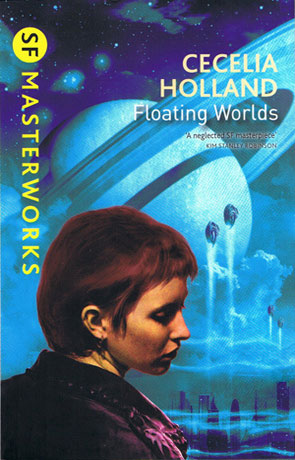
2) Floating Worlds (1976) by Cecelia Holland is, apparently, a very influential space opera, 'a neglected SF masterpiece.' Set an unspecified time in the future, it opens with the protagonist wandering round the ruins of Manhattan as a tourist:

'From here she could see through the broken walls to the next row of ruins, and through them to the next, all huge, the biggest buildings she had ever seen. The people who had built this city had dominated earth for three centuries, by money, by force, and by guile; they had colonized Mars, reached as far as Uranus, cracked atoms and made whole cities out of polymer, and Manhattan had been the heart of that empire.
...
"Did they live here? In glass buildings?" Some fable moved elusively at the edge of her memory.
"No. They lived somewhere else and came in here during the day."
"Now tell me the truth."
"I'm sorry, kitch, that is the truth."
She stood looking up at the glass. Maybe in those days glass had been more common than it was now. Waves of stain crossed it, traces of dry dust like tracks from the time when the ruins had been under water.'

In this distant future, Earth is an anarchist state, Mars is consumerist, Luna (the Moon) is fascist, while the moons of Uranus and Saturn make up the Styth Empire. The Styths are a mutant race of humans who believe they should conquer everything.

The protagonist, Paula Mendoza, is hired by the Committee for the Revolution, a sort-of vestigial government which oversees the Earth's anarchy, to negotiate a truce with Styths, because she happens to speak their language. Paula doesn't really care about the job:

'She had already decided not to put anything on the walls since she was keeping the job only until she found other work... She felt herself being forced into a role. Her life was closing in on her. She hated the Committee job, even the Styth case bored her, but it paid well and she kept putting off quitting because she liked the money.'

Holland's prose is very terse: she uses a lot of short sentences. This makes everything feel like the tense build-up to some climactic revelation or catastrophe:

'Paula took the midnight train to New York. Walking up the aisle of the car, she saw Bunker sitting next to the window on a forward bench. After a moment she put her bag on a rack over his head and sat down opposite him He had a book plug in his ear; he ignored her. She stretched her legs out before her. The train was almost empty. The lights flashed on and off, and the bench under her jerked forward. She braced herself. The train bounded forward, stopped cold, and started up again. They rolled off into the dark.'

Paula and Bunker proceed to have a short, boring conversation, and then Paula goes home.

Fifty pages in, at the end of chapter one, Paula is summoned to Mars to chat with some Styth negotiators. Throughout chapter two she has boring conversations with people on Mars, and then decides to fuck one of the top Styths:

'He straightened up on his arms. She could scarcely breathe in the dense fragrance he was giving off. When she kissed him again, his skin was warm, almost feverish. They got up and undressed. His body was perfect. Dressed, he simply looked massive. His broad chest swelled into his back, the muscle and bone smoothly shaped down to his long waist. He had an erection. They lay down side by side on the couch. His skin warmed her. While she explored him with her hands and her mouth she tried to get used to his scent. All in silence they joined together. His eyes closed, as if he were doing it alone. She rubbed herself down on his thick stalk, her hand on his hip, intent on the swelling tension in her groin.'

Floating Worlds feels like a trashy soap opera... in space!

I gave up when the big reveal at the end of chapter two, 105 pages in, was OH NO! SHE'S PREGNANT WITH HIS BABY!

Not my thing.

3) Synners (1991) by Pat Cadigan. I did not get very far with this one. I found Cadigan's writing extremely irritating. I felt like she was trying too hard to be cool, down with the kids. The story is about tattooed druggie hackers who listen to rock music and go against a big corporate record label, or something. 

At the start of chapter 2, one character (who is of course very cool) is in court, wondering whether she will be found guilty of anything and charged. The speculation concludes with:

'Fuck it, what difference did one more charge make, anyway? The fines would clean her out and then some, one more garnishment on her wages, so-fucking-what. All she cared about now was getting back on the street'

Later, she wonders what her BFF Mark is doing:

'But the best question was what the fuck was Mark doing there all on his own without a word to her. She and Mark were in it together, always had been. They'd been in it together in the beginning, and when Galen had bought most of the video-production company out from under the Beater, and they'd been in it together when Galen had let the monster conglomerate take EyeTraxx over from him, and they were supposed to be in it together the day after tomorrow, when they were due to show up for their first full day working for the monster conglomerate.'

Cadigan is so fucking cool that she italicises the word 'fuck'.

I gave up at page 36. Not my thing.

The other two disappointments were Fatherland (1992) by Robert Harris and Naked Lunch (1959) by William Burroughs.
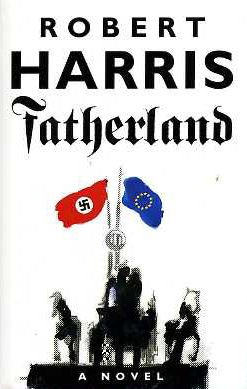
Fatherland came across as a cliché detective thriller with an alternate history gimmick: in 1960s Nazi Germany, loner cop Xavier March investigates a brutal murder, which leads him to discover a terrifying conspiracy going right up to the highest echelons of government..

I didn't reach the end, but I could see where it was going and couldn't be bothered sitting it out. I checked Wikipedia.

SPOILER ALERT.

March discovers that the Holocaust happened.

Naked Lunch is a very unpleasant and nonsensical read. There's no real plot. The chapters can be read in any order. Drug addiction and homosexuality are recurring themes. I gave up when I realised that if I was reading this on the internet, not in a 'Modern Classics' edition, I would have given up far sooner.

E.g.:

'The boy crumples to his knees with a long "OOOOOOOOH", shitting and pissing in terror. He feels the shit warm between his thighs. A great wave of hot blood swells his lips and throat. His body contracts into a foetal position and sperm spurts hot into his face. The Mugwump dips hot perfumed water from alabaster bowl, pensively washes the boy's ass and cock, drying him with a soft blue towel. A warm wind play over the boy's body and the hairs flat free. The Mugwump put a hand under the boy's chest and pulls him to his feet. Holding him by both pinioned elbows, propels him up the steps and under the noose. He stands in front of the boy holding the noose in both hands.'

Or:

"Darling, I want to rim you," she whispers.
"No. Not now."
"Please, I want to."
"Well, all right. I'll go wash my ass."
"No, I'll wash it."
"Aw shucks now, it ain't dirty."
"Yes it is. Come on now, Johnny boy."
She leads him into the bathroom. "All right, get down." He gets down on his knees and leans forward, with his chin on the bath mat. "Allah," he says. He lookd back and grins at her. She washes his ass with soap and hot water sticking her finger up it.
"Does that hurt?"
"Noooooooooooooo."

Not my thing.

Hopefully the books that I'm currently reading won't be so disappointing: Orlando (1928) by Virginia Woolf, Arguably (2011) by Christoper Hitchens, Bridget Jones' Diary (1996) by Helen Fielding, and The Scar (2002) by China Mieville. So far, I am enjoying them all.

Friday, 4 September 2015

'Babel-17' by Samuel R. Delany

A few years ago I read Nova (1968) by Samuel R. Delany, and was thoroughly disappointed. I no longer own my copy, and don't remember the story very well, so I've had to use Wikipedia to jog my memory: in the far future, the galaxy is split between two human factions - Draco and the Pleiades Federation - who compete over the power source Illyrium. To shift the balance of power between the factions, two space captains - Lorq Von Ray with his ragtag band of misfits from the Pleiades, and Prince Red with his corporate crew from Draco - race to the heart of an erupting nova to secure a vast quantity of Illyrium. It's a nautical adventure story... in space! 

This is what I remember about Nova:

About halfway through one of the characters drops a massive hint about how the book is going to end, and I felt like Delany was sat next to me, watching me read, elbowing me in the side, saying "Can you guess what I'm going to do at the end? Can you guess? I'm really clever. I doubt you'll guess what I'm going to do. I'm really clever."

"You better not do what I think you're going to do," I thought-spoke to the imaginary Delany.

"I'm really clever. You'll be really impressed with what I'm going to do at the end," imaginary Delany assured me.

I reached the end. 

"Oh, for fuck's sake."

Delany had done exactly what I thought he would; I closed the book and stormed off, hoping to vent my frustration on a housemate. Imaginary Delany followed me, poking me in the side, saying, "Did you see what I did there? I'm so clever. I mean, do you now understand what I did earlier? Aren't I really clever? Isn't that a really clever ending? Did you like the little hint I gave you earlier? I'm so clever."

From that first impression of Delany's work, I wasn't too keen on reading more of it, but I'm giving every SF Masterwork a chance: if Martian Time-Slip (1964) had been my first Philip K Dick novel, rather than my eighth, it would've been a terrible first impression of Dick's work. I'm giving Delany two more chances: Babel-17 (1966) and Dhalgren (1975), his two other Masterworks titles. I picked up a charmingly trashy 1978 Ace edition of Babel-17 in Powell's City of Books back in 2013, and have only just got round to reading it.

Masterworks Cover
Ace Cover

Ace Blurb
In the far future, the Earthpeople's Alliance is under attack. The Invaders have sabotaged important Alliance locations using Babel-17, a mysterious language that the Military Cryptography Department can't crack. It's up to Captain Rydra Wong, polylingual poetess, and her crew to discover the secrets of Babel-17 and stop the Invasion!

Babel-17, like Nova, is very much a nautical adventure story... in space!

'The pilot sailed the ship through those currents as sailing ships winded the liquid ocean.'

Wong wanders around the planet's poorer areas to assemble her crew. To find her pilot, she watches a wrestling match. Because:

"In the ship, the pilot's nervous system is connected directly with the controls. The whole hyperstasis transit consists of him literally wrestling the stasis shifts."

Wong & Co travel around, chatting to people, having action sequences, and learning about Babel-17. It's a fast-paced, well-written space adventure with some fun speculation about language. Wikipedia informs me that 'Sapir-Whorf Hypothesis', that language influences thought and perception, is the inspiration for the story:

'The blue room was round and warm and smooth. No way to say warm in French. There was only hot and tepid. If there's no word for it, how do you think about it?'

Babel-17 has a very dramatic impact on thought and perception:

'She  didn't "look at the room."
She "something at the something." The first something was a tiny vocable that implied an immediate, but passive, perception that could be aural or olfactory as well as visual. The second something was three equally tiny phonemes that blended at different musical pitches: one an indicator that fixed the size of the chamber at roughly twenty-five feet long and cubical, the second identifying the colour and probable substance of the walls - some blue metal - while the third was... a place holder for particles that should denote the room's function when she discovered it... All four sounds took less time on her tongue and in her mind than the one clumsy diphthong in 'room'. Babel-17; she had felt it before with other languages, the opening, the widening, the mind forced to sudden growth. But this, this was like the sudden focusing of a lens blurry for years.'

It's not a great book; it feels more deserving of the trashy Ace cover than a Masterworks edition, but it is entertaining. The final ~50 pages felt like the anticlimax of a disappointing Doctor Who episode, and the language speculation, while fun, is inconsistent and rather shallow. As dated 60s SF goes, you could do a lot worse (you could also do better). Give it a read if you happen to have a copy lying around, but don't have high expectations.

Monday, 24 August 2015

A Ballard Binge

I've read a few J.G. Ballard books recently. Ballard is one of those authors who is not very well known amongst the general public, but is very popular amongst authors and literary peeps. It might help to think of him as the British equivalent to Philip K. Dick. Their books are very weird (although this doesn't tell you very much or prepare you for actually reading them). Ballard's work gave rise to the adjective 'Ballardian'; Dick's work gave rise to the adjective 'Dickian'. Their stories are often about modernity messing with people's heads, but in very different ways. They can both come across as quite pretentious. I'm not sure how much this comparison does either of them justice.


I first decided to read Ballard after Philip Reeve, author of the Mortal Engines series, recommended Ballard's early disaster SF novels while speaking at an event at the University of Nottingham. The three disaster novels are: The Drowned World (1962), about melting polar ice-caps flooding the earth; The Burning World (1964, revised and re-released as The Drought in 1965), about a global water shortage; and The Crystal World (1966), which has a pseudo-scientific explanation worthy of Doctor Who. Time is leaking out of the universe. Matter, once held by time like a saturated solution, is now crystallising across the cosmos. Wibbly-wobbly timey-wimey.

These novels, unlike other disaster novels, focus on the psychological states of the characters rather than the outward effects of the catastrophe. The protagonists are mesmerised by the disaster, undergoing a psychological transformation as they explore the changing world, accepting it as the world to come. Ballard makes the catastrophe into a positive change.

I read The Drowned World in 2013, and found it slightly disappointing. It has its moments, but the story - less than 200 pages - felt like it dragged on and on and on, as though Ballard struggled to make it novel length. The Crystal World I read most recently, and similarly found it slightly disappointing and too long. What is most memorable about both of them is the evocative descriptions of the changed world:

'The road narrowed, avoiding the slope which led up to the house, but its annealed crust, blunted like half-fused quartz, offered a more comfortable surface than the crystal teeth of the lawn. Fifty yards ahead, Dr. Sanders came across what was unmistakably a jewelled rowing boat set solidly into the roadway, a chain of lapis lazuli mooring it to the verge. He realised that he was walking along a small tributary of the river, and that a thin stream of water still ran below the crust. This vestigial motion in some way prevented it from erupting into the spur-like forms of the rest of the forest floor.

As he paused by the boat, feeling the crystals along its sides, a huge four-legged creature half-embedded in the surface lurched forward through the crust, the loosened pieces of lattice attached to its snout and shoulders shaking like a transparent cuirass... Invested by the glittering light that poured from its body, the crocodile resembled a fabulous armoured beast. Its blind eyes had been transformed into immense crystalline rubies.'

- The Crystal World, Chapter 6

Slightly put off by my disappointment with The Drowned World, it was quite a while until I attempted another Ballard. At an event at the University of Nottingham, Christopher Priest, author of The Prestige (1995), recommended Ballard's short stories, saying that he found Ballard's novels disappointing. From my experience with Ballard's work so far, I find myself agreeing with Priest. Ballard's short stories are the shit. I picked up the anthology Myths of the Near Future (1982) at Loncon 3, and was surprised at the quality and diversity of its 10 stories.

In the titular story, humanity is suffering from 'space sickness' after space travel is abandoned. In the collapsed society, handfuls of people still dream of space exploration. Some walk around naked flapping their arms, hoping to transform into birds. The protagonist analyses pornographic imagery, thinking that the images of lustful union hide the key to the secrets of the universe:

'That evening he rested in his chair beside the empty pool, watching the video-cassettes of his wife projected on to the wall at the deep end. Somewhere in these intimate conjunctions of flesh and geometry, of memory, tenderness and desire, was a key to the vivid air, to that new time and space which the first astronauts had unwittingly revealed here at Cape Kennedy.'

Other stories from that collection include Having A Wonderful Time, told as a series of postcards from a woman trapped on a cheap holiday resort, and Theatre of War, a script for TV documentary on a twentieth century British civil war, with all the dialogue having been adapted from coverage of the Vietnam war.


The Voices of Time (1984) contains another 8 stories; The Disaster Area (1967) contains another 9. Vermillion Sands (1971) gets its name from the surreal futuristic holiday resort where its 9 stories - featuring cloud-sculptors, singing plants, living clothing, emotional houses, and more - are set. 

Short story collections are usually hit and miss, but Ballard's misses are at least interesting. His hits are spectacular. Some stories felt rushed. Here are some entertainingly bad sentences from stories that needed a final polish:

'In her face the diagram of bones formed a geometry of murder.'
- The Cloud-Sculptors of Coral D, Vermilion Sands

'"Where, my God, where is he? Where is he?"
Shifting his emphasis from the first of these interrogatories to the second, as if to illustrate that the fruitless search for Hinton's whereabouts had been superseded by an examination of his total existential role in the unhappy farce of which he was the author and principle star, Dr Mellinger turned upon his three breakfastless subordinates.'
- Minus One, The Disaster Area

'Talking to her was like walking across a floor composed of blocks of varying heights, an analogy reinforced by the squares of the terrace, into which her presence had let another random dimension.'
- The Screen Game, Vermilion Sands

These add a bit of comic relief. When the main negative to the anthologies is a few bad sentences, that's got to be a good sign. At some point it would have been cheaper for me to splash out on The Complete Short Stories of J.G. Ballard, but I didn't think I'd want to read that many. Having read four anthologies, I find myself still wanting to read the remaining six: War Fever (1990), The Venus Hunters (1980), Low-Flying Aircraft (1976), The Atrocity Exhibition (1969), The Day of Forever (1967), and The Terminal Beach (1964). I'm taking a break from Ballard so won't be reading those until next year at the earliest.

Enthused by my enjoyment of his short stories, I decided to give his novels another go. Concrete Island (1974) is my favourite so far (it is also Neil Gaiman's favourite; Gaiman wrote the introduction to the latest edition). A man crashes his car and traps himself on a piece of wasteland in the middle of a motorway intersection. This sounds like a stupid idea, but Ballard manages to convince you that it could happen, and therein lies the novel's power. My main criticism of Concrete Island is that the grass does a lot of seething ('they wandered through the seething grass', 'the grass seethed around him', etc).
The Unlimited Dream Company is the most surreal and most disappointing of the four novels I read. The protagonist crashes a light aircraft into the Thames. When he awakes, he may or may not have come back from the dead, may or may not be insane, and may or may not have magical sex powers. A lot happens in the story, but the narration is so monotonous that no matter what's going on - the protagonist transforms into a giant whale, then transforms into a stag and fucks the residents of Shepperton (who have transformed into does), then discovers that his semen causes vegetation to sprout from the ground, etc - it feels like nothing is happening. During the Magic Semen Sequence, the monotonous tone worked well: the narrator's seeming indifference made an entertaining contrast to the weird events described. This effect might have been intended for the whole book, but monotony overshadowed weirdness.


'Leaving the church, I threw the semen on to the cobbled pathway outside the vestry door. As I paused there, looking across the swimming pool at the replica aircraft in the grounds of the film studios, green-fluted plants with milk-red blossoms sprang through the stones at my feet. I stepped among them and set off towards the town, my swollen penis in my hand. As I ran through the trees I thought of Miriam. Again I ejaculated beside the tennis courts, and hurled my semen across the flower-beds.'

- The Unlimited Dream Company, Chapter 22

Of the Ballard books I've read, I highly recommend Concrete Island and all the short story collections. To a lesser degree, I also recommend The Crystal World. Despite my general dissatisfaction with his novels, I'm still tempted to read a few more of them. Those that most interest me are: Crash (1973), High Rise (1975), Empire of the Sun (1984), and The Kindness of Women (1991). I already own copies of Hello America (1981) and Rushing To Paradise (1994), so may as well give them a go too. However, I won't be reading those until next year at the earliest, because I'm having a Ballard break.